
Hi-Vis Shirts for Warehouse & Forklift Operations (Type R): A Buyer's Guide for PPE Programs
Forklifts and pedestrians share tight aisles, blind corners, cross-traffic intersections, and loading docks where lighting can change by the minute. In these conditions, "being seen" is not a nice-to-have-it's a core control that supports your traffic plan, training, and site rules.
This guide explains when a warehouse team should specify ANSI/ISEA 107 "Type R" hi-vis shirts, how to decide Class 2 vs Class 3, and what to put on a bulk RFQ so your supplier can quote fast-and ship consistent, auditable uniforms.
Why visibility breaks down in warehouse & forklift zones
Warehouse incidents often happen when people assume the driver can see them. In reality, visibility is reduced by:
Blind corners and rack ends (especially in high-bay racking)
Mixed traffic: reach trucks, pallet jacks, yard trucks, and pedestrians
Noise + distraction: horns ignored, radios on, fast pace
Light transitions: dock doors, outdoor-to-indoor moves, night shifts
PPE layering: a hi-vis vest under a jacket = reflective blocked
Uniform inconsistency: different colors, faded garments, missing labels
Hi-vis shirts work best when they are treated as part of a system: traffic routes + right-of-way rules + training + mirrors/spotters + consistent hi-vis apparel policy.
Type O vs Type R (and why your topic says Type R)
ANSI/ISEA 107 uses garment "Types" to describe expected work settings:
Type O (Off-Road): Off-road workplaces where workers are not exposed to public road traffic (common in indoor facilities). Type O is typically associated with Performance Class 1.
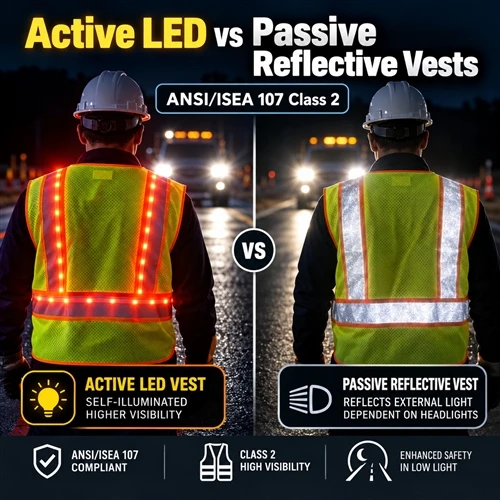
Type R (Roadway / Temporary Traffic Control): Work where people are exposed to roadway or traffic-like hazards, often aligning with roadway/temporary traffic control activities. Type R is commonly specified in Performance Class 2 or 3.
When a warehouse should upgrade to Type R (simple decision checklist)
If you answer "YES" to any of the below, Type R (often starting at Class 2) becomes a practical spec:
Workers regularly operate in loading docks with trailer moves, yard tractors, or mixed vehicle traffic
The site includes yard roads / internal roadways with truck traffic near pedestrians
Staff direct traffic at gates, entrances, staging lanes, or temporary reroutes
Night shifts, fog/rain conditions, or poor lighting create low-visibility risk
Your EHS program standardizes a single "higher level" uniform across multiple sites
Tip: Many operations choose Type R as a company-wide baseline to avoid confusion when employees move between dock, yard, and near-road tasks.
Class 1 vs Class 2 vs Class 3 for forklift operations
Performance Class is about how much visible hi-vis background and retroreflective material is present, supporting detection and recognition.
Practical class selection (warehouse-first)
Class 1: Controlled environments, lower-speed internal vehicle movement, limited exposure to complex backgrounds.
Class 2: A strong default for warehouse + dock + yard mixed use, higher visibility needs, and most "Type R" warehouse programs.
Class 3: Maximum conspicuity for complex backgrounds, full-body recognition needs, and higher-risk visibility conditions (often used when sleeves/coverage are required for the highest class configuration).
Scenario → Recommended Type/Class (use this as your internal policy table)
| Warehouse / Yard Scenario | Recommended Type | Recommended Class | Notes (what makes it higher risk) |
|---|---|---|---|
| Pure indoor warehouse, controlled aisles, low-speed, strong lane separation | Type O | Class 1 | Use if traffic plan is mature and visibility is stable |
| Indoor + loading dock exposure, trailers, yard tractors, light transitions | Type R | Class 2 | Dock doors, glare, night shift increases risk |
| Yard roadway exposure or traffic control-like activities near gates/entrances | Type R | Class 2–3 | Standardize across roles to reduce confusion |
| Night shift + frequent outdoor moves + complex backgrounds | Type R | Class 3 | Prioritize sleeve/coverage configurations for recognition |
What to look for in a Type R hi-vis shirt (spec checklist)
A hi-vis shirt fails when it is uncomfortable, inconsistent, or hard to maintain-so people stop wearing it correctly. Here's what buyers should specify.
1) Fabric & comfort for long shifts
Breathability / moisture management (mesh or birdseye knits are common)
Durability (snag resistance in racking, seam strength, colorfastness)
Seasonality: short sleeve vs long sleeve; layering compatibility
Fit range: inclusive sizing to avoid oversized "flapping" garments that snag
2) Reflective layout that drivers can interpret fast
360° visibility (front + back + sides)
Consistent band placement across sizes
Sleeves help motion recognition (arm movement is easier to spot in peripheral vision)
3) Worksite practicality
ID/badge area, radio loops (if needed), pocket configuration
High-wear reinforcements at shoulders (optional)
Clear labeling for audits, onboarding, and replacement
RFQ template: what to put in the buyer's request (copy/paste)
Use this to shorten the back-and-forth and get comparable quotes.
| RFQ Field | What to Specify | Example |
|---|---|---|
| Intended use | Warehouse + forklift + loading dock + yard road exposure | "DC + docks + yard traffic" |
| Standard target | ANSI/ISEA 107 | "Type R, Class 2 (or Class 3)" |
| Shirt style | Short sleeve / long sleeve / polo | "Long sleeve crew neck" |
| Fabric | Knit type + GSM + composition | "Birdseye polyester 130–150gsm" |
| Hi-vis color | Yellow-green / orange-red | "Hi-vis yellow-green" |
| Reflective | Width + layout | "2"/5cm bands, 360°" |
| Logo/branding | Method + placement | "Heat transfer on chest + back" |
| Labels | Private label + compliance labeling | "Custom neck label + care label" |
| Sizes | Size run + size chart | "S–5XL" |
| Packing | Each in polybag / carton | "1pc/OPP; 50–100pcs/ctn" |
| MOQ + lead time | Needed volume and delivery date | "500–3000 pcs; ship in 25–35 days" |
| Samples | Pre-production sample request | "1–2 samples before bulk" |
Relevant pages on Our site:
ANSI 107 Class 2 Hi Vis Polyester Apparel (birdseye polyester + reflective tape)
Safety T Shirts with Reflective Stripes (poly/cotton + reflective tape)
Long Sleeve Safety Shirts (bulk/OEM safety long sleeve options)
Deployment: how to roll out hi-vis shirts in a warehouse program
1) Assign "who wears what, where"
Create a simple role map:
Forklift operators: Type R baseline where vehicles mix with pedestrians
Pick/pack: Type R if crossing active aisles; Type O only if fully separated lanes
Dock staff / yard walkers: Type R (often Class 2+)
Visitors/contractors: provide a visitor solution consistent with your policy
2) Protect consistency (the hidden ROI)
Standardize:
Approved colors
Reflective layout
Labeling requirements
Replacement triggers (faded, torn reflective, contaminated garments)
Consistency reduces training burden and improves "instant recognition" across departments and sites.
3) Care & replacement policy
Instead of guessing, define:
Allowed wash settings (temperature, bleach rules)
When to retire garments (reflective damage, severe fading, loss of retroreflectivity, torn seams)
A replacement cadence by role (dock/yards wear faster than indoor pickers)
Common mistakes (and how to fix them)
Buying only vests-then covering them with jackets
Fix: move to hi-vis shirts as the "base layer," or specify outerwear that maintains reflective layout.
Choosing based on reflective width only
Fix: focus on 360° layout and role-based coverage, not a single dimension.
No site walkthrough before ordering
Fix: walk your highest-risk intersections (rack ends, dock doors, cross aisles), then choose Type/Class accordingly.
Inconsistent sizing and fit
Fix: lock a size chart and approve samples in the same fabric/reflective configuration.
FAQ: Hi-vis shirts for warehouse & forklift operations (Type R)
1) Do warehouses need Type R, or is Type O enough?
Type O can be appropriate for controlled, off-road indoor environments. If your team regularly works around docks, yard lanes, or near-road traffic exposure, Type R is a stronger and more consistent choice.
2) What's the difference between Type R and Type O?
Type O is intended for off-road settings; Type R is intended for roadway/temporary traffic control-like exposure where traffic hazards are present.
3) Class 2 vs Class 3-how do I decide for night shift?
If night shift includes frequent outdoor moves, complex backgrounds, and high-risk crossings, Class 3 can improve recognition-especially when sleeve/coverage configurations support full-body visibility. Otherwise, Class 2 is often a strong baseline for warehouse + dock operations.
4) Should forklift operators wear long sleeve or short sleeve hi-vis shirts?
Choose based on climate, abrasion risk, and whether you need additional visible material for higher class configurations. Long sleeves also help keep reflective visible when arms move.
5) What should I check on the label before accepting a bulk shipment?
Verify the garment is labeled to the intended standard and that Type/Class are consistent with your RFQ, plus care instructions and any required private labeling.
6) How can we keep compliance high after rollout?
Make it easy: consistent inventory, clear replacement rules, onboarding training, and a policy that matches real workflows (dock, yard, cross aisles).
7) Can we add OEM logo and custom packaging?
Yes-define logo method/placement and packaging in the RFQ to avoid delays and rework.
8) What's the fastest way to get quotes that are truly comparable?
Use the RFQ table above, require pre-production samples, and standardize the same reflective layout and labeling across sites.
If you're building a warehouse visibility program and want a Type R / Class 2–3 shirt baseline with OEM branding, request a quote and share your role map + environment (indoor-only vs dock/yard exposure).
Start here: ANSI 107 Class 2 Hi Vis Polyester Apparel