Abstract
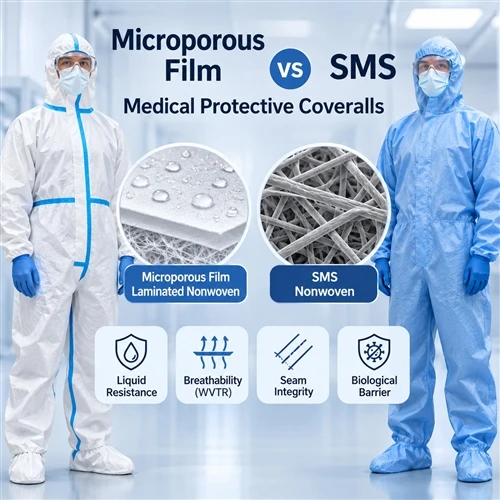
The selection of protective materials for medical coveralls requires an evaluation of liquid penetration resistance, biological barrier performance, moisture vapor transmission, thermal comfort, mechanical durability, and garment construction. Microporous film-laminated nonwoven fabrics and spunbond-meltblown-spunbond (SMS) nonwovens use different barrier mechanisms, resulting in different performance characteristics under clinical exposure conditions.
Microporous laminates combine a polymer film barrier with a nonwoven substrate, whereas SMS fabrics rely on the layered fiber structure and surface characteristics of polypropylene webs. Their suitability cannot be determined from material names or individual hydrostatic resistance measurements alone. Fabric-level test results, seam construction, garment configuration, sterilization compatibility, and manufacturing consistency must be considered together.
This review examines the engineering differences between these two material systems and establishes a technical evaluation framework for medical protective coverall development, institutional procurement, and OEM supplier qualification.
Keywords: Microporous Film, SMS Nonwoven, Medical Protective Coverall, Liquid Penetration Resistance, Biological Barrier, Moisture Vapor Transmission, EO Sterilization, Seam Integrity, Medical PPE Material Selection.
Clinical Exposure Requirements and Material Selection Criteria for Medical Protective Coveralls
Clinical Exposure Profiles and Barrier Requirements
Material selection for medical protective coveralls should begin with an assessment of the exposure mechanism rather than the nominal fabric category. Clinical environments expose protective garments to different combinations of aqueous fluids, blood, body secretions, contaminated surfaces, aerosols, and particulate matter. The magnitude of exposure depends on the medical procedure, duration of contact, liquid volume, applied pressure, and potential for mechanical damage during movement.
Three exposure conditions are particularly relevant to protective garment development:
Low-pressure liquid contact: Occasional splashes and contact with contaminated surfaces. Surface repellency and resistance to liquid wetting are relevant, but they do not establish resistance to sustained pressure.
Continuous or pressure-driven liquid exposure: Prolonged contact with fluids or compression of contaminated garment surfaces. Hydrostatic resistance and synthetic blood penetration testing become more important.
Biological contamination: Potential exposure to infectious agents carried by blood, body fluids, or other contaminated media. Material penetration testing must correspond to the relevant biological challenge and intended protection claim.
A material that performs adequately against water may not provide equivalent resistance against synthetic blood or other liquids with different surface tensions. Therefore, water resistance, biological barrier performance, and chemical splash resistance should be evaluated as separate engineering properties.
Clinical Risk Classification and International Requirements
For US healthcare procurement, ANSI/AAMI PB70 establishes liquid barrier classifications for surgical gowns, isolation gowns, and related protective apparel. Its four levels correspond to different exposure risks, ranging from minimal liquid contact to high-risk procedures requiring resistance to synthetic blood and viral penetration.
However, PB70 should not automatically be applied as a classification system for every full-body protective coverall. In Europe, EN 14126 addresses protective clothing against infective agents and is typically relevant to protective coveralls. The applicable regulatory framework also depends on the intended use and product classification.
|
Exposure condition |
Main engineering concern |
Relevant evaluation |
|
Water splash |
Surface wetting and penetration |
AATCC 42 |
|
Continuous water pressure |
Liquid breakthrough |
AATCC 127 |
|
Synthetic blood exposure |
Blood-like liquid penetration |
ISO 16603 / ASTM F1670 |
|
Blood-borne pathogen exposure |
Surrogate viral penetration |
ISO 16604 / ASTM F1671 |
|
Infectious-agent exposure |
Material barrier performance |
EN 14126 |
|
Garment joint exposure |
Seam and closure leakage |
Seam-specific barrier testing |
The distinction between material performance and garment classification is particularly important. A fabric may pass a laboratory penetration test while the finished coverall remains vulnerable at the zipper, hood interface, crotch seam, sleeve connection, or ankle opening.
Translating Clinical Requirements into Material Specifications
For institutional procurement, the technical specification should identify the intended exposure, required protection level, material construction, seam configuration, and test evidence.
A practical specification should include:
Fabric composition and layer configuration.
Fabric mass in g/m².
Material thickness in mm.
Hydrostatic pressure resistance in cm H₂O or kPa.
Synthetic blood penetration results.
Viral penetration test results where required.
Moisture vapor resistance or transmission.
Seam barrier performance.
Mechanical strength.
Sterilization configuration.
Finished garment inspection requirements.
The sterile microporous protective suit for hospital use is an example of a full-body garment configuration using a microporous film-laminated polypropylene substrate and heat-applied seam tape. Its product page reports a hydrostatic head greater than 200 cm H₂O. This is a supplier-reported specification, not independent evidence of biological protection or whole-garment compliance.
For this reported value, 200 cm H₂O corresponds to approximately 19.6 kPa. Procurement teams should request the original laboratory report, including the test method, pressure ramp rate, specimen conditioning, number of specimens, and leakage endpoint.
Microporous Film Laminates and SMS Nonwovens: Material Structures and Manufacturing Processes
SMS Nonwoven Architecture
SMS stands for spunbond-meltblown-spunbond. It is a three-layer polypropylene nonwoven construction in which each layer contributes a different structural function.
The outer spunbond layers generally provide mechanical integrity, handling strength, and resistance to surface damage. The central meltblown layer consists of finer fibers arranged into a relatively dense fibrous network. This middle layer contributes to filtration and resistance to particle penetration.
The principal structural characteristics are:
Spunbond outer layer for tensile integrity.
Meltblown middle layer for fine-fiber barrier formation.
Spunbond inner layer for substrate stability.
Random fiber distribution.
Thermally bonded fiber intersections.
Interconnected pores within the fibrous structure.
The resulting material is porous rather than a continuous polymer film. Its liquid resistance depends on fiber diameter, pore dimensions, surface chemistry, fabric density, and the pressure applied by the contacting liquid.
A denser meltblown layer can reduce the size of the available penetration pathways. However, reducing pore dimensions can also increase resistance to airflow and moisture transport.
The manufacturing process typically includes polypropylene extrusion, fiber formation, web deposition, layer combination, and thermal point bonding. Variations in polymer melt characteristics, fiber diameter, web uniformity, and bonding conditions can produce measurable differences between production lots.
Microporous Film-Laminated Nonwoven Construction
Microporous film laminates combine a nonwoven substrate with a thin polymer barrier layer. A common construction uses a polypropylene spunbond substrate laminated with a microporous polyethylene film.
The nonwoven substrate provides handling strength and dimensional support. The film layer provides the principal liquid barrier.
One established manufacturing approach uses mineral filler incorporation, film extrusion, and controlled stretching to form microporous structures. Calcium carbonate is one example of a filler used in certain microporous polyethylene film systems.
The stretching process creates interconnected microscopic pathways within the polymer film. These pathways allow water vapor transport under suitable conditions while resisting liquid penetration when the pore structure and surface properties are appropriately controlled.
Important manufacturing parameters include:
|
Manufacturing stage |
Process variable |
Potential performance effect |
|
Polymer preparation |
Resin composition and filler dispersion |
Film uniformity |
|
Film extrusion |
Melt temperature and extrusion rate |
Thickness consistency |
|
Film formation |
Cooling and draw conditions |
Film morphology |
|
Stretching |
Stretch ratio and process control |
Pore formation |
|
Lamination |
Adhesive distribution and bonding pressure |
Interlayer adhesion |
|
Final conversion |
Cutting and garment assembly |
Structural integrity |
A film with excessive stretching may develop defects or uncontrolled pore structures. Insufficient stretching may result in inadequate vapor transmission. Nonuniform filler distribution can produce local variations in pore formation.
Lamination also affects the final performance. Excessive adhesive coverage may block transport pathways, while inadequate bonding can result in delamination during garment handling or use.
Microporous Film Versus SMS: An Important Structural Distinction
Microporous film and SMS should not be treated as mutually exclusive material categories.
SMS describes a nonwoven substrate architecture. Microporous film describes a membrane barrier structure. A finished protective fabric can combine both technologies by laminating a microporous film onto an SMS substrate.
The technically meaningful comparison is therefore between:
Unlaminated SMS nonwoven.
Microporous film-laminated SMS nonwoven.
Other film-laminated nonwoven constructions.
Nonporous film-coated nonwoven alternatives.
This distinction matters when interpreting performance reports. A result obtained from an SMS/PE microporous laminate cannot be attributed to unlaminated SMS fabric.
For material development and procurement comparison, the microporous film-laminated protective suit provides a commercial reference for polyethylene membrane and nonwoven substrate construction. By comparison, the SMS nonwoven Type 5/6 protective coverall represents a fibrous barrier construction without requiring the same microporous film architecture.
The 2023 study by El-Ghoubary and colleagues investigated composite materials incorporating SMS polypropylene and different polymer films. It demonstrated that film type, nonwoven structure, and lamination technology all influence barrier and comfort properties.
For material development and procurement, the following two configurations provide useful references:
These are product configuration references, not independent comparative test results.
Liquid Penetration Mechanisms and Biological Barrier Performance of Microporous Film and SMS Fabrics
Liquid Penetration Through Fibrous Nonwoven Structures
Liquid penetration through SMS fabrics is influenced by the interaction between liquid surface tension, fiber surface energy, pore geometry, and applied pressure.
When a liquid contacts a hydrophobic fibrous structure, the surface may initially resist wetting. However, increasing pressure can force the liquid into interconnected pores.
A simplified capillary entry pressure relationship is:

Where:
 = approximate liquid entry pressure.
 = liquid surface tension.
 = contact angle.
 = effective pore radius.
For a hydrophobic pore, a smaller effective radius generally increases the pressure required for liquid entry, assuming comparable surface chemistry and pore geometry.
This model is useful for explaining penetration mechanisms, but actual SMS fabrics contain irregular interconnected pores rather than uniform cylindrical capillaries. Their barrier performance cannot be calculated from average pore size alone.
The meltblown layer is particularly relevant because its finer fiber network can reduce the size of continuous penetration pathways. Nevertheless, surface wetting, compression, material defects, and liquid composition remain important variables.
Liquid Exclusion Through Microporous Film
Microporous films use a different barrier mechanism.
The polymer film contains microscopic pathways that support gas-phase water vapor transport. Liquid resistance depends on pore size distribution, pore connectivity, surface energy, and the absence of defects that could create continuous liquid penetration paths.
A microporous film must maintain a controlled relationship between pore structure and liquid entry pressure.
Potential failure mechanisms include:
Oversized or irregular pores.
Pinholes.
Local film thinning.
Incomplete lamination.
Film cracking.
Mechanical damage during garment conversion.
Liquid penetration through exposed seams.
A microporous membrane therefore cannot be evaluated solely through nominal pore size. The distribution of pore sizes and the integrity of the complete film are equally important.
Synthetic Blood and Viral Penetration Testing
Two laboratory methods are particularly relevant to medical protective material evaluation.
ISO 16603:2004 evaluates the resistance of protective clothing materials to synthetic blood penetration under specified test conditions.
ISO 16604:2004 evaluates resistance to penetration by blood-borne pathogens using the Phi-X174 bacteriophage surrogate.
Both standards remain published and were confirmed in 2025. ISO 16603 is a synthetic blood test, while ISO 16604 uses a biological surrogate. They are not interchangeable with ordinary hydrostatic head testing.
In the United States, corresponding ASTM references include F1670/F1670M and F1671/F1671M. NIOSH also emphasizes that testing can be performed on fabric specimens as well as seams and closures.
The distinction can be summarized as follows:
|
Test |
Challenge medium |
Main evaluation |
|
Hydrostatic head |
Water |
Resistance to pressure-driven water penetration |
|
ISO 16603 |
Synthetic blood |
Resistance to synthetic blood penetration |
|
ISO 16604 |
Phi-X174 bacteriophage system |
Resistance to surrogate viral penetration |
|
ASTM F1670 |
Synthetic blood |
Synthetic blood penetration resistance |
|
ASTM F1671 |
Phi-X174 bacteriophage system |
Viral penetration resistance |
A hydrostatic head value should not be converted directly into a viral protection claim.
Finished garment configuration also affects the interpretation of liquid barrier performance. The disposable microporous coverall with hood and boots provides an additional construction reference for evaluating full-body coverage, microporous laminated fabric, and sealed garment interfaces. Its actual biological barrier performance must be established through the applicable independent test reports.
Published Comparative Performance Evidence
El-Ghoubary et al. (2023) evaluated three composite nonwoven materials for surgical gown applications:
Market sample: SS polypropylene with nonporous polyethylene film.
Sample 1: SMS polypropylene with microporous polyethylene film.
Sample 2: SMS polypropylene with monolithic thermoplastic polyurethane film.
The two developed composites had an actual mass of approximately 70 g/m², while the market comparator was approximately 60 g/m².
The reported hydrostatic pressure results were:
|
Composite construction |
Hydrostatic head |
|
SS PP / nonporous PE film |
264.23 cm H₂O |
|
SMS PP / microporous PE film |
284.96 cm H₂O |
|
SMS PP / monolithic TPU film |
310.86 cm H₂O |
The microporous PE laminate exceeded the nonporous PE comparator in this study. The monolithic TPU laminate recorded the highest hydrostatic result among the three specimens.
However, these findings do not establish that every microporous film laminate performs better than every SMS fabric. The comparison involved different substrates, films, lamination processes, and surface treatments.
The study also reported wet bacterial penetration blocking results of 88% for the market sample and 100% for both developed composites. The test used Staphylococcus aureus in a membrane filtration procedure. It was not an ISO 16604 bacteriophage penetration test and must not be presented as proof of viral barrier classification.
For medical PPE procurement, these findings support further evaluation of composite barrier materials, not automatic approval of a particular garment configuration.
A wider range of material lots, independent laboratory tests, and finished-garment validation would be required before applying the results to commercial product qualification.
Moisture Vapor Transmission, Air Permeability and Thermal Comfort in Medical Protective Coveralls
Three Different Measurements of Material Breathability
Breathability is frequently used as a general description of protective clothing comfort. For engineering evaluation, however, it should be divided into separate measurable properties.
1. Water Vapor Transmission Rate (WVTR)
WVTR measures the quantity of water vapor passing through a unit area of material over a specified period.

Where:
Δm = measured mass loss.
A = exposed specimen area.
Δt = test duration.
The usual reporting unit is g/m²/24h.
WVTR is influenced by temperature, relative humidity, air movement, specimen thickness, and test configuration. Results obtained using different cup methods or environmental conditions should not be directly compared without checking the methodology.
2. Air Permeability
Air permeability measures the volume of air passing through a defined specimen area under a specified pressure difference.
It is commonly reported in cm³/cm²/s or equivalent units.
ASTM D737-18(2023) provides a test method applicable to woven, knitted, nonwoven, coated, and multilayer textile fabrics.
ASTM Store
Air permeability is relevant to ventilation through porous SMS structures. However, a microporous film may permit water vapor transport while allowing little or no measurable bulk airflow.
Consequently, low air permeability does not necessarily indicate low moisture vapor transmission.
3. Water Vapor Resistance (RET)
RET measures the resistance of a material or multilayer assembly to water vapor transport under controlled thermal and humidity conditions.
A lower RET generally indicates lower resistance to evaporative heat loss.
ISO 11092 uses the sweating guarded-hotplate method to evaluate thermal resistance and water vapor resistance. Its latest edition, ISO 11092:2026, was published in May 2026.
These measurements should be reported separately rather than combined into an undefined breathability rating.
Comparative Experimental Results
The 2023 El-Ghoubary study provides useful comparative data for laminated nonwoven structures.
|
Material construction |
Air permeability (cm³/cm²/s) |
Reported WVTR value |
|
SS PP / nonporous PE film |
6.15 |
2.2691 |
|
SMS PP / microporous PE film |
11.50 |
39.5153 |
|
SMS PP / monolithic TPU film |
4.84 |
30.43 |
The study found that the microporous PE composite had the highest measured air permeability and reported water vapor transmission among the three samples. The monolithic TPU composite also demonstrated higher reported vapor transmission than the nonporous PE comparator.
Data interpretation note: The study's methods describe WVTR in g/m²/day, while its results table uses a different unit label. The numerical values above are reproduced as reported, without attempting an unsupported unit conversion. The original laboratory records should be consulted before using them as procurement acceptance values.
The differences between these materials are associated with several structural factors:
Microporous film provides pathways for water vapor diffusion.
Monolithic hydrophilic TPU uses absorption and diffusion through polymer segments.
Nonporous PE film restricts vapor transport.
SMS fiber diameter and web density affect air movement.
Lamination adhesive coverage changes the available transport pathways.
Thermal bonding can modify fiber arrangement and fabric porosity.
The results demonstrate that film chemistry alone does not determine comfort performance. Lamination technology and substrate construction are also significant.
Thermal Comfort Under Clinical Working Conditions
Material-level testing cannot fully predict wearer comfort.
A medical protective coverall covers a large proportion of the body and may restrict heat and moisture release during prolonged clinical activity. Actual thermal load is affected by:
Ambient temperature.
Relative humidity.
Air velocity.
Physical activity.
Garment coverage.
Garment fit.
Underlying clothing.
Moisture accumulation.
Duration of use.
A garment with good WVTR may still create substantial heat stress if its design restricts ventilation at the neck, wrists, ankles, or other openings.
Similarly, a lightweight SMS coverall may allow greater air exchange but provide insufficient liquid resistance for a high-exposure task.
A useful validation program should combine fabric-level measurements with garment wear assessment under defined environmental and activity conditions.
Material Selection for Comfort-Controlled Medical PPE
|
Evaluation requirement |
SMS nonwoven |
Microporous film laminate |
|
Bulk airflow |
Generally possible through fibrous pores |
Depends on membrane and laminate construction |
|
Water vapor transport |
Depends on web density and finishes |
Depends on pore structure and film properties |
|
Liquid barrier |
Depends on surface treatment and fibrous structure |
Depends on film integrity and pore characteristics |
|
Thermal comfort |
Influenced by fiber density and garment design |
Influenced by film resistance and garment design |
|
Lamination sensitivity |
Not applicable to unlaminated SMS |
High relevance |
|
Mechanical flexibility |
Depends on basis weight and bonding |
Depends on film thickness and substrate |
For additional material references, the cleanroom coveralls page lists PP, SMS, and microporous fabric options. Its material information can help identify commercial configurations, but it should not be treated as a comparative clinical performance report.
Seam Integrity, Garment-Level Leakage and Barrier Performance Retention Under Clinical Movement
Why Fabric Barrier Results Cannot Represent the Entire Garment
A protective coverall is a constructed assembly rather than a flat sheet of barrier material.
The finished product contains multiple structural interfaces:
Shoulder seams.
Sleeve attachment seams.
Side seams.
Crotch seams.
Hood connections.
Front zipper assemblies.
Wrist and ankle openings.
Waist interfaces.
Reinforced construction areas.
Each interface introduces potential discontinuities in the material barrier.
For example, conventional sewing creates needle perforations. Even when the base fabric passes a liquid penetration test, an uncovered needle hole can become a leakage pathway under sufficient pressure.
The performance of the garment therefore depends on the combined properties of the fabric, seams, closures, and interface construction.
NIOSH specifically identifies seams and closures as important components of protective clothing barrier performance. Its selection guidance also explains that garments can tear during kneeling, bending, and reaching when their construction or sizing is inadequate.
Stitched Seams with Heat-Applied Seam Tape
One common construction for microporous protective coveralls uses stitched seams covered by a heat-applied polymer tape.
The stitching provides mechanical connection between garment panels. The seam tape covers needle perforations and provides an additional liquid barrier.
This arrangement requires control of several manufacturing parameters:
|
Parameter |
Engineering significance |
|
Tape width |
Determines the coverage area over the stitched seam |
|
Bonding temperature |
Influences polymer softening and adhesion |
|
Application pressure |
Influences contact between tape and substrate |
|
Dwell time |
Determines the duration of thermal bonding |
|
Tape thickness |
Affects flexibility and barrier construction |
|
Adhesive compatibility |
Influences bonding to the substrate |
|
Peel strength |
Indicates resistance to tape separation |
|
Flexing resistance |
Evaluates retention of adhesion during movement |
Insufficient heat or pressure can result in incomplete bonding. Excessive heat can damage the film or cause deformation of the nonwoven substrate.
The process window must therefore be established for the actual combination of fabric, tape, adhesive, and production equipment.
Mechanical Stress During Clinical Movement
Clinical activities impose repeated deformation on protective clothing.
Examples include:
Bending to assist patients.
Kneeling beside beds.
Raising the arms.
Turning the torso.
Walking for extended periods.
Reaching across clinical equipment.
Sitting and standing repeatedly.
These movements create tensile and shear stresses around garment joints.
A seam that performs satisfactorily under static conditions may experience local stress concentration when the wearer bends or stretches.
The crotch, underarm, shoulder, and back regions deserve particular attention because their construction and geometry can concentrate mechanical loads.
Garment sizing is also relevant. Excessive tightness increases stress on seams, while excessive looseness increases the likelihood of snagging and interference with clinical work.
Testing Seam Strength and Liquid Leakage
Seam evaluation should separate mechanical strength from liquid barrier integrity.
ISO 13935-2:2026 specifies a grab method for measuring the maximum force required to rupture sewn seams. However, its normal scope excludes many nonwoven and coated fabric constructions. It should not automatically be applied to microporous laminates without confirming method suitability.
ISO 13994:2005 evaluates visible liquid penetration through protective clothing materials under continuous liquid contact and pressure. It can be used for material specimens and certain constructions such as seams, but does not assess the complete garment design, interfaces, and overall protective configuration.
A practical test program should include:
Seam tensile or rupture evaluation using a suitable validated method.
Tape adhesion and delamination inspection.
Hydrostatic resistance of the seam construction.
Synthetic blood penetration testing where applicable.
Inspection following repeated flexing and deformation.
Finished-garment leakage evaluation.
Garment-Level Barrier Retention
A useful engineering approach is to compare the performance of specimens before and after mechanical conditioning.
The following sequence can be used as a development framework:
Initial material inspection
|
Fabric barrier testing
|
Seam and closure inspection
|
Mechanical conditioning
|
Post-conditioning seam testing
|
Finished-garment barrier evaluation
|
Acceptance against defined requirements
The conditioning procedure should reproduce the intended use conditions as closely as possible. The number of cycles, applied load, bending angle, and conditioning environment must be documented.
No universal number of bending cycles should be assumed without a product-specific validation protocol.
For comparison with commercial constructions, Anti Splash Disposable Medical Coverall provides an example of a taped-seam medical coverall configuration. The actual seam performance still requires supporting test documentation.
Engineering Trade-Offs Between Liquid Resistance, Breathability, Flexibility and Material Weight
Barrier Performance Versus Vapor Transport
The primary engineering conflict is the need to prevent liquid penetration while allowing sufficient moisture release.
Increasing film thickness or reducing effective pore dimensions may improve liquid resistance, but can increase resistance to moisture transport.
Conversely, increasing pore dimensions or reducing barrier coverage may improve vapor movement while reducing the pressure required for liquid penetration.
The final design therefore requires an acceptable operating range rather than maximizing one measurement.
Flexibility and Mechanical Performance
Microporous film laminates can become less flexible when the film layer is thick, the adhesive coverage is excessive, or the substrate has a high basis weight.
SMS materials avoid the additional film layer in their unlaminated configuration. Their flexibility is influenced by fiber characteristics, web density, and thermal bonding.
However, an SMS material with a higher basis weight is not necessarily more suitable for every clinical application. Increased mass may improve certain mechanical and barrier properties while increasing garment weight and thermal burden.
Mechanical flexibility should be assessed through bending, repeated deformation, drape, and finished-garment wear evaluation.
Material Weight and Layer Configuration
The 2023 comparative study provides a useful example of how material mass and construction interact.
The developed SMS/film composite specimens had a mass of approximately 70 g/m², compared with approximately 60 g/m² for the market comparator. Despite the greater mass, the developed composites showed better results in several measured performance categories.
This demonstrates why fabric weight should not be used as a standalone indicator of protective performance.
A lower GSM does not automatically mean better comfort, and a higher GSM does not automatically mean better protection.
Comparative Engineering Decision Matrix
|
Performance factor |
Unlaminated SMS |
SMS + microporous PE film |
SMS + monolithic TPU film |
|
Barrier mechanism |
Fibrous network |
Fibrous network plus microporous film |
Fibrous network plus hydrophilic film |
|
Liquid resistance |
Depends on fiber structure and finish |
Depends on membrane and laminate integrity |
Depends on polymer and laminate integrity |
|
Water vapor transport |
Through fibrous structure |
Through microporous pathways |
Through absorption and diffusion |
|
Air permeability |
Generally possible |
Depends on membrane and lamination |
Depends on construction |
|
Flexibility |
Depends on GSM and bonding |
Depends on film and substrate |
Depends on film and substrate |
|
Manufacturing complexity |
Nonwoven production |
Film production and lamination |
Film production and lamination |
|
Critical QC point |
Web uniformity |
Pore structure and lamination |
Film continuity and adhesion |
Selecting the Appropriate Material Configuration
The selection should follow the required protection profile.
SMS nonwoven may be appropriate when:
The application requires particulate protection.
Air exchange is an important design consideration.
The intended liquid exposure is limited.
The relevant protection classification has been demonstrated.
Finished-garment performance meets the procurement requirements.
Microporous film-laminated nonwoven may be appropriate when:
Higher liquid barrier performance is required.
A controlled water vapor transport pathway is needed.
Film continuity can be maintained during manufacturing.
Seams can be adequately sealed.
The final construction passes the applicable barrier tests.
Monolithic polymer film laminates may be appropriate when:
A hydrophilic vapor transport mechanism is required.
A continuous polymer barrier is preferred.
The associated reduction in bulk air permeability is acceptable.
Adhesion and flexibility remain suitable for the intended garment.
No construction should be selected exclusively on the basis of its material name or a single published test result.
EO Sterilization Compatibility, Chemical Safety and Environmental Considerations in Medical Barrier Materials
Ethylene Oxide Sterilization and Material Compatibility
Ethylene oxide sterilization is used for certain medical products that require terminal sterilization at conditions compatible with their material composition.
For a medical protective coverall, EO compatibility must be evaluated across the complete product configuration.
Relevant components include:
Polypropylene nonwoven substrate.
Polyethylene microporous film.
Lamination adhesive.
Seam tape.
Elastic components.
Zippers and closures.
Printing inks.
Sterile packaging materials.
EO sterilization can introduce material-specific risks. Polymer composition, moisture exposure, temperature, gas concentration, exposure duration, and aeration conditions can influence residual chemical levels and material properties.
A material that maintains its appearance after sterilization is not necessarily proven to retain its original barrier performance.
Sterilization Process Validation
ISO 11135:2014, together with Amendment 1:2018, addresses the development, validation, and routine control of EO sterilization processes for medical devices.
The current ISO listing identifies the 2014 edition as reviewed and confirmed in 2024, while also indicating that a replacement is expected. The applicable edition and amendment should therefore be checked at the time of product qualification.
A validated EO process should establish:
Defined sterilization load configuration.
Controlled process parameters.
Process qualification.
Routine monitoring.
Biological indicator and process challenge arrangements where applicable.
Defined aeration conditions.
Documented batch release criteria.
Sterility assurance must be supported by the sterilization validation and batch records, not merely by a supplier statement that the product is EO treated.
Residual EO and Chemical Safety
ISO 10993-7:2026, published in April 2026, specifies allowable limits and measurement procedures for residual EO and ethylene chlorohydrin in EO-sterilized medical devices within its scope.
It also addresses the assessment of residual chemical levels and conformity for product release.
Part 7: Ethylene oxide sterilization residuals+1
Its applicability must be determined according to the product's regulatory classification and intended use. It should not be automatically presented as a universal certification requirement for every disposable PPE coverall.
For material development, post-sterilization evaluation should consider:
Residual EO.
Residual ethylene chlorohydrin.
Film flexibility.
Adhesive integrity.
Tape adhesion.
Elastic recovery.
Color changes.
Packaging seal integrity.
Changes in liquid barrier performance.
A useful validation design compares untreated and EO-processed specimens under the same test conditions.
Sterile Barrier Packaging
Packaging integrity is another part of the sterile product system.
ISO 11607-1:2019 addresses materials, preformed sterile barrier systems, and packaging systems intended to maintain the sterility of terminally sterilized medical devices until use. The standard was confirmed in 2024 and has an amendment published in 2023.
Packaging development should consider:
Material compatibility with EO.
Seal strength.
Seal continuity.
Package integrity.
Transport damage.
Aging stability.
Sterilization compatibility.
Opening characteristics.
The packaging standard does not replace EO process validation or establish that the garment material itself has passed biological barrier testing.
For an example of a commercial sterile garment configuration, see Disposable Sterile Cleanroom Coveralls With Boots.
The product configuration provides a useful reference for garment coverage and construction, but independent sterilization and packaging validation records remain necessary.
Environmental Considerations
Disposable medical protective coveralls commonly combine polymer films, nonwoven substrates, adhesives, and elastic components.
This multilayer construction creates challenges for material separation and recycling.
Microporous film-laminated PP/PE structures should not automatically be classified as readily recyclable. The practical disposal route depends on:
Material composition.
Local waste regulations.
Biological contamination.
Infection-control requirements.
Availability of suitable waste treatment facilities.
Packaging and labeling requirements.
For contaminated medical PPE, infection-control and regulated waste management requirements take precedence over ordinary material recycling considerations.
Environmental evaluation should therefore consider the complete product life cycle, including raw material sourcing, manufacturing waste, packaging, transport, sterilization energy, and final disposal.
Comparative Performance Validation, Manufacturing Consistency and OEM Supplier Qualification Requirements
Establishing a Multi-Level Validation Framework
Medical protective coverall qualification should combine material-level testing, component-level inspection, finished-garment evaluation, and sterilization validation where applicable.
A single laboratory result cannot establish the performance of an entire protective garment.
A structured validation program should include the following stages:
|
Validation stage |
Test or inspection |
Main purpose |
|
Incoming material |
GSM, thickness, visual inspection |
Verify raw material consistency |
|
Membrane integrity |
Microscopic defect inspection |
Identify pinholes and film discontinuities |
|
Liquid barrier |
Hydrostatic pressure testing |
Evaluate pressure-driven penetration |
|
Biological barrier |
ISO 16603 / ISO 16604 |
Evaluate synthetic blood and surrogate viral penetration |
|
Breathability |
ISO 11092:2026 |
Measure thermal and water vapor resistance |
|
Air permeability |
ASTM D737 |
Evaluate bulk airflow |
|
Mechanical integrity |
Tensile and tear testing |
Evaluate material strength |
|
Seam construction |
Seam strength and peel testing |
Evaluate joint integrity |
|
Garment performance |
Finished-garment barrier testing |
Assess complete garment construction |
|
Sterilization |
EO validation and residual testing |
Verify applicable sterilization requirements |
|
Packaging |
Seal strength and integrity testing |
Evaluate sterile barrier packaging |
The test selection must correspond to the intended protection claim. For example, hydrostatic pressure testing cannot replace ISO 16604 when viral penetration resistance is required.
Manufacturing Consistency and Process Control
Even when a fabric passes initial qualification, variations during manufacturing can affect subsequent production batches.
Microporous film laminates are particularly sensitive to film formation, stretching, and lamination conditions.
An effective manufacturing control plan should monitor:
Raw material control
Polymer resin identification.
Nonwoven basis weight.
Film thickness.
Filler dispersion.
Incoming material appearance.
Adhesive batch consistency.
Film and lamination control
Extrusion temperature.
Film thickness distribution.
Film stretching conditions.
Pore structure consistency.
Adhesive application pattern.
Lamination pressure.
Bonding temperature.
Interlayer adhesion.
Garment conversion control
Cutting dimensions.
Seam allowance.
Stitch density.
Tape positioning.
Heat-sealing temperature.
Zipper and closure installation.
Elastic component attachment.
Finished garment dimensions.
Final inspection
Surface defects.
Film delamination.
Exposed stitching.
Incomplete seam coverage.
Closure functionality.
Garment size consistency.
Packaging identification.
Batch traceability.
The purpose is to maintain the relationship between the qualified material specification and the finished production garment.
OEM Supplier Qualification Requirements
For international institutional procurement, supplier evaluation should extend beyond sample approval and quoted unit price.
A technical supplier qualification process should examine the following areas:
|
Qualification category |
Required documentation or evidence |
|
Material identification |
Fabric composition and technical data sheet |
|
Barrier performance |
Original laboratory test reports |
|
Biological protection |
Applicable ISO, ASTM or EN test reports |
|
Breathability |
WVTR, RET and air permeability results |
|
Seam integrity |
Seam construction and barrier evaluation |
|
Manufacturing consistency |
Incoming and in-process inspection records |
|
Sterilization |
EO validation documentation where applicable |
|
Residual chemicals |
Applicable residual EO and ECH reports |
|
Packaging |
Sterile barrier packaging validation where applicable |
|
Regulatory compliance |
Declaration, certification and classification documents |
|
Production management |
Batch identification and traceability |
|
OEM capability |
Approved samples, technical specifications and change control |
Important Documentation Checks for Medical PPE Procurement
Several common documentation problems deserve particular attention.
1. Hydrostatic pressure and biological penetration are different test categories.
A report showing a hydrostatic head above 200 cm H₂O does not establish compliance with ISO 16603, ISO 16604, or EN 14126.
2. Fabric test reports do not automatically qualify the finished coverall.
Seams, closures, interfaces, and garment construction require separate evaluation.
3. EO treatment and validated sterilization are not interchangeable.
Buyers should request the applicable process validation, routine monitoring, and batch release documentation.
4. Certification references must match the actual product.
A manufacturer's general certificate cannot automatically be used as evidence that every fabric construction, garment size, or production batch meets the same requirements.
Product-Specific Procurement Verification
The reference hospital protective suit page reports:
SF microporous film laminated to polypropylene nonwoven.
Stitched seams with blue heat-applied seam tape.
Hydrostatic head greater than 200 cm H₂O.
EO-sterilized or non-sterile configurations.
Custom colors and sizing from S to 5XL.
However, its published technical description requires additional documentation before a procurement team can independently verify all protection claims.
Verification of Test Reports and Protective Classification
Medical protective coverall procurement requires verification of test methods, product classifications, and supporting laboratory documentation. ASTM F1670 evaluates resistance to synthetic blood penetration, whereas hydrostatic head testing measures resistance to water penetration under pressure. EN 14126 specifies performance requirements and test methods for protective clothing against infective agents; it should not be interpreted as a hydrostatic pressure test method.
Where suppliers specify a Level D protection designation, buyers should request the applicable classification standard, product scope, and supporting test reports. The designation should not be accepted without identifying the regulatory or technical framework under which it is claimed.
For EO-sterilized protective garments, procurement documentation should include applicable sterilization validation records, routine process monitoring, residual EO test results, and sterile barrier packaging validation. These records should correspond to the actual product configuration and intended application.
For broader product evaluation, buyers can review the disposable protective coverall product range and compare available garment constructions, material specifications, and associated technical documentation before supplier qualification.
Engineering Conclusions on Microporous Film Versus SMS Fabric Selection for Medical Protective Coveralls
Material Selection Must Follow the Required Protection Profile
Microporous film-laminated nonwoven and SMS nonwoven materials provide different barrier mechanisms.
SMS uses a fibrous network to create mechanical resistance against particles and, depending on construction and treatment, liquid penetration.
Microporous film laminates combine a polymer membrane with a supporting nonwoven substrate. The membrane provides a controlled liquid barrier while permitting water vapor transport through its microporous structure.
Neither construction can be considered universally superior.
The appropriate choice depends on the required biological barrier, liquid exposure conditions, wearer comfort, garment construction, and manufacturing validation results.
Comparative Engineering Conclusions
|
Decision factor |
SMS nonwoven |
Microporous film laminate |
|
Primary barrier mechanism |
Fibrous network |
Polymer membrane plus nonwoven substrate |
|
Liquid resistance |
Dependent on web structure and surface treatment |
Dependent on film integrity and pore characteristics |
|
Biological barrier |
Requires applicable penetration testing |
Requires applicable penetration testing |
|
Moisture vapor transport |
Dependent on fiber structure and density |
Dependent on film and lamination technology |
|
Airflow |
Through fibrous pores |
Restricted or modified by membrane structure |
|
Garment flexibility |
Dependent on GSM and bonding |
Dependent on film thickness and substrate |
|
Manufacturing controls |
Fiber formation and thermal bonding |
Film formation, stretching and lamination |
|
Critical failure risks |
Wetting, pore penetration, structural defects |
Pinholes, delamination and seam leakage |
|
Main procurement concern |
Verified barrier performance at required exposure level |
Verified membrane and garment-level integrity |
Recommended Material Selection Framework
For medical protective clothing developers, the following decision process provides a practical starting point.
Scenario 1: Particulate protection with relatively low liquid exposure
SMS nonwoven may be considered where the required protection classification, particle barrier, mechanical performance, and garment construction have been demonstrated.
Scenario 2: Higher liquid barrier requirements
Microporous film-laminated nonwoven may be considered where continuous liquid exposure or pressure-driven penetration is a primary concern. Synthetic blood and biological barrier testing must still be conducted when required by the intended protection claim.
Scenario 3: Extended wear and thermal comfort
Both material systems should be assessed using WVTR, RET, air permeability, garment coverage, and wearer-related thermal evaluation. A material with a high laboratory WVTR does not automatically produce a comfortable finished garment.
Scenario 4: Sterile medical protective coveralls
The material, adhesive, seam tape, elastic components, and packaging should undergo compatibility evaluation against the intended EO sterilization process. Sterilization validation, residual chemical assessment, and packaging integrity must be addressed separately.
Engineering Priorities for Future Material Development
Further material development should focus on five technical areas.
Membrane morphology control: Improve pore distribution and film uniformity while reducing the occurrence of local defects.
Lamination optimization: Maintain interlayer adhesion without unnecessarily restricting moisture vapor transport.
Seam barrier engineering: Develop reliable heat-sealing processes that retain adhesion under repeated deformation.
Garment-level performance validation: Expand testing from flat fabric specimens to complete garments, including closures and interfaces.
Post-sterilization performance: Verify that EO processing does not compromise membrane integrity, seam adhesion, elastic performance, or packaging.
The 2023 comparative research demonstrates that changing film type and lamination technology can substantially alter air permeability, water vapor transmission, hydrostatic resistance, and wet bacterial penetration results. These findings support material-specific engineering development rather than selection based solely on generic SMS or microporous fabric descriptions.
Final Engineering Assessment
Microporous film-laminated nonwoven is a relevant material option for medical protective coveralls requiring a combination of liquid barrier performance and moisture vapor transmission. SMS nonwoven remains an important alternative for applications where its fibrous structure and demonstrated protection level meet the required exposure conditions.
The most reliable procurement decision is based on the complete protective clothing system, not the nominal fabric category.
Material specifications, independent laboratory results, seam construction, finished-garment testing, EO compatibility, packaging integrity, and batch consistency should form one connected qualification process.
For OEM product developers and institutional buyers, the final material selection should be supported by a documented performance specification and a repeatable manufacturing validation plan.
Selected Scientific Literature and Technical References
Peer-reviewed research
1. El-Ghoubary, W. A., El-Sayad, G. M., El Gamal, F. A., and Abouzaid, H. A. K. (2023). Development of breathable and liquid/wet bacterial penetration barrier composite laminated fabrics for surgical gown applications. Journal of Industrial Textiles. DOI: 10.1177/15280837231170294.
Read the full research paper
International standards and testing references
2. ISO 16603:2004. Clothing for protection against contact with blood and body fluids - Synthetic blood penetration test.
3. ISO 16604:2004. Clothing for protection against contact with blood and body fluids - Penetration by blood-borne pathogens using Phi-X174 bacteriophage.
4. ISO 13994:2005. Clothing for protection against liquid chemicals - Resistance to penetration by liquids under pressure.
5. ISO 11092:2026. Textiles - Measurement of thermal and water-vapor resistance under steady-state conditions.
6. ISO 15496:2018. Textiles - Measurement of water vapor permeability for quality control.
7. ASTM D737-18(2023). Standard Test Method for Air Permeability of Textile Fabrics.
8. ISO 11135:2014 and Amendment 1:2018. Sterilization of health-care products - Ethylene oxide.
9. ISO 10993-7:2026. Biological evaluation of medical devices - Ethylene oxide sterilization residuals.
10. ISO 11607-1:2019. Packaging for terminally sterilized medical devices - Requirements for materials and sterile barrier systems.
Regulatory and protective clothing guidance
11. US CDC/NIOSH. Standards and Specifications for Healthcare Protective Clothing.
12. US FDA. Medical Gowns - Barrier Performance Levels and Intended Use.
13. EN 14126. Protective Clothing - Performance Requirements and Test Methods for Protective Clothing Against Infective Agents.
CDC/NIOSH explanation of EN 14126