Material Architecture of Flame-Resistant Coveralls with Integrated Retroreflective Tape and Fluorescent Visibility Zones
Integrated high-visibility flame-resistant (FR) coveralls present a fundamental engineering conflict in personal protective equipment (PPE) design: achieving high optical returns while maintaining thermal protection and mechanical compliance. In hazardous environments such as petrochemical refineries, offshore oil platforms, and electrical utility sites, garments must simultaneously satisfy thermal protective standards (e.g., NFPA 2112, EN ISO 11612) and high-visibility requirements (e.g., ANSI/ISEA 107 Class 3, EN ISO 20471 Class 3).
The primary operational degradation pathway for retroreflective materials integrated into FR coveralls stems from thermal expansion mismatches, interfacial shear during laundering, and surface abrasion. Glass-bead retroreflective elements require an optical exposure area to retroreflect incident light. Greater glass-bead surface exposure enhances the initial coefficient of retroreflection (  ), expressed as:

Where:
 = coefficient of retroreflection (cd⋅lx⋅m²)
 = luminous intensity returned toward the observer (
 )
)
 = illuminance at the specimen (
 )
)
 = effective reflective surface area (m²)
However, increasing bead exposure reduces the polymeric matrix anchoring volume surrounding each sphere. Under industrial laundering (ISO 15797) or flex fatigue, reduced bead embedment leads to mechanical bead loss, which diminishes retained  .
.
Existing approaches to improve durability rely on crosslinked resin systems or protective polymeric topcoats. Highly crosslinked binders improve chemical resistance and anchor stability but increase local stiffness, causing stress concentration along seam stitch lines. Protective topcoats shield the glass spheres from physical abrasion, but introduce an intermediate optical layer that alters light refraction, reducing low-angle retroreflective efficacy.
An engineering gap remains: balancing glass-bead embedment depth and interfacial binder adhesion to maintain RA>100 cd⋅lx⋅m² (at α = 0.2°, β = 5°) after repeated industrial wash cycles without degrading the underlying FR fabric's thermal barrier or mechanical integrity.
To evaluate these mechanisms, consider a representative multi-layer composite system for FR coveralls:
|
Layer Component |
Chemical / Physical Type |
Primary Structural Function |
Controlled Variable |
Failure Mechanism |
|
Micro-Glass Spheres |
Barium-titanate glass (n≈1.90--1.93) |
Optical refraction and focusing |
Sphere diameter (30--75 μm) |
Mechanical dislodgement (bead loss) |
|
Binder Matrix |
Crosslinked FR Polyurethane/Acrylic |
Anchoring spheres; mechanical cohesion |
Embedment depth (50%--65%) |
Hydrolysis / Micro-cracking |
|
Reflective Mirror |
Vapor-deposited Aluminum |
Specular reflection at sphere focal plane |
Layer continuity (≈500--1000 AA) |
Chemical oxidation / Delamination |
|
Tie-Layer |
Flame-retardant hot-melt or latex |
Interfacial bonding to base textile |
Application weight (g/m²) |
Interfacial shear failure / Delamination |
|
FR Textile Substrate |
Modacrylic/Cotton blend or Aramid |
Structural support & thermal protection |
Fabric GSM & elongation |
Fiber degradation / Thermal shrinkage |
High-performance PPE engineering relies on advanced material architectures that combine thermal-shielding fabrics with specialized FR workwear with reflective tape to maintain structural integrity under flash fire conditions.
Sewing, Tape Placement, and Garment Assembly Parameters Governing Reflective Integration in FR Coveralls
Integrating sew-on retroreflective tape into an FR coverall introduces localized structural constraints. The sewing process pierces the reflective backing and the FR fabric with needle penetrations, creating stress concentration points that affect seam strength and air/thermal leakage.
Binder Coating & Bead Distribution
Controlled Bead Embedment
50%–65% Target
Curing & Aluminum Vapor Deposition
Slitting into Tape Widths
e.g., 50 mm
Sewing onto FR Fabric Substrate
Stitching Density Control
Garment Assembly & Quality Inspection
Key process parameters in garment assembly govern seam integrity and tape performance:
Needle Type and Size: Ball-point or sharp needles (size 80/12 to 90/14) minimize fiber breakage in woven FR substrates.
Stitch Density: Maintained at 3.5--4.5 stitches/cm. Excessive stitch density degrades the reflective tape carrier layer, promoting tear initiation along stitch lines. Insufficient stitch density reduces seam strength.
Sewing Thread: 100% Aramid (e.g., Nomex®) thread is required to ensure stitch lines remain intact under direct flame exposure.
Tape Position and Tension: Differential tension between the reflective tape and the elastic/woven FR fabric causes puckering, altering entrance angles (β) and lowering retroreflective efficiency.
====== -->
────── -->
Heavy-duty industrial environments require specialized protective garments, such as compliant navy FR hi-vis refinery coveralls designed specifically for hydrocarbon processing and offshore operations.
To evaluate structural variations during assembly, the following baseline test matrix provides a comparative evaluation framework:
|
Sample ID |
Substrate Type |
Tape Attachment Method |
Stitch Density (stitches/cm) |
Thread Material |
Key Variable |
|
Control |
Standard FR Cotton (300 GSM) |
Sewn |
3.0 |
Standard Spun Polyester |
Baseline Assembly |
|
Sample A |
88/12 FR Cotton/Nylon (250 GSM) |
Sewn |
4.0 |
100% Aramid (Nomex®) |
Thread / Substrate Matched |
|
Sample B |
Modacrylic Blend (280 GSM) |
Sewn |
5.0 |
100% Aramid (Nomex®) |
High Stitch Density |
|
Sample C |
Inherently FR Aramid (200 GSM) |
Heat Transfer |
N/A (Laminated) |
N/A |
Adhesive Integration |
Thermal Compatibility, Interfacial Stability, and Material Interaction between FR Fabric and Reflective Tape
The interaction between the FR fabric base and the retroreflective tape during thermal exposure or laundering depends on interfacial bond integrity. Differences in thermal expansion coefficients (  ) between synthetic reflective polymers and natural or inherently flame-resistant fibers can induce shear stress at the interface during thermal cycling:

Where:
 = interfacial shear stress (MPa)
 = temperature differential (K)
 = coefficient of thermal expansion (K⁻¹)
 = effective composite modulus (MPa)
Under flame exposure tests (e.g., ISO 11612 / NFPA 2112 vertical flame tests), non-compliant polymeric binder materials may melt, drip, or ignite, compromising the protective barrier. Consequently, the binder resin must incorporate FR additives (such as liquid-phase phosphorus compounds, hydrated alumina, or brominated additives with antimony trioxide synergists) or consist of inherently self-extinguishing polymers.
[ Incoming Thermal Radiation / Flame ]
Glass Spheres (Inorganic/Stable)
FR-Treated Polyurethane Matrix
←─
Char formation under high heat
Aramid / Treated FR Base Substrate
←─
Thermal barrier intact
During industrial laundering at  with alkaline detergents (
 ), uncrosslinked polyurethane matrices undergo hydrolysis:

This reaction cleaves main-chain ester linkages, causing matrix softening, bead loss, and delamination. Utilizing aliphatic polyether-based polyurethane binders with polyisocyanate crosslinkers mitigates hydrolytic degradation, maintaining structural integrity across repeated laundering cycles.
Selecting durable retroreflective trims involves integrating certified sew-on reflective fabric tape for safety apparel that complies with EN ISO 20471 photometric metrics.
Surface Morphology, Seam Interaction, and Reflective-Layer Integrity across Garment Construction Zones
Scanning Electron Microscopy (SEM) and cross-sectional optical microscopy reveal that microstructural defects dictate the retroreflective retention rate of FR coveralls.
[ Optimal Glass-Bead Embedment ]
Binder Matrix
(55% Embedment Depth)
[ Degraded Embedment Post-Laundering ]
(Bead Loss)
Cracked Matrix
(Interfacial Micro-cracks)
The structural integrity of retroreflective elements varies by garment region due to mechanical stress concentration:
Shoulders
─
High UV & Abrasion Zone
Torso Horizontal Bands: Subject primarily to cyclic flex fatigue and planar tensile deformation. Microstructural damage manifests as vertical micro-cracks in the binder matrix perpendicular to the direction of body movement.
Sleeve and Leg Bands: Exposed to localized impact and rotational shear. Surface morphology shows mechanical scuffing of exposed glass sphere crowns, reducing individual sphere optical aperture.
Seam Intersection Zones: Sewing needles penetrate the reflective backing, creating localized stress concentrations. Under cyclic mechanical loading, micro-fractures propagate from these needle penetrations along the stitch line, leading to localized reflective layer flaking.
To survive harsh industrial cleaning cycles without optical matrix degradation, manufacturers utilize high-durability sew-on reflective tape for repeated laundering on all high-stress seams.
Reflective Strip Width, Placement Geometry, Seam Location, and Fabric Flexibility as Structural Performance Variables
Placement geometry directly governs dynamic high-visibility performance and ergonomic comfort. Standard 50 mm (2 inch) retroreflective bands provide sufficient surface area (A) to fulfill ANSI/ISEA 107 Class 3 photometric requirements without excessively restricting fabric breathability or drape stiffness.
The bending rigidity (B) of a fabric-tape composite system can be modeled using the Peirce cantilever principle:

Where:
w = fabric weight per unit area (g/m²)
c = bending length (cm)
Integrating continuous, wide retroreflective bands increases local bending rigidity (B), resulting in localized restriction of garment flex:
[ Low Stiffness: Bare FR Fabric ]
Flexibility Retained
[ High Stiffness: Integrated Tape Zone ]
Bending Rigidity Increased
[ Class 3 Ergonomic & Photometric Layout ]
[FRONT]
Upper Torso Band
Lower Torso Band
←─
Shoulder Bands (Over-the-shoulder)
←─
Upper Torso Horizontal Band
←─
Lower Torso Horizontal Band
←─
Upper Leg Band
←─
Lower Leg Band
Achieving Class 3 visibility compliance across limbs and torso typically mandates configuring a reflective safety coverall with 5 cm tape mapped directly to biomechanical motion zones.
Garment-Level Retroreflective Performance, R_A Response, and Mechanical Stability under Workwear Use Conditions
The coefficient of retroreflection (  ) varies significantly with observation angle (α) and entrance angle (β). Glass-bead technology exhibits wider angularity than microprismatic systems, maintaining optical return across varied worker body postures.
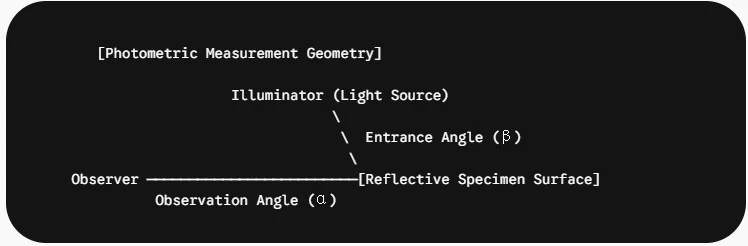
Standard testing specifies observation angles of α = 0.2° and α = 0.5°, with entrance angles of β = 5° and β = 30°.
Mechanical stability of the tape-fabric seam is evaluated via tensile strength and peel adhesion testing:


Where:
σ = tensile stress (MPa)
 = maximum force at rupture (N)
 = initial cross-sectional area (mm²)
 = seam efficiency percentage (%)
 = seam breaking strength (N)
 = unsewn fabric strength (N)
[ Tensile Test Configuration ]
[ Upper Clamp ]
←─
Reflective Tape
←─
FR Fabric Seam
[ Lower Clamp ]
Typical performance specifications across sample variations are detailed below:
|
Property / Metric |
Test Method |
Standard Minimum Requirement |
Baseline FR Coverall Sample |
Optimized Assembly Sample |
|
Initial |
ISO 20471 / EN 471 |
≥330 cd⋅lx⋅m² |
500 cd⋅lx⋅m² |
480 cd⋅lx⋅m² |
|
High Angle (α = 0.2°, β = 5°) |
ISO 20471 |
≥290 cd⋅lx⋅m² |
380 cd⋅lx⋅m² |
370 cd⋅lx⋅m² |
|
Seam Breaking Strength |
ISO 13935-2 |
≥200 N |
350 N |
420 N |
|
Seam Efficiency (η) |
ISO 13935-2 |
≥70% |
78% |
86% |
|
Peel Strength (Tape to Fabric) |
ISO 2411 |
≥15 N/50 mm |
22 N/50 mm |
35 N/50 mm |
 (α = 0.2°, β = 5°)
Structural seam integrity and ergonomic fit are critical when tailoring a heavy-duty flame retardant boiler suit with reflective tape for utility and maintenance crews.
R_A Retention, Seam Durability, and Reflective-Layer Degradation after Repeated Laundering, Abrasion, and Flexing
Durability characterization involves subjecting finished garments to combined stress conditioning: repeated industrial laundering (ISO 15797 / ISO 6330), Martindale abrasion (ISO 12947-2), and cyclic flexing (ISO 7854 Method A).
Retained retroreflection is calculated as:

Microstructural degradation during conditioning follows a distinct progression:
➔
▼
◄─
▼
➔
|
Conditioning Exposure |
Applied Method |
Observed Degradation Mechanism |
RA Retention (% Initial) |
|
25 Industrial Washes (75 °C) |
ISO 15797 |
Minor bead loss; binder intact |
88% |
|
50 Industrial Washes (75 °C) |
ISO 15797 |
Moderate bead loss; micro-cracking |
65% |
|
5,000 Abrasion Cycles |
ISO 12947-2 |
Crown scratching on glass spheres |
82% |
|
7,500 Flex Cycles |
ISO 7854 |
Transverse matrix micro-fractures |
74% |
Prolonging the operational lifespan and photometric coefficient (  ) of high-vis apparel mandates strict adherence to proper washing and maintenance of reflective workwear.
Finished-Garment Validation of Reflective Visibility Zones in Flame-Resistant Coveralls for Hazardous Worksites
Validating the complete FR coverall requires confirming that material-level retroreflective performance translates to finished-garment compliance under simulated industrial operating conditions.
Complete 360-degree photometric validation ensures that heavy-duty reflective overalls for industrial workwear provide adequate retroreflection from both near and far distances.
[ 360-Degree Photometric Verification Setup ]
[ Goniometer / Photometer Sensor ]
[180° Back] -->
[ 0° Front ]
[ Rotating Mannequin ]
[ 180° Back ]
[ 90° Side ]
Quality Control and Engineering Procurement Framework
To manage manufacturing risks, quality control protocols are organized across three distinct stages:
Incoming Material Inspection
FR Fabric: Verify fabric weight (g/m²), tear strength (ISO 13937-2), and vertical flame resistance (ASTM D6413 / ISO 15025).
Reflective Tape: Audit initial  values (≥330 cd⋅lx⋅m² at α = 0.2°, β = 5°), tape width tolerances (±1.0 mm), and glass sphere distribution uniformity. For flexible trim configurations on softshell or elastic garment components, engineering specs often call for high-visibility reflective sewn-on fabric tape.
In-Process Assembly Verification
Stitch Integrity: Monitor stitch density (3.5--4.5 stitches/cm), needle temperature, and thread tension.
Thermal Matching: Ensure sewing threads are 100% Aramid (Nomex®) to prevent seam opening during thermal events.
Batch Verification & Final Inspection
360-Degree Photometric Audit: Measure  across 360-degree rotation angles on a mannequin to confirm non-obscured visibility zones.
Laundering Audit: Conduct batch testing (5 to 25 wash cycles per ISO 15797) to confirm post-wash  retention (>100 cd⋅lx⋅m²) and seam strength stability (≥200 N).
Rigorous production quality assurance requires establishing strict protocols for safety workwear quality control covering raw materials, seam tensile strength, and retroreflective coefficient validation.
By aligning material architecture, binder chemistry, sewing assembly parameters, and garment-level placement geometry, finished FR coveralls achieve long-term retroreflective performance (  ) and thermal barrier protection across hazardous industrial environments.