Technical Analysis of Recycled PP Non-Woven Bag Structure, Interfacial Adhesion, Load Distribution, and Manufacturing Performance
Recycled polypropylene non-woven shopping bags are often specified by basis weight, dimensions, handle type, printing, and nominal carrying load. Those parameters are useful, but they do not fully explain why two bags made from apparently similar recycled PP non-woven material can fail at very different loads. The more important engineering question is how the material, lamination interface, thermal-bonded fiber network, sewn or bonded joints, handle attachment geometry, and bottom construction work together as one load-bearing system.
For laminated structures, the interface between the PP non-woven substrate and the surface film becomes part of that system. Polypropylene is inherently difficult to wet and bond without suitable surface preparation. Corona treatment introduces polar functionality and raises surface energy, improving wettability and adhesion; however, treatment level, aging after treatment, substrate formulation, contamination, and excessive treatment can all affect final laminate bond performance. Published work on corona-treated PP films also shows that surface energy can decline during storage, meaning that a material that was suitable for lamination immediately after treatment may not behave identically after prolonged storage.
The issue becomes more complex with recycled PP. Reprocessing history, polymer degradation, contamination, mixed-polymer fractions, additives, and melt-flow variability can influence both bulk strength and interfacial behavior. Research on post-consumer recycled polypropylene has identified weak interfacial behavior associated with segregated polyethylene in recycled PP systems, illustrating why recycled content percentage alone cannot predict adhesion performance. For shopping-bag development, the implication is straightforward: recycled content, GSM, lamination quality, and finished-bag load performance should be evaluated as connected variables rather than independent specifications.
Central engineering question: How do recycled PP non-woven substrate properties, interfacial adhesion, reinforcement design, and handle geometry interact to determine stress distribution and failure behavior in reusable shopping bags?
Subordinate questions: Which interface or structural region becomes the weakest load path? Does increasing GSM improve finished-bag capacity when handle or seam failure remains dominant? When does lamination strengthen the structure, and when does it introduce delamination risk? Which material and finished-product tests provide buyers with the most useful evidence before bulk approval?
Quick Summary
- Finished-bag load capacity is controlled by the complete force path from handle to attachment zone, body panel, gusset, and bottom-not by fabric GSM alone.
- Recycled PP variability can affect fiber strength, thermal bonding, surface condition, lamination adhesion, and lot-to-lot consistency, so recycled-content percentage should never replace mechanical testing.
- Lamination can increase surface protection, printability, stiffness, and dimensional stability, but weak interfacial adhesion introduces peeling and delamination failure modes.
- Handle ends, stitch perforations, gusset corners, and transitions between reinforced and unreinforced material are common stress-concentration zones that should be tested at finished-bag level.
- Nonwoven tensile and tear testing should be combined with handle-pull, seam/joint, cyclic-load, abrasion, and laminate-peel evaluation rather than relying on a single fabric-strength result.
- OEM specifications should define the required application, carrying load, reuse cycle, construction, test method, and acceptance criteria before the supplier selects GSM or reinforcement.
Quick Navigation
- Understanding Recycled PP Non-Woven Fabric, Lamination Layers, Handle Materials, and Reinforcement Components
- Shopping Bag Panel Construction, Handle Attachment, Lamination, Heat Bonding, and Sewing Process Design
- How Interfacial Adhesion and Layer Bonding Influence Stress Transfer and Load Distribution in Recycled PP Non-Woven Bags
- Laminated vs Non-Laminated Recycled PP Non-Woven Structures: Material, Bond Strength, Stiffness, and Reusability Comparison
- How GSM, Fiber Bonding, Seam Reinforcement, Handle Geometry, and Lamination Quality Affect Tensile Strength, Tear Resistance, and Load Capacity
- Testing Interlayer Adhesion, Fabric Tensile Strength, Seam Strength, Handle Pull Resistance, Abrasion Durability, and Batch Consistency
- Selecting Recycled PP Non-Woven Bag Specifications for Retail Shopping, Promotional Distribution, Repeated Use, and Custom OEM Projects
Understanding Recycled PP Non-Woven Fabric, Lamination Layers, Handle Materials, and Reinforcement Components
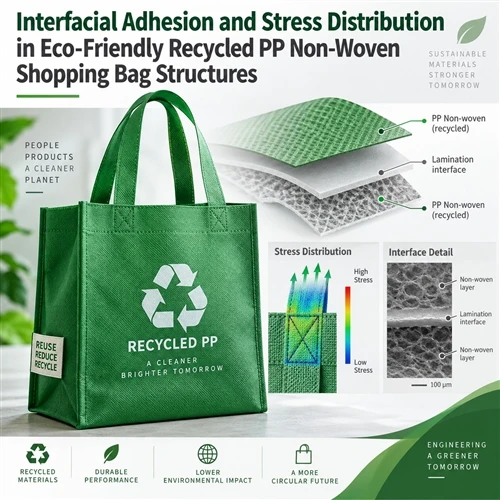
A recycled PP non-woven shopping bag should be treated as a multi-component mechanical system. The substrate provides the main panel structure, but the finished product may also contain a printed film, extrusion or adhesive bonding layer, sewing thread, PP webbing, reinforcement patches, gusset panels, binding tape, and printed or laminated surfaces. Changing any one of these components can change where stress accumulates and how the bag fails.
Recycled PP Spunbond Non-Woven Substrate
Spunbond polypropylene is formed by extruding continuous thermoplastic filaments, laying them into a web, and consolidating the web through thermal bonding. The resulting sheet does not behave like an isotropic solid plate. Fiber orientation, bonding-point geometry, web uniformity, basis weight, filament properties, and machine-direction versus cross-direction orientation affect tensile response.
For buyers, GSM is therefore a material descriptor rather than a finished-product strength rating. Increasing GSM normally increases the amount of material available to carry load, but the improvement in breaking force is not necessarily proportional. A heavier web with weak thermal bonding or poor fiber distribution may perform worse than a lighter, more uniform web in a critical direction.
The distinction becomes more important when recycled PP is introduced. Processing history can change polymer molecular structure and rheology, while recycled feedstock may contain broader compositional variation than a controlled virgin PP grade. Recent work on recycled polypropylene has documented mechanical-property loss associated with recycling-induced chain degradation, although results from molded or film specimens cannot be transferred quantitatively to spunbond bag fabric. The relevant procurement lesson is that actual non-woven rolls and finished bags must be tested rather than assigning a strength value based only on recycled-content percentage.
For projects requiring a commercial example of this material family, a recycled non-woven grocery shopping bag provides a useful reference for examining how fabric weight, reinforcement, printing, and reusable construction can be combined in a retail bag specification.
Lamination Layers and Surface Films
A laminated non-woven bag generally combines the fibrous PP substrate with a comparatively continuous surface layer. Depending on the manufacturing route, this may involve printed PP film, extrusion lamination, or an adhesive-bonded film system. The laminate changes more than appearance. It can modify bending stiffness, surface friction, moisture resistance, dimensional stability, print definition, and the way local stress is transferred across the substrate.
The interface is mechanically important because a bonded laminate must transfer shear stress between layers. If adhesion is sufficient, the layers behave more like a coupled structure. If the interface is weak, loading can produce local slip, blistering, edge lift, or progressive delamination instead of distributing force through the intended laminate section.
Polypropylene surface chemistry is particularly relevant. Corona treatment of polyolefin surfaces introduces polar groups, increases surface energy, and improves wettability and adhesion. Research has also shown that the treatment effect can decay with storage time and that lamination strength depends on treatment conditions. This means that a purchasing specification limited to "laminated PP" is incomplete: the supplier's surface-treatment control, lamination process, storage time, and bond verification also matter.
A practical product reference is a laminated non-woven shopping bag, where the engineering question is not simply whether a film is present, but whether the film, substrate, printing process, and bonding method remain stable through folding, sewing, loading, and repeated handling.
Handles and Reinforcement Materials
Handles commonly use folded PP non-woven material, PP webbing, or another textile strap. Their mechanical role is to collect a relatively concentrated hand load and transfer it into a much larger bag panel. The handle attachment therefore acts as a load-transfer joint.
If a 10 kg payload is carried by two handles under static equilibrium, the nominal gravitational force is approximately 98 N before considering dynamic movement. The actual force at individual handle attachments can be substantially higher during lifting, swinging, sudden stops, uneven loading, or one-handle carrying. This is why a static nominal-load statement cannot be treated as a safety factor.
Reinforcement enlarges the area through which the handle force enters the body panel. X-box stitching, rectangular reinforcement patches, extended handle tails, double-layer non-woven material, or webbing that continues farther down the panel can reduce local stress concentration. However, reinforcement must terminate gradually enough to avoid simply moving the stress concentration to the edge of the reinforced zone.
| Component | Main Engineering Function | Common Failure Risk | Buyer Control Point |
|---|---|---|---|
| Recycled PP non-woven substrate | Carries panel tensile and tear loads | Fiber-web rupture, thermal-bond failure, puncture propagation | GSM, tensile, elongation, tear, uniformity |
| Lamination film | Surface protection, print carrier, stiffness modification | Cracking, peeling, edge lifting | Film compatibility, fold resistance, adhesion |
| Bonding interface | Transfers shear between film and non-woven substrate | Delamination | Surface treatment, peel behavior, aging |
| Handle/webbing | Transfers user load into bag panels | Handle rupture or elongation | Material width, thickness, tensile strength |
| Handle attachment | Spreads concentrated load into panel | Stitch-hole tearing, joint pull-out | Attachment geometry, reinforcement area, pull test |
| Bottom/gusset | Supports payload and distributes panel tension | Corner tearing, seam opening | Panel orientation, seam design, local reinforcement |
The important pattern is that each component carries a different part of the load path. A bag should therefore be specified by the strength of the complete structure rather than by the strongest individual material.
Shopping Bag Panel Construction, Handle Attachment, Lamination, Heat Bonding, and Sewing Process Design
Manufacturing decisions determine whether material properties measured on a flat sheet survive conversion into a finished shopping bag. Cutting creates edges and corners; sewing introduces holes; ultrasonic or thermal bonding locally melts fibers; lamination creates a second interface; folding changes local curvature; and handle installation creates concentrated tensile zones. Each process can either preserve or reduce the useful strength of the substrate.
Panel Layout and Stress Direction
The first structural decision is the panel pattern. A bag may use separate front, back, side-gusset, and bottom panels, or a more integrated construction with folds replacing some seams. Fewer seams reduce the number of potential joint failures, but they can also constrain print layout, gusset geometry, material nesting, and machine handling.
Nonwoven material should also be considered directionally. If tensile properties differ between machine direction and cross direction, orienting the stronger direction toward the dominant load path may improve performance without increasing GSM. This is particularly relevant between the upper handle zone and lower bag body, where tensile force travels vertically before turning through the bottom structure.
Lamination Before Conversion
Lamination is normally completed before bag cutting and sewing. Process control should focus on surface condition, treatment level, temperature, pressure, line speed, film tension, adhesive or extrusion-bond uniformity, and curing where applicable.
The sequence matters. A laminate that appears acceptable immediately after processing can still fail during converting if folds or needle penetration initiate a peel front. For this reason, laminate approval should include both flat-sample adhesion evaluation and converted-product inspection around folds, handle attachment points, and seams.
Handle Attachment Engineering
Handle attachment is frequently the structural bottleneck. A narrow attachment area produces higher local stress for the same applied load. Extending the attachment length, adding reinforcement, or increasing effective stitch area can spread the load, but only if the base non-woven fabric can transfer that load without tearing around the reinforcement boundary.
Stitch density also has an optimum range. Too few stitches reduce joint area. Excessive stitching can perforate the PP web so densely that the needle holes form a tear path. The correct specification should therefore define the whole seam assembly-thread, needle, stitch type, stitch density, reinforcement, and attachment geometry-rather than specifying only "reinforced handles."
For larger retail formats, large capacity supermarket shopping bags are a useful reference point because the increased payload makes handle-load transfer and local reinforcement more important than in lightweight promotional bags.
Heat Bonding Versus Sewing
PP non-woven material can be joined by sewing or by thermal/ultrasonic bonding, depending on design, material weight, tooling, production rate, and appearance requirements. The two methods fail differently.
| Joint Method | Load-Transfer Mechanism | Main Advantage | Main Failure Risk |
|---|---|---|---|
| Sewn joint | Thread transfers load through discrete needle penetrations | Flexible construction and easy reinforcement | Perforation tearing, thread breakage, seam opening |
| Ultrasonic/thermal bond | Localized melting and consolidation joins thermoplastic layers | Fast, thread-free production | Insufficient fusion or excessive thermal damage |
| Laminated + sewn structure | Laminate carries panel load; stitches transfer joint load | High print quality with conventional bag assembly | Stitching can initiate delamination or film cracking |
Neither process is inherently superior. A low-load promotional bag may prioritize production speed and appearance, while a repeatedly reused grocery bag may require a larger sewn reinforcement zone and more conservative handle-load qualification.
How Interfacial Adhesion and Layer Bonding Influence Stress Transfer and Load Distribution in Recycled PP Non-Woven Bags
The engineering role of interfacial adhesion can be expressed as a load-transfer problem. When a laminated panel bends or stretches, the surface film and non-woven substrate do not experience exactly the same deformation unless the interface transfers sufficient shear between them. Strong interfacial bonding allows the two layers to respond more cooperatively; weak bonding allows relative movement and creates conditions for local peeling.
Why PP Adhesion Requires Surface Control
Untreated polypropylene has comparatively low surface energy, which makes reliable wetting by inks, coatings, and adhesives difficult. Corona treatment increases surface polarity through oxidation and improves wettability. Published studies on polyolefin film treatment show that treatment level influences adhesion and that the increased surface energy can decline with aging. This creates a time-dependent manufacturing variable: the interval between surface treatment and printing or lamination can matter.
This effect becomes particularly relevant for recycled feedstock. Recent interface research on post-consumer recycled PP found that segregated polyethylene in the recycled substrate could create a weak boundary layer and reduce peel strength relative to virgin PP in the studied coating system. That experiment used a barrier-coating architecture rather than shopping-bag lamination, so the numerical results should not be transferred directly. The mechanism is nevertheless relevant: mixed-polymer or contaminated recycled surfaces can create interfacial behavior that is not predicted by nominal "PP" identification alone.
Stress Flow Through a Shopping Bag
When a loaded bag is lifted, force travels through a sequence:
Payload → bottom panel/gusset → body panel → reinforcement zone → handle attachment → handle → user
This path is not uniform. Local stress rises where geometry changes abruptly, where stitch holes reduce net section, where the gusset folds, where a handle terminates, and where a stiff laminate meets a more flexible region. The highest local stress can therefore occur far above the average stress calculated from total bag width.
A practical way to think about this is:
Average load is a bag-level number; failure begins at a local stress concentration.
This distinction explains why simply increasing GSM can produce disappointing results. If failure is consistently initiating at a 20 mm-wide handle attachment, adding material across the entire 400 mm-wide body panel may add cost while only marginally improving the actual failure threshold.
Peel Stress Versus Shear Stress
Interfaces usually tolerate in-plane shear better than peeling concentrated at an edge. A sharp fold, stiff film edge, or stitch penetration can create peel-like loading that progressively opens the laminate. Once a small delaminated region forms, the effective bonded area decreases and the remaining interface must carry more load.
The resulting sequence may be:
Local interface defect → edge separation → reduced bonded area → higher local stress → progressive delamination
For buyers, this means a visually acceptable flat laminate is not enough. Folded corners, gussets, stitched regions, and handle roots should be examined after loading because those locations impose combined bending, shear, and peel stresses.
Competing Failure Explanations
Two bags with different laminate adhesion may nevertheless fail at the same load if the handle attachment breaks first. Conversely, a very strong handle reinforcement cannot compensate for severe panel delamination if the laminate contributes materially to stiffness and load transfer. This leads to two competing engineering explanations:
Hypothesis A: higher interfacial adhesion increases structural stability by maintaining load sharing between laminate and non-woven substrate.
Hypothesis B: interfacial adhesion has little effect on ultimate bag load when another component-such as handle attachment or bottom seam-is the dominant failure point.
The correct conclusion can only be established by observing actual failure modes during finished-bag tests. Peel strength alone cannot identify the controlling failure mechanism.
Laminated vs Non-Laminated Recycled PP Non-Woven Structures: Material, Bond Strength, Stiffness, and Reusability Comparison
Lamination changes the mechanical and commercial profile of a recycled PP non-woven shopping bag. The correct choice depends on whether the project prioritizes surface graphics, splash resistance, stiffness, repeated handling, simplified recycling, low mass, or unit cost.
| Parameter | Laminated Recycled PP Non-Woven | Non-Laminated Recycled PP Non-Woven | Engineering Impact |
|---|---|---|---|
| Surface structure | Non-woven substrate plus continuous film/bonding interface | Exposed non-woven fiber web | Lamination adds another functional layer and another potential failure interface |
| Stiffness | Typically higher for equivalent substrate construction | Typically softer and more flexible | Higher stiffness can improve shape retention but increase fold stress |
| Print surface | Smoother surface supports detailed graphics | Printing interacts directly with fibrous surface texture | Branding requirements may determine construction |
| Splash resistance | Continuous film can reduce direct liquid penetration through the face | More dependent on web density and finishing | Does not automatically make sewn seams waterproof |
| Failure modes | Panel rupture, seam failure, film cracking, delamination | Panel rupture, tear, seam/joint failure | Lamination adds interface-specific QC requirements |
| Material simplicity | Depends on film and adhesive compatibility | Can be simpler if substrate, handle and reinforcement are all PP | Relevant to recycling-stream design |
| Unit cost | Additional film, printing, lamination and process control | Fewer converting steps | Cost difference depends strongly on print method and volume |
The table does not imply that laminated construction is mechanically stronger in every case. The substrate may still carry most of the tensile load, and a poor laminate can introduce new defects. The engineering benefit of lamination must therefore be measured against its interface quality and the product's actual use conditions.
Comparison with a laminated PP woven shopping bag is also useful because woven and non-woven PP distribute load differently. A woven tape structure transfers force through intersecting oriented tapes, whereas a spunbond non-woven distributes force through a bonded filament network. The same laminate film can therefore produce different finished-bag behavior depending on the substrate underneath it.
For a buyer, the relevant question is not "laminated or non-laminated-which is stronger?" It is "which construction reaches the required service life and load target with the lowest unnecessary material, process complexity, and failure risk?"
How GSM, Fiber Bonding, Seam Reinforcement, Handle Geometry, and Lamination Quality Affect Tensile Strength, Tear Resistance, and Load Capacity
Finished-bag performance emerges from several interacting variables. Increasing one variable does not necessarily improve the final product if another variable remains the limiting failure point.
GSM and Fiber-Web Strength
Basis weight measures material mass per unit area. ISO 9073-1 covers determination of mass per unit area for nonwovens, while tensile behavior can be evaluated using the ISO 9073 series. ISO 9073-3:2023 specifies strip testing for breaking force and elongation of nonwovens in conditioned or wet states, using 25 mm or 50 mm specimen options. These tests provide a controlled material comparison, but they do not directly predict bag capacity because finished-bag geometry introduces joints and stress concentrations.
Higher GSM generally means more polymer mass and potentially more load-bearing filaments. However, performance also depends on fiber diameter, polymer condition, web uniformity, thermal-bond area, and orientation. A specification such as "100 gsm" should therefore be paired with actual tensile and tear acceptance limits if strength is commercially important.
Thermal Bonding of the Fiber Web
Spunbond strength depends on the integrity of the thermally bonded network. Underbonding can leave insufficient junction strength between filaments. Excessive thermal exposure can flatten or embrittle local regions and change flexibility. Recycled resin variability can also complicate process optimization because melt-flow behavior and thermal history may differ from a tightly controlled virgin resin stream.
The procurement implication is that fabric rolls from different recycled feedstock batches should not be assumed equivalent merely because they have the same nominal GSM and color.
Tear Resistance and Defect Propagation
ISO 9073-4:2021 specifies a trapezoid method for determining tear resistance of nonwovens. Tear testing is especially relevant around die cuts, stitch perforations, handle roots, and notches because a shopping bag rarely fails as a perfectly uniform tensile strip. Small defects can become crack starters under repeated loading.
The distinction between tensile and tear performance matters. A fabric can have acceptable strip breaking force while still being vulnerable to tear propagation from a needle hole. Buyers should therefore avoid substituting one test for the other.
Handle Geometry and Load-Transfer Area
Handle width, length, attachment depth, spacing, reinforcement area, and edge distance all influence stress distribution. Increasing attachment length generally spreads load over a larger region, but the reinforcement must remain compatible with the substrate. A very stiff reinforcement patch on a soft web can create a high-stress boundary at the patch edge.
A useful engineering comparison is:
| Design Change | Expected Mechanical Effect | Possible Trade-Off |
|---|---|---|
| Higher GSM | More material available to resist panel tension and tear | Higher material cost and bag mass |
| Wider handle | Lower local pressure and potentially broader load transfer | More webbing/material and different appearance |
| Longer handle attachment | Spreads load over greater panel length | More stitching/bonding and production time |
| Larger reinforcement patch | Reduces peak stress in immediate attachment zone | Can shift stress to patch boundary |
| Higher stitch density | More thread engagements per unit length | Excessive perforation can weaken non-woven substrate |
| Stronger laminate bond | Improves layer coupling and resistance to peel initiation | Requires tighter surface-treatment and lamination control |
The dominant message is that load capacity cannot be engineered with GSM alone. A buyer should specify the required finished-bag test load and then use material GSM, reinforcement, seam design, and handle geometry to achieve that target.
Testing Interlayer Adhesion, Fabric Tensile Strength, Seam Strength, Handle Pull Resistance, Abrasion Durability, and Batch Consistency
A useful QC program separates material qualification from finished-product qualification. Material tests identify whether the incoming substrate and laminate are consistent; finished-bag tests determine whether the conversion process has preserved enough structural performance for the intended application.
Non-Woven Tensile Strength
ISO 9073-3:2023 provides a strip method specifically for nonwovens, while ISO 9073-18:2023 covers grab tensile testing. ASTM D5035 also includes a cut-strip procedure applicable to nonwoven fabrics. The buyer and supplier should agree on one method, specimen orientation, conditioning, wet or dry state, specimen width, and reporting unit before setting acceptance limits. Results from different test methods should not be mixed into one specification.
Buyer implication: test both machine direction and cross direction when anisotropy could affect panel layout.
Tear Resistance
ISO 9073-4:2021 addresses trapezoid tear resistance specifically for nonwovens. Tear results help evaluate whether a small defect can propagate under load, which is directly relevant to needle perforations and handle attachment zones.
Buyer implication: if field failures begin at stitch holes rather than as broad panel rupture, tear resistance may be more diagnostic than another increase in nominal tensile strength.
Interlayer Adhesion
For flexible bonded laminates, a peel-type test can compare bond integrity. ASTM D1876 describes a T-peel method for relative peel resistance of adhesive bonds between flexible adherends. Whether that exact geometry is appropriate for a specific PP non-woven laminate depends on how the laminate can be separated and gripped, so the test method should be validated for the construction rather than cited automatically.
The output should be recorded as peel force normalized to specimen width where the chosen method requires it. More important than one average value is the failure mode: clean interfacial separation, adhesive failure, cohesive failure, substrate fiber tearing, or film rupture. If the substrate tears before the laminate separates, the interface may already exceed the strength needed for that specimen configuration.
Handle-Pull and Finished-Bag Load Testing
A handle-pull test loads the most important structural joint directly. The procedure should define bag condition, load direction, loading rate, fixture, number of specimens, and failure criterion. For reusable bags, a cyclic-load sequence can be more informative than a single destructive pull because repeated lifting can progressively enlarge needle holes or weaken folds before ultimate rupture occurs.
For example, an OEM specification may define an application-specific working payload and then require a higher laboratory proof load or repeated-load sequence. The safety factor should be agreed by the buyer according to product risk; it should not be presented as a universal industry number.
Seam and Joint Evaluation
ASTM D1683/D1683M is often cited for sewn seam strength, but its scope is woven fabrics rather than PP nonwovens. Likewise, ISO 13935-2:2026 specifies a grab method for seam rupture but notes that it is normally not applicable to nonwovens. These standards can inform test-machine concepts and reporting discipline, but a non-woven shopping-bag program should use a validated internal or buyer-agreed finished-joint method unless an applicable customer standard is specified.
This distinction matters because calling a familiar seam standard "applicable" without checking its scope can produce technically weak purchase specifications.
Abrasion and Reuse Durability
ASTM D4966 covers Martindale abrasion testing and states that it is generally applicable to woven, knitted, and nonwoven fabrics, although material thickness can limit suitability. It also warns that abrasion results can vary substantially between laboratories and test conditions. ISO 12947-2 applies to textile fabrics including nonwovens but excludes coated fabrics from its stated application, so laminated material may require a different abrasion protocol depending on whether the objective is to test the exposed film or the underlying textile.
Buyer implication: specify the exact construction being tested and the failure endpoint. "Passes abrasion testing" has little technical meaning without the method, abradant, pressure/load, cycle count, and definition of failure.
Batch Consistency and Incoming QC
| Inspection Stage | Recommended Check | Reason |
|---|---|---|
| Incoming non-woven | GSM, width, thickness if relevant, color, surface defects, tensile/tear sampling | Confirms roll-to-roll material consistency |
| Incoming laminate | Bond appearance, wrinkles, bubbles, surface treatment evidence where available | Detects interface defects before conversion |
| Cutting | Panel dimensions, orientation, edge quality | Controls fit and stress direction |
| Handle assembly | Position, attachment depth, stitch/bond pattern, reinforcement | Controls primary load-transfer joint |
| In-line assembly | Gusset alignment, seam width, skipped stitches, thermal-bond continuity | Prevents local structural weak points |
| Final inspection | Dimensions, appearance, printing, finished-bag load test sampling | Confirms product-level performance |
Statistical acceptance sampling such as AQL may be used for visual and workmanship inspection where agreed between buyer and supplier, but AQL does not replace destructive mechanical testing. The sampling plan, critical/major/minor defect definitions, and mechanical-test frequency should be specified separately.
Selecting Recycled PP Non-Woven Bag Specifications for Retail Shopping, Promotional Distribution, Repeated Use, and Custom OEM Projects
The correct starting point for specification development is the application, not a predetermined GSM. A sourcing team should first define the load, dimensions, product shape, reuse expectation, printing requirement, environmental exposure, and acceptable failure risk. Material and construction can then be selected to meet those targets.
Retail Grocery Shopping
Retail grocery bags encounter mixed load shapes, repeated lifting, contact with cart surfaces, and concentrated pressure from packaged products. The specification should prioritize handle pull resistance, bottom/gusset integrity, tear resistance, and sufficient abrasion durability. If detailed graphics and wipe-clean surfaces are required, lamination may be appropriate, but its adhesion should be tested after folding and cyclic loading.
Where the priority is repeated retail use, reusable non woven shopping tote bags provide a relevant construction reference for considering the relationship between material weight, reusable design, handles, printing, and retail carrying requirements.
Promotional Distribution
A promotional bag may carry lighter loads and have a shorter expected reuse cycle, while branding quality and unit cost become more important. In this application, additional GSM or oversized reinforcement may have little commercial value if the required payload is low. Conversely, reducing material below the point where handles distort or panel edges tear can damage the brand impression even if the bag is technically intended for short use.
Repeated-Use Shopping Bags
Repeated-use products should be evaluated for cumulative damage rather than only first-load strength. Handle-hole growth, crease fatigue, surface abrasion, print wear, laminate edge lifting, and gradual seam deformation should be included in sample review. A bag that survives one high static load may still perform poorly after hundreds of lower-load handling cycles.
Application-to-Specification Framework
| Application Requirement | Performance Target | Specification Focus | Validation |
|---|---|---|---|
| Light promotional distribution | Short-duration carrying, strong visual branding | Economical GSM, print compatibility, adequate handle joint | Basic load and appearance testing |
| Supermarket retail | Mixed grocery loads and repeated handling | Tear resistance, gusset strength, handle reinforcement | Handle pull + finished-bag load + tear testing |
| Repeated household reuse | Multiple carrying cycles | Reinforced handles, abrasion resistance, fold durability | Cyclic load + abrasion + post-test inspection |
| Premium printed retail bag | Detailed graphics plus reusable structure | Lamination adhesion, fold resistance, surface treatment | Peel evaluation + cyclic loading + print/fold inspection |
| High-volume OEM program | Low batch variability | Material tolerances, traceability, process controls | Incoming QC + in-line checks + lot-based mechanical testing |
OEM Development Sequence
A practical OEM development program should follow this order:
- Define application: product dimensions, expected contents, nominal working load, reuse cycle, destination market, and printing requirements.
- Select candidate construction: recycled PP content, non-woven GSM, laminated or unlaminated surface, handle material, gusset design, and reinforcement.
- Develop samples: use production-representative material rather than visually similar substitute fabric wherever mechanical performance matters.
- Measure material performance: tensile, tear, laminate adhesion, and relevant abrasion behavior.
- Test finished structure: handle pull, static/cyclic load, seam or joint integrity, bottom deformation, and failure mode.
- Revise the actual weak point: do not automatically increase GSM if the observed failure occurs at the handle, seam, or laminate interface.
- Lock bulk specifications: define material tolerances, construction details, test methods, sample approval criteria, and inspection frequency.
For broader material and construction comparisons across reusable formats, the shopping bags category can be used to compare non-woven, woven, laminated, and other retail bag structures without assuming that one construction is appropriate for every load or branding requirement.
Buyer Decision Rule
Choose a heavier substrate when panel tensile or tear failure remains the limiting mechanism after joint design has been optimized.
Increase reinforcement when failures initiate around handle attachment zones while the surrounding panel retains adequate strength.
Improve lamination process control when peeling, blistering, or interface separation occurs before substrate rupture.
Use a non-laminated construction when surface-film performance is unnecessary and material simplicity, softness, low mass, or simplified mono-material design is more important.
Request additional testing when recycled feedstock changes, a new lamination film or adhesive is introduced, the handle geometry changes, or production moves to a materially different process line.
Do not approve bulk production solely from GSM, recycled-content percentage, or a supplier's nominal load claim. Approval should be based on an agreed construction tested in its finished form.
FAQ
Does higher GSM always increase the load capacity of a recycled PP non-woven shopping bag?
No. Higher GSM usually adds material that can contribute to tensile and tear resistance, but finished-bag capacity may still be limited by handle attachment, seams, gusset corners, thermal bonding, or laminate failure. Buyers should increase GSM only after identifying whether the panel itself is the controlling failure mode.
How should laminate adhesion be evaluated on a recycled PP non-woven bag?
Use a repeatable peel-type method suitable for the specific laminate and record both force and failure mode. The result should then be checked against converted-product behavior at folds, seams, and handle zones. Flat-laminate peel strength alone cannot confirm finished-bag durability.
Can a supplier guarantee carrying capacity from fabric GSM alone?
No technically defensible capacity claim should be based on GSM alone. Carrying performance depends on fabric strength, directionality, joint construction, handle geometry, reinforcement, bag dimensions, and loading conditions. A finished-bag load protocol is needed.
Does recycled PP automatically make a shopping bag environmentally preferable?
No. Recycled content reduces dependence on virgin feedstock, but environmental performance also depends on recycled-content verification, product mass, reuse frequency, manufacturing losses, laminate composition, transport, and end-of-life route. "Eco-friendly" should therefore be supported by defined environmental attributes rather than treated as a material property.
When should an OEM buyer revalidate the construction?
Revalidation is advisable after changes to recycled resin source, non-woven GSM, lamination film, surface-treatment process, adhesive, handle material, reinforcement geometry, sewing or bonding method, or any dimension that materially changes the load path. The purpose is to confirm that the previously approved failure behavior has not shifted to a new weak point.
Technical Evaluation for Recycled PP Non-Woven Bag Development: Submit your bag dimensions, application, target load, reuse cycle, recycled-content requirement, fabric or laminate specification, handle construction, artwork, testing requirements, order quantity, and destination market for technical review. Xiamen Topmatched Import and Export Co., Ltd. can evaluate the material structure, reinforcement design, sample requirements, testing plan, and quotation based on the complete project specification rather than fabric GSM alone.