Disposable coverall GSM is the mass of a defined fabric construction per unit area, expressed in g/m²; it is not a protection rating. Buyers should specify whether the measurement covers the nonwoven substrate or finished laminate, then assess barrier performance, mechanical reliability and garment construction separately. A useful purchase specification combines a controlled fabric weight with evidence that the supplied configuration meets the intended exposure requirements.
What Does Coverall GSM Measure: Base Fabric, Barrier Film, or the Complete Laminate?
A quotation stating "60 GSM disposable coverall" leaves an engineering question unanswered: 60 g/m² of which material? The figure could describe an uncoated polypropylene nonwoven, a finished SMS structure, or a laminate containing a nonwoven substrate, polymer film and bonding material.
These descriptions are not interchangeable. A purchase order that records only total GSM allows materially different constructions to appear equivalent on paper.
ISO 9073-1:2023 specifies a method for determining the mass per unit area of nonwoven fabrics. ASTM D3776/D3776M-20(2025) addresses fabric mass per unit area through several sampling options. Neither measurement, by itself, establishes a protective classification. [1,2]
Define the measured construction before specifying g/m²
|
Description on a quotation |
What the measurement should identify |
What remains unresolved |
|
Spunbond PP GSM |
Finished spunbond nonwoven, including any specified finish |
Fiber distribution, bonding quality and protective performance |
|
SMS GSM |
Combined spunbond–meltblown–spunbond structure |
Weight distribution among layers and meltblown continuity |
|
Microporous laminate GSM |
Finished nonwoven, film and retained bonding material |
Film composition, thickness, pore structure and laminate integrity |
|
Base fabric GSM |
Substrate before film application or other finishing |
Final composite weight and barrier construction |
|
Finished garment weight |
Total mass of one identified size and configuration |
Fabric GSM unless fabric area and component masses are separately known |
For a concrete product example, review this 63 gsm microporous laminated coverall. The product page lists a microporous PE film laminated to nonwoven polypropylene; buyers should confirm whether the stated GSM covers the complete laminate and how it is measured.
A complete coverall also contains seams, zipper components, elastic, labels and possibly tape or attached socks. Those components affect garment mass but do not belong in a body-fabric GSM result unless the sampling definition explicitly includes them.
Comparing the weights of two finished garments can therefore mislead. A larger pattern, longer zipper or wider seam tape can make one garment heavier without changing its body fabric.
Calculate g/m² without confusing specimen mass and garment mass
The dimensional relationship is:
Fabric mass per unit area = specimen mass in grams ÷ specimen area in square metres
As a calculation example, a specimen measuring 100 cm² has an area of 0.01 m². If its measured mass is 0.60 g, the calculated result is 60 g/m².
This example demonstrates the arithmetic; it is not a substitute for the sampling, conditioning and measurement procedure in the selected standard.
Specimen area accuracy matters. An incorrectly sized cutter, stretched specimen or incomplete cut changes the denominator. Loose fibers, adhesive contamination or accidental inclusion of seam tape changes the numerator. A laboratory report should identify the specimen condition and material represented, rather than presenting an unexplained average.
Most importantly, the report must distinguish the sample from the lot. ASTM explicitly notes that its small-swatch option represents the submitted sample and does not necessarily represent the production lot. [2]
Where the Weight Goes: How Spunbonding, Meltblown Layers, and Film Lamination Shape Fabric Structure
Total GSM combines material contributions that perform different jobs. Understanding where that mass is located is more useful than assuming every additional gram improves the same property.
In a spunbond structure, continuous filaments form the supporting web. In SMS, a meltblown layer lies between spunbond layers. In a film laminate, the supporting nonwoven and barrier film remain distinct structural elements even when the finished surface appears uniform.
DuPont's technical catalogue distinguishes these fabric technologies and describes the meltblown layer's particle-filtration role within SMS. It also treats seams as a separate part of garment protection. These are construction principles, not evidence that an unspecified material meets a particular requirement. [3]
Separate total GSM from layer allocation
For a laminate, a useful accounting relationship is:
Finished laminate GSM ≈ substrate GSM + film GSM + retained adhesive or finish GSM
The relationship assumes that all measurements refer to the same finished area and compatible material conditions. Stretching, shrinkage, edge trimming and finishing losses can complicate comparisons between upstream component specifications and the converted material.
Consider two hypothetical laminates:
|
Illustrative construction |
Substrate |
Film |
Retained bonding material |
Total |
|
Laminate A |
35 g/m² |
20 g/m² |
5 g/m² |
60 g/m² |
|
Laminate B |
45 g/m² |
10 g/m² |
5 g/m² |
60 g/m² |
These invented values illustrate mass allocation only. They do not describe commercial products or predict which laminate provides better protection.
The distinction matters because the same total weight can contain different amounts of supporting web and barrier film. Neither construction should be accepted solely because it meets 60 g/m².
Evaluate film thickness in µm alongside composition and pore structure
Film thickness cannot be calculated reliably from laminate GSM alone. Even when film mass is known separately, conversion to thickness requires appropriate density information. Fillers and voids make a solid-polymer density assumption unsuitable for some microporous films.
Manufacturing route also matters. Research on stretched polypropylene-based membranes has examined how polymer composition, drawing and filler-related void formation influence membrane structure. Those findings explain why mass alone cannot describe a porous film, but they do not establish performance for a finished protective coverall. [4]
For procurement, request the film identity and construction record where needed to control the approved design. A supplier may protect proprietary formulation details; that does not remove the need for a stable material designation, documented performance and notification of relevant changes.
Bonding deserves similar attention. A laminate can meet total GSM while its adhesive distribution or bonding conditions differ from the approved sample. The practical question is whether the process consistently produces the required adhesion, flexibility and barrier integrity-not whether the finished roll merely reaches the target mass.
Why Two Coverall Fabrics with the Same GSM Can Provide Different Levels of Protection
GSM records quantity. Protective performance depends on how that quantity is arranged and how the material responds to the relevant challenge.
For liquid exposure, the relevant variables include surface wetting, pore structure, film continuity, contact pressure and exposure duration. For particles, pathways through the material and through garment openings require separate consideration. For biological exposure, the challenge liquid and detection method are also part of the evidence.
CDC/NIOSH identifies fabric properties, the characteristics of microorganism carriers and external stresses as factors affecting penetration. That framework provides no basis for replacing exposure-specific testing with a fabric-weight threshold. [5]
Distinguish ISO 811 water resistance from biological barrier evidence
ISO 811:2018 concerns resistance to water penetration under hydrostatic pressure. A result expressed in cm H₂O or kPa describes the specified water challenge; it does not automatically establish resistance to synthetic blood, a bacteriophage challenge or a particular chemical. [6]
For blood-related protection, CDC distinguishes synthetic-blood methods-ISO 16603 and ASTM F1670-from methods using the Phi-X174 bacteriophage system, including ISO 16604 and ASTM F1671. Fabric and seam evidence must also be distinguished. [7]
|
Procurement question |
Evidence to request |
What GSM cannot establish |
|
Does the fabric resist water pressure? |
Hydrostatic test method, specimen condition, pressure endpoint and result |
Water-entry pressure |
|
Does it resist the relevant biological challenge? |
Applicable challenge method, exposure conditions, detection procedure and outcome |
Biological penetration resistance |
|
Does the assembled garment limit particle ingress? |
Appropriate garment-level evidence for the claimed use |
Leakage through closures and interfaces |
|
Does it resist a particular chemical exposure? |
Chemical-specific data with concentration, temperature and test conditions |
Chemical compatibility or safe wear time |
|
Will the supplied construction retain its barrier? |
Relevant post-processing, mechanical and storage evaluation |
Resistance to damage or aging |
The table is an evidence-selection framework. The required tests and acceptance criteria depend on the intended use; it is not a universal test package for every disposable coverall.
Published research also shows why material architecture deserves separate attention. El-Ghoubary and colleagues compared laminated fabrics for surgical-gown applications using different film and nonwoven constructions, evaluating several barrier and transport properties. The research supports investigating structure and processing rather than mass alone. Its results cannot be transferred directly to a coverall with different seams, coverage or exposure conditions. [8]
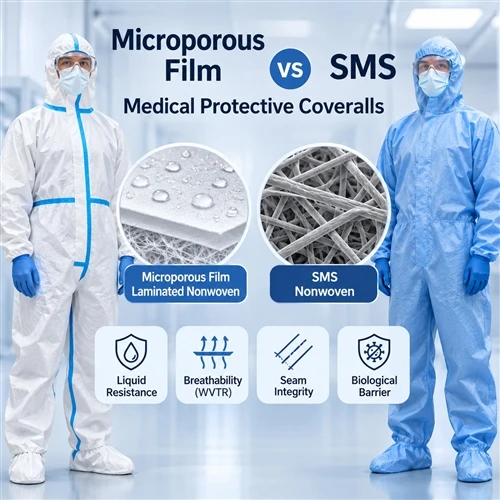
To understand why equal GSM does not establish equivalent protection, compare the material structures discussed in microporous film versus SMS fabric for protective coveralls. Evaluate the barrier layer, bonding method and relevant test evidence alongside total fabric weight.
If two suppliers submit different methods or incomplete reports, their relative protection remains insufficiently established. Selecting the heavier fabric does not resolve that evidence gap.
Request a Coverall Fabric Specification Review
Send Topmatched your intended task, proposed fabric construction, target g/m² and required performance tests. Request a review of the quoted material definition and the supporting documentation available.
Request a Specification Review
Does Lower GSM Improve Comfort? Separating Fabric Weight from Air and Moisture Transport
A lighter fabric reduces mass per unit area. Whether it reduces heat burden depends on what changed to achieve that reduction.
Removing supporting web material is not equivalent to changing a membrane's transport properties. Reducing film thickness, altering adhesive coverage or modifying pore structure can affect different mechanisms. A lower GSM value does not identify which mechanism has changed.
Air permeability measures airflow through the material under a stated pressure difference. Moisture vapor transmission concerns water moving through the construction under a vapor-pressure gradient. A fabric can have limited airflow while still transmitting some water vapor.
ISO 9237:1995 provides a method for measuring fabric air permeability. For comparisons, the result should retain the test pressure difference, test area and reporting units. [9]
Compare L/m²/s, g/m²/24 h and m²·Pa/W separately
|
Property |
Typical reporting units |
Essential comparison information |
Interpretation limit |
|
Air permeability |
L/m²/s or mm/s |
Method, pressure difference, test area and specimen state |
Does not measure water-vapor transport |
|
Water-vapor transmission rate |
g/m²/24 h |
Method variant, temperature, humidity gradient and orientation |
Values from different conditions may not be comparable |
|
Water-vapor resistance, Ret |
m²·Pa/W |
Method edition and specimen assembly |
Does not prescribe a safe wearing duration |
|
Thermal resistance, Rct |
m²·K/W |
Method and tested layer arrangement |
Does not reproduce every workplace condition |
ISO 11092:2026 measures thermal and water-vapor resistance under steady-state conditions. It explicitly states that its test conditions do not represent specific comfort situations and that it does not establish physiological-comfort performance specifications. An older report should therefore retain its original method edition rather than being relabelled as a test to the current edition. [10]
Foundational research by Epps and Leonas examined pore size and air permeability in four nonwoven fabrics, including SMS structures. The observed relationships differed between fabric types. Published in 2000, the study is useful for understanding structure–transport relationships, not for setting a current universal GSM limit. [11]
For sample evaluation, compare garments under controlled, relevant conditions: the same underclothing, representative movements, comparable ambient conditions and the intended PPE combination. Record discomfort and restriction separately from laboratory transport results.
A wearer describing a suit as "lighter" may be responding to lower stiffness or a better pattern rather than lower fabric mass. Procurement teams should retain these distinctions in the evaluation form.
Similarly, moisture inside a coverall does not by itself prove external leakage. The investigation must distinguish perspiration and condensation from liquid ingress. GSM cannot diagnose the source.
When Lightweight Construction Becomes a Weak Point: Tearing, Seam Stress, and Barrier Damage
Lightweight construction becomes unsuitable when the approved material and garment no longer withstand the demands of the task. There is no single GSM at which that transition occurs across all fabric systems.
Three mechanisms should be investigated separately: failure within the body fabric, failure at a seam, and damage to the barrier layer without obvious failure of the supporting web.
A specimen may retain its overall shape while its film develops a local defect. Conversely, a seam may open because of garment fit even when a flat fabric specimen has acceptable strength.
Record strength in N together with specimen geometry and failure location
Tensile, tear and seam tests apply different loading arrangements. Their numerical results cannot be compared simply because each includes force units.
A useful report identifies machine and cross directions where relevant, specimen dimensions, gripping arrangement, conditioning, loading procedure and failure mode. For seams, specify the actual stitch, tape, seam allowance and material combination tested.
The acceptance criterion should follow the applicable product requirement or an agreed engineering specification. A laboratory result should not be judged against an invented universal minimum.
|
Observed failure |
Possible variables to investigate |
Evidence needed before changing GSM |
|
Body fabric tears during bending |
Local web weakness, directional properties, fit or existing damage |
Tear behavior, material orientation and garment fit observations |
|
Crotch or shoulder seam opens |
Pattern restriction, seam allowance, stitch construction or load concentration |
Seam test and movement trial on the supplied size |
|
Tape edge lifts |
Bonding conditions, contamination or material incompatibility |
Adhesion assessment and seam barrier evaluation |
|
Film separates from substrate |
Inadequate bonding or incompatible process conditions |
Laminate adhesion and defect mapping |
|
Barrier fails without a large tear |
Pinhole, abrasion or local film damage |
Suitable barrier test before and after the relevant conditioning |
These are investigation paths, not diagnoses. The responsible cause must be established from the failed material and its production history.
A practical development trial should also record how failure occurred. If fabric consistently tears beside an intact seam, strengthening the seam again may not solve the problem. If a garment restricts reaching or squatting, increasing fabric weight may leave the same stress concentration in place.
CDC/NIOSH includes fabric and seam strength, closure barriers and garment size among selection considerations. This supports evaluating the assembled garment alongside the material rather than accepting GSM as a substitute for construction evidence. [5]
Where a sterile version is ordered, evaluate the actual processed configuration. Do not assume that a report on untreated fabric also represents the laminate, seam and packaging after the specified sterilization and storage conditions. The necessary evidence should be agreed for that configuration; routine laundering is not an appropriate default qualification for a disposable garment.
Adding Weight or Changing Structure: Which Approach Addresses the Actual Performance Gap?
Before increasing GSM, identify the failed requirement and the physical location of the failure.
A recommendation to "use heavier material" is incomplete unless it explains what additional mass will change. More supporting web material, more barrier film and more adhesive are different modifications. Each may affect strength, flexibility, transport or processing in a different way.
The following matrix is an engineering decision aid, not a prediction that a particular modification will pass testing.
|
Performance gap |
Potential value of adding weight |
Structural or process change to investigate |
Required confirmation |
|
Low supporting-web strength |
May help within a controlled construction |
Fiber distribution, bonding or directional balance |
Mechanical testing on the revised fabric |
|
Liquid barrier fails at a local defect |
Additional mass may leave the defect mechanism unchanged |
Film continuity, handling damage or lamination conditions |
Relevant barrier testing and defect investigation |
|
Leakage occurs at needle holes |
Body-fabric weight may have little relevance |
Seam construction and sealing process |
Seam-level barrier evidence |
|
Garment restricts movement |
More mass may increase stiffness |
Pattern dimensions and seam placement |
Fit and movement evaluation |
|
Excessive moisture accumulation |
Weight change alone gives no reliable answer |
Membrane, bonding coverage and garment configuration |
Comparable transport tests and wearer evaluation |
|
Batch results fluctuate |
A higher nominal target may mask variation |
Process control, sampling and material traceability |
Production data against agreed limits |
Use g/m² as a controlled variable, not the only development target
A useful comparison keeps the problem statement stable: same intended task, same required protective outcome and clearly identified construction changes.
When multiple variables change together, a successful sample does not reveal which change produced the improvement. It may still qualify as a finished design, but its development record should not claim a causal relationship that was never isolated.
For example, increasing total mass while changing the film and seam tape creates a new construction. It is not evidence that the extra GSM alone solved the barrier problem.
The approval record should identify the complete revised material and garment. Otherwise, a later supplier may reproduce only the nominal weight while omitting the feature responsible for performance.
A sensible commercial comparison follows technical qualification. Compare the price and operational consequences of constructions that meet the required specification. A lower price for an unqualified material is not a like-for-like saving.
Equally, a heavier qualified option is not automatically preferable. If two constructions satisfy the same documented requirements, differences in movement, heat burden, packaging, supply consistency and cost can become legitimate selection factors.
Does Reducing GSM Reduce Environmental Impact? Material Savings, Replacement Rates, and Contaminated Waste
Reducing fabric GSM can reduce material consumption when garment area, construction yield and replacement frequency remain unchanged. That is a mass-saving calculation, not a complete environmental assessment.
The appropriate comparison is the material and waste associated with completing the intended task while maintaining required protection. Counting only grams per unused garment can conceal differences in rejects, premature replacement and packaging.
Calculate material savings in g/m² and kg before making broader claims
Consider an illustrative purchasing scenario:
|
Assumption |
Original construction |
Reduced-weight construction |
|
Fabric consumption per garment |
3.0 m² |
3.0 m² |
|
Fabric GSM |
60 g/m² |
55 g/m² |
|
Calculated fabric mass per garment |
180 g |
165 g |
|
Fabric mass for 10,000 garments |
1,800 kg |
1,650 kg |
Under these assumptions, the fabric saving is 150 kg. The example excludes trims, packaging, process losses and any difference in garment replacement. The assumed area is not a specification for a Topmatched product.
If the lighter construction requires more replacements, part or all of that saving can disappear. For fabric mass alone, the break-even relationship is:
Replacement-count ratio = original mass per garment ÷ revised mass per garment
For the example, 180 ÷ 165 is approximately 1.091. About 9.1% more garments would eliminate the calculated fabric-mass advantage. This is an accounting illustration, not permission to accept greater failure or contamination risk.
The next question is whether mass reduction changes manufacturing yield. A material requiring additional rejects, repeated conversion or extra protective packaging may shift rather than remove environmental burdens. Those effects require measured production information.
Separate contaminated-waste controls from polymer recyclability
Polypropylene or polyethylene content does not establish that a used coverall can enter ordinary recycling. Contamination, mixed components, collection arrangements and treatment requirements must be considered.
WHO distinguishes infectious and other hazardous healthcare wastes from general waste and addresses segregation and appropriate treatment. Its guidance does not support treating all used PPE as either automatically recyclable or automatically belonging to one disposal route. [12]
A defensible supplier statement is specific: a revised construction reduces fabric mass by a measured amount under stated assumptions. A claim of lower overall environmental impact needs a broader comparison covering the relevant life-cycle stages.
Procurement should therefore request the calculation boundary, material inventory, production yield and disposal assumptions behind an environmental claim. GSM is an input to that assessment, not its conclusion.
From a Nominal GSM to a Purchase Specification: Sampling, Tolerances, Test Evidence, and Batch Acceptance
A usable specification must connect four things: the approved construction, the measurement procedure, the performance evidence and the supplied batch.
Begin with a stable material code. "Microporous fabric, 60 GSM" is too broad if the membrane, substrate or bonding process can change without review. The supplier's internal code should connect the purchase order to the approved technical record.
Buyers comparing disposable coverall materials and construction options should request quotations against the same definition of finished fabric, garment configuration and evidence requirements.
State the sampling basis under ISO 9073-1 or ASTM D3776
Select an appropriate method and identify the edition. Agree how samples will represent the lot, including the rolls and positions sampled, while following the selected method's requirements.
Do not pool unidentified specimens and report only one average. Retain the link between each result and its source roll or location.
An average can hide opposing deviations. In an illustrative dataset, results of 54 and 66 g/m² average 60 g/m². Whether either result is acceptable depends on the agreed limits; the mean alone does not answer that question.
The procurement specification should also state how measurement uncertainty and disputed results will be handled. Retesting should follow an agreed procedure rather than continuing until an acceptable result appears.
Separate nominal g/m², individual limits and performance acceptance
|
Specification field |
Information to record |
Acceptance purpose |
|
Material identity |
Supplier code, revision and layer description |
Prevent unapproved construction substitution |
|
Measured construction |
Finished laminate, SMS or specified substrate |
Make GSM results comparable |
|
Nominal mass |
Target g/m² |
Define the production target |
|
Tolerance |
Agreed limits and whether they apply to individual results, averages or both |
Define measurable acceptance |
|
Sampling plan |
Lot definition, selection method and sample traceability |
Establish what the results represent |
|
Test method |
Method, edition and conditioning requirements |
Control measurement consistency |
|
Barrier evidence |
Required test, conditions, specimen type and acceptance criterion |
Confirm the relevant protection |
|
Mechanical evidence |
Material directions, seam configuration and required outcomes |
Confirm handling and movement reliability |
|
Garment configuration |
Pattern, sizes, closures, seams and accessories |
Link testing to delivered products |
|
Change control |
Changes requiring notification, review or requalification |
Preserve the approved design |
No universal GSM tolerance is assigned here. A percentage chosen without considering the validated construction, process capability and required performance may create a precise-looking but ineffective specification.
A lower tolerance limit also needs evidence. Passing a barrier test at the nominal weight does not demonstrate that every construction permitted at the lower limit will pass. Where variation could affect protection, qualification should address the relevant range.
Review evidence by model and revision, not by supplier name alone
Check that the test report identifies the material or garment actually offered. Review the specimen type, test conditions, reported result and scope. A report covering another fabric or seam configuration may be useful background but does not automatically qualify the proposed order.
Separate legal conformity documentation from technical test data. The destination market and intended use determine the relevant requirements; a GSM report is neither a product certificate nor authorization for a protective claim.
For incoming acceptance, define what happens when one part of the specification fails. A lot that meets GSM but lacks required performance evidence remains unresolved. A lot that passes a barrier test but falls outside the agreed material specification requires documented review rather than automatic release.
Retained samples, roll records and garment-batch identification make later investigations more useful. They allow a complaint to be traced to a construction and production period rather than to a generic product name.
Specifying Coverall Weight Around Required Protection Rather Than Choosing the Highest GSM
The correct disposable coverall GSM is the controlled weight of a construction that satisfies the intended performance and garment requirements. It cannot be selected reliably from a universal "light," "medium" or "heavy" ranking.
Start by defining the exposure and required evidence. Identify the material architecture, then evaluate barrier performance, transport properties, mechanical behavior and the finished garment. Set the nominal g/m² and tolerances around that approved construction.
The examples in this review show why the distinctions matter. Two 60 g/m² laminates can allocate mass differently. An average of 60 g/m² can conceal substantial specimen variation. A reduction from 60 to 55 g/m² can save material under fixed assumptions without proving lower total environmental impact.
Procurement should therefore preserve both sides of the specification: what the material is and what the finished product must demonstrate. A heavier coverall with incomplete evidence remains incompletely qualified. A lighter coverall becomes a purchasing option only when its relevant performance, construction and production consistency are supported.
Request Bulk Pricing Against a Defined Coverall Specification
Send Xiamen Topmatched your material construction, target g/m², tolerance requirements, size distribution, garment configuration, required tests and order quantity. Request an itemized proposal identifying available documentation and any sample evaluation or qualification work still required.
Request an Itemized Coverall Quote
Frequently Asked Questions
What GSM should I specify for disposable protective coveralls?
There is no universal protective GSM. Define the exposure, required tests, material construction and garment configuration first. Specify fabric weight and tolerances around a construction supported by relevant performance evidence.
Can I replace an approved coverall with a cheaper product of the same GSM?
Not on GSM alone. Compare material identity, layer construction, seams, closures, sizing and applicable test evidence. Treat a different construction as a proposed substitution requiring documented review before purchase.
What should a supplier provide before I approve a bulk order?
Request a defined material specification, representative sample, GSM measurement basis, agreed tolerances, relevant test reports and garment configuration details. Confirm traceability and change-control arrangements. Identify missing evidence and resolve its significance before approving production.
References
[1] International Organization for Standardization. ISO 9073-1:2023 - Nonwovens - Test methods - Part 1: Determination of mass per unit area. Official standard record.
[2] ASTM International. ASTM D3776/D3776M-20(2025) - Standard Test Methods for Mass Per Unit Area (Weight) of Fabric. Official standard record.
[3] DuPont. DuPont Personal Protection: 2024 Product Catalog. Manufacturer technical reference. Catalogue.
[4] Polypropylene-Based Porous Membranes: Influence of Polymer Composition, Extrusion Draw Ratio and Uniaxial Strain. Polymers, 2018, 10(1), 33. https://doi.org/10.3390/polym10010033.
[5] CDC/NIOSH. Selecting Protective Clothing. Updated October 28, 2026. Technical guidance.
[6] International Organization for Standardization. ISO 811:2018 - Textiles - Determination of resistance to water penetration - Hydrostatic pressure test. Official standard record.
[7] CDC/NIOSH. Standards and Specifications. Updated October 28, 2026. Protective clothing test guidance.
[8] El-Ghoubary, W. A., El-Sayad, G. M., El Gamal, F. A., and Abouzaid, H. A. K. Development of breathable and liquid/wet bacterial penetration barrier composite laminated fabrics for surgical gown applications. Journal of Industrial Textiles, 2023. https://doi.org/10.1177/15280837231170294.
[9] International Organization for Standardization. ISO 9237:1995 - Textiles - Determination of the permeability of fabrics to air. Official standard record.
[10] International Organization for Standardization. ISO 11092:2026 - Textiles - Physiological effects - Measurement of thermal and water-vapour resistance under steady-state conditions (sweating guarded-hotplate test). Official standard record.
[11] Epps, H. H., and Leonas, K. K. Pore Size and Air Permeability of Four Nonwoven Fabrics. 2000. https://doi.org/10.1177/1558925000OS-900215.
[12] World Health Organization. Health-care waste. 2024. Fact sheet.