Polypropylene disposable coveralls for pharmaceutical production should be specified against two separate objectives: controlling contamination from personnel and protecting workers from defined process hazards. Spunbond polypropylene, SMS nonwoven, and microporous film laminates have different structures; purchasing approval must therefore depend on documented shedding, barrier, garment-integrity, and-where required-sterilization performance, rather than fabric weight or a "cleanroom" label alone.
Pharmaceutical Production Exposure and Contamination Control: Specification Requirements for Sterile and Non-Sterile Polypropylene Coveralls
The first purchasing decision is the production task. Secondary packaging, powder dispensing, equipment cleaning, and aseptic filling do not impose identical garment requirements. Record whether medicinal product is exposed, which contaminants must be controlled, and whether the wearer faces dust, liquid, biological, or chemical exposure.
Product protection and wearer protection require separate evidence. A garment that resists inward particle penetration may still release fibres from its own surface. A sterile coverall may still have unsuitable particle shedding, poorly fitted cuffs, or inadequate resistance to the chemical used during cleaning.
EU GMP Annex 1: Match Garment Qualification to the Production Area
EU GMP Annex 1, paragraphs 7.11–7.15, connects clothing selection with the process and area grade. For Grade B, including access or interventions into Grade A, it calls for sterilized gowning components and assessment of garment particle shedding and retention. It also requires garment qualification to establish the maximum wearing period before replacement. These provisions do not prescribe a universal polypropylene basis weight.
For US aseptic operations, FDA guidance likewise addresses sterilized, nonshedding garments, component overlap, and qualification of gowning technique. Buying a particular fabric does not replace the facility's gowning qualification.
The specification should identify hood design, wrist and ankle interfaces, footwear arrangement, size measurements in centimetres, and packaging presentation. Review available cleanroom coverall material and garment options against these requirements. Treat the listed configurations as development options, not proof of suitability for a particular cleanroom grade.
Spunbond, SMS, and Microporous Film Laminates: Manufacturing Routes, Garment Assembly, and Process Limitations
"Polypropylene coverall" identifies too little of the construction to support a purchasing decision. It may describe an uncoated spunbond garment, a multilayer SMS fabric, or the supporting layer of a laminate whose principal barrier is polyethylene.
|
Material system |
Manufacturing route and barrier structure |
Parameters to lock before ordering |
Qualification concern |
|
Spunbond polypropylene |
Extruded continuous filaments form a bonded fibrous web |
Basis weight in g/m², bonding pattern, thickness, fibre distribution |
Open pathways and loose fibres require task-specific evaluation |
|
SMS polypropylene |
Spunbond outer layers surround a finer meltblown layer |
Total and layer-specific basis weights, web uniformity, bonding conditions |
Local meltblown variation can affect particle and liquid penetration |
|
Microporous film laminate |
A porous polymer film is bonded to a supporting nonwoven |
Film polymer, thickness in µm, substrate g/m², bond coverage |
Pinholes, delamination, and conversion damage can compromise the barrier |
|
Nonporous PE-coated nonwoven |
A polyethylene layer covers the supporting fabric |
Coating thickness in µm, continuity, adhesion, flexibility |
Restricted moisture transport and coating defects require assessment |
In a common microporous-film process, stretching a filled polymer film creates voids around filler particles. Pore formation, film thickness, and bonding conditions affect the resulting laminate. This processing route is not universal; the supplier should identify the actual film technology.
For a proposed 50 g/m² laminate, establish whether the figure refers to the substrate alone or the complete composite. These descriptions are not interchangeable. Also define whether adhesive mass is included and how acceptance measurements are sampled across the roll.
Increasing bonding temperature or pressure can improve attachment but can also alter pores, stiffen the laminate, or damage thin film. Cutting and sewing introduce further risks after fabric inspection.
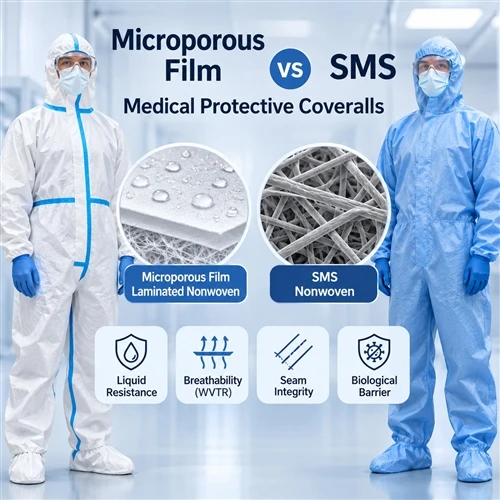
The comparison of microporous film versus SMS fabric for protective coveralls provides additional context for evaluating these constructions. Purchase specifications should identify the selected architecture rather than permit substitution under a generic "PP nonwoven" description.
Particle, Liquid, and Biological Barrier Mechanisms: Fabric Testing, Flexing Resistance, and Failure Pathways
Fibrous webs resist particle passage through mechanisms that depend on particle size, fibre structure, and flow conditions. Microporous films resist liquid entry through their pore geometry and wetting behaviour. Larger defects or reduced liquid surface tension can change penetration behaviour even when the nominal fabric construction remains unchanged.
Particle generation, inward particle penetration, water resistance, and biological penetration are separate measurements.
ISO 9073-10 and ISO 811: Separate Shedding from Penetration
ISO 9073-10:2003 measures lint and particle generation from nonwovens in the dry state; ISO confirmed this edition in 2025. ISO 811:2018 measures resistance to water penetration under hydrostatic pressure. Neither test alone establishes pharmaceutical gown suitability.
|
Performance question |
Relevant method or framework |
Required reporting detail |
Interpretation limit |
|
Does the material generate particles? |
ISO 9073-10:2003 |
Particle-size channels, counts, specimen preparation, test settings |
Material linting is not complete garment emission during work |
|
Does water penetrate the fabric? |
ISO 811:2018 |
Pressure in kPa or cm H₂O, pressure increase, conditioning, endpoint |
Water resistance does not establish pathogen resistance |
|
Does synthetic blood penetrate? |
ASTM F1670/F1670M-25, where relevant |
Challenge conditions, exposure sequence, pass/fail result |
A synthetic-blood result is not a viral penetration result |
|
Does a pathogen surrogate penetrate? |
ASTM F1671/F1671M-26, where relevant |
Phi-X174 challenge, specimen identity, test outcome |
Applies to the tested material or assembly and conditions |
|
Does the complete garment resist inward airborne particles? |
ISO 13982-1 Type 5 framework, where applicable |
Garment model, sizes, interfaces, supporting test reports |
Does not establish outward cleanliness or aseptic suitability |
ASTM F1671/F1671M-26 uses Phi-X174 bacteriophage as its penetration test system. ISO 13982-1 addresses full-body protection against airborne solid particles. These tests answer different exposure questions and should be selected only where the process risk justifies them.
A water head of 200 cm H₂O corresponds to approximately 19.6 kPa. That conversion changes the unit, not the meaning of the test: it cannot convert water-resistance data into evidence of resistance to blood-borne pathogens. CDC guidance distinguishes these test purposes.
Request evaluation of performance retention after a defined flexing or movement challenge. The protocol should state cycle count, loading, conditioning, and subsequent barrier test. Compare conditioned specimens with initial specimens from the same construction; do not accept an unspecified "flex tested" claim.
Specify Your Pharmaceutical Coverall Requirements
Share your production application, fabric weight, testing requirements, sterile or non-sterile configuration, and order quantity. Topmatched will prepare a quotation outlining available supporting documentation and any additional qualification needed.
Moisture Vapor Transport and Evaporative Resistance: Balancing Barrier Requirements with Thermal Burden During Pharmaceutical Work
Moisture vapour moves in response to a vapour-pressure gradient. Film thickness, pore structure, adhesive coverage, and the underlying nonwoven influence resistance to that transport. Air permeability measures a different property: bulk airflow through the material under a pressure difference.
A film laminate can permit water-vapour transfer while restricting liquid penetration. This does not mean it allows unrestricted airflow or prevents heat accumulation during work.
ISO 11092:2026 and ISO 9237:1995: Specify Comparable Comfort Measurements
ISO 11092:2026 measures thermal and water-vapour resistance using a sweating guarded hotplate. The standard explicitly does not provide universal physiological-comfort acceptance limits. ISO 9237:1995 addresses fabric air permeability.
|
Metric |
Reporting unit |
Conditions needed for comparison |
Purchasing interpretation |
|
Water-vapour transmission rate, WVTR |
g/m²/24 h |
Method, temperature, humidity, specimen orientation, air movement |
Compare only results obtained under equivalent conditions |
|
Evaporative resistance, Ret |
m²·Pa/W |
ISO 11092 edition, specimen assembly, conditioning |
Lower values indicate less resistance under the test conditions |
|
Air permeability |
L/m²/s |
Pressure differential, test area, conditioning |
Does not substitute for WVTR or particle-retention testing |
|
Wear assessment |
Minutes, °C, % RH, defined activity |
Undergarments, task, garment size, breaks, environmental conditions |
Establishes practical restrictions for the specified work scenario |
Do not compare a WVTR result measured under one temperature and humidity gradient with another obtained under different conditions as if they were equivalent. Likewise, a fabric Ret result does not determine an acceptable wearing time by itself.
Assess the final garment with its hood, footwear interfaces, underlayers, and intended work movements. For sterilized configurations, compare moisture-transport results before and after the validated process where material change is a credible risk. Storage aging should be included when it could affect the laminate or adhesive.
Seam and Closure Integrity: Sterilization Compatibility, Packaging Validation, and Protective Performance Retention
Sewing creates needle holes. Tape can cover those holes, but its effectiveness depends on adhesion, coverage, seam geometry, and the absence of channels. Tape colour does not identify barrier performance.
Record tape polymer, width in millimetres, application settings, seam allowance, and the validated process window. Report seam strength in newtons and tape adhesion with the test geometry and specimen width. A peel value without its method cannot support comparison.
Garment qualification should examine the crotch, underarm, zipper termination, hood attachment, and footwear interface after representative movement. Local stiffness can concentrate stress beside an otherwise well-bonded tape.
ISO 11135 and ISO 11607: Separate Sterilization from Package and Garment Integrity
ISO 11135:2014, including its applicable amendment, addresses EO sterilization process development, validation, and routine control for medical devices. Its use must reflect the product's classification and the documented validation framework; a pharmaceutical coverall is not automatically a medical device.
For products within their scope, ISO 11607-1:2019 addresses packaging materials and sterile barrier systems, while ISO 11607-2:2019 addresses validation of forming, sealing, and assembly processes. Applicable amendments should be included in the specification. iso.org
The purchasing file should distinguish sterilization validation, routine batch release, residual evaluation, package integrity, and garment performance after processing. A process indicator does not replace this evidence.
For any claimed shelf life, request supporting aging and transport evidence for the actual garment-package combination. Seal strength alone does not demonstrate package integrity, and sterilization alone does not demonstrate that seam tape retains adhesion.
Interactions Among Particle Shedding, Barrier Protection, Breathability, and Garment Mobility in Pharmaceutical Cleanrooms
Optimizing one property can create a limitation elsewhere. A heavier layer may increase mechanical margin while increasing thermal resistance. Additional bonding may reduce loose fibres but reduce flexibility. More tape can cover penetrations while making joints harder to bend.
ISO 9073-10 and ISO 11092: Evaluate Changes Across More Than One Property
Qualification should compare the same finished constructions across particle generation, moisture resistance, and mechanical performance. Comparing the shedding of one fabric with the breathability of another cannot establish a balanced specification.
Fit also influences contamination control. Excessively tight garments load seams during squatting and reaching. Excessively loose garments can contact equipment or disturb the working area. Evaluate the intended size range using the facility's actual movements, undergarments, gloves, and footwear.
A proposed qualification exercise might include 20 squats and 20 overhead reaches, followed by inspection and selected seam or barrier tests. Those numbers are an example for protocol development, not a standardized pass requirement. The facility should define the movement sequence and acceptance limits from its work assessment.
Do not reduce whole-garment approval to "no visible tear." The assessment should also consider closure movement, cuff displacement, tape lifting, and particle release under the chosen protocol.
Material Extractables, EO Residues, and Disposable Coverall Waste: Human Safety and Pharmaceutical Contamination Risks
Material safety involves more than polypropylene resin. Lamination adhesives, elastic components, pigments, printing inks, zipper materials, and packaging may introduce substances relevant to worker contact or process contamination.
An extractables study should identify its extraction medium, temperature, duration, analytical method, and reporting units, such as µg/g or µg/item. Extraction results do not automatically represent transfer into the pharmaceutical product; that interpretation requires a credible exposure pathway.
ISO 10993-7:2026: Evaluate EO Residues Within the Correct Scope
ISO 10993-7:2026 specifies allowable limits and measurement procedures for EO and ethylene chlorohydrin residues in EO-sterilized medical devices within its scope. It is not a blanket chemical-safety certificate for every disposable garment. Part 7: Ethylene oxide sterilization residuals
For an EO-sterilized coverall, request the residual test method, sampling time after aeration, tested component configuration, and justification for the acceptance limits. Fabric, adhesives, and packaging can behave differently; a report for a different assembly may not cover the ordered product.
Sterility also does not establish a suitable endotoxin level or absence of chemical residues. Where the contamination-control assessment identifies those risks, specify separate test requirements.
For waste assessment, quantify garment mass in g/item, packaging mass in g/item, and consumption per shift. Disposal routing should follow actual contamination and local requirements. A PP/PE laminate containing adhesives and elastics should not be described as readily recyclable solely because its main polymers are thermoplastics.
Evidence Gaps and Manufacturing Scale-Up: Test Acceptance Criteria, Batch Traceability, and Supplier Qualification
The recurring evidence gap is the distance between a tested fabric specimen and the garment delivered in bulk. Reports may omit lot identity, test conditioning, seam construction, sterilization status, or the relationship between the tested sample and the current production model.
ISO 9073-10 and ISO 11092: Convert Test Reports into Controlled Purchase Specifications
Require each report to identify the method edition, specimen condition, units, results, and acceptance criterion. Where a method does not establish a universal limit, the purchaser must approve a justified limit before qualification begins.
For example, a proposed 50 g/m² fabric specification with a ±5% tolerance would give an acceptance range of 47.5–52.5 g/m². This is an illustrative commercial tolerance, not a cleanroom standard or proof of barrier performance. It still requires an agreed sampling method and separate functional acceptance criteria.
|
Control point |
Evidence required from the supplier |
Purchasing decision |
|
Material identity |
Layer composition, total g/m², film thickness in µm, approved bill of materials |
Reject unapproved substitutions |
|
Particle and comfort performance |
Applicable ISO 9073-10 and ISO 11092 reports, specimen identity, agreed limits |
Confirm correspondence with the ordered construction |
|
Seam process |
Tape specification, settings, inspection records, mechanical and barrier results |
Confirm that factory settings reproduce the qualified assembly |
|
Sterile configuration |
Process validation, batch release, applicable residual and packaging evidence |
Approve the actual processing and packaging route |
|
Traceability |
Fabric, assembly, packaging, and sterilization lot linkage where applicable |
Ensure affected shipments can be identified |
|
Change control |
Notification and requalification rules for material, site, equipment, or subcontractor changes |
Prevent supply changes from bypassing technical approval |
When comparing a China manufacturer, export supplier, or contract factory, establish who makes the fabric, assembles the garment, performs sterilization, and releases the shipment. An audit of one site does not automatically qualify every subcontracted operation.
Use the available disposable coverall materials and construction options to define candidate models, then request model-specific documentation.
Development priorities should follow observed failure modes. Variable shedding calls for better control of webs, cutting, and assembly. Tape lifting calls for improved compatibility and bonding control. Uncertain post-sterilization performance calls for testing of processed garments. Production scale-up should demonstrate consistency against the approved specification rather than rely on one development sample.
Engineering Conclusions for Specifying Polypropylene Disposable Coveralls in Pharmaceutical Production
A defensible specification identifies the production task, material architecture, finished-garment design, and required evidence. Basis weight in g/m² supports material control; it cannot independently establish cleanliness, biological protection, chemical resistance, or sterile suitability.
Approve the garment as a complete system, including seams, closures, gloves and footwear interfaces, packaging, and sterilization where required. Keep particle shedding, penetration resistance, moisture transport, and performance retention as separate acceptance decisions.
Discuss Your Pharmaceutical Coverall Order
Share your production area, material specifications, fabric weight, size breakdown, testing requirements, packaging, sterile status, and order quantity. Request an itemized proposal covering samples, available technical documentation, required qualification testing, and production lead time.
Frequently Asked Questions
Can a 50 g/m² polypropylene disposable coverall be approved for Grade B pharmaceutical production?
Not from basis weight alone. Approval requires garment qualification covering particle shedding and retention, sterilized presentation, integrity, fit, and gowning procedures. A 50 g/m² specification controls material mass; it does not establish Grade B suitability.
What should buyers confirm before placing a bulk OEM order for pharmaceutical coveralls?
Confirm the exact construction, g/m² tolerance, size range, seam design, test requirements, packaging, and sterile status. Request MOQ by configuration and a lead time covering sample approval, qualification, and any sterilization. Do not assume one MOQ applies to both sterile and non-sterile versions.
Does an EO sterilization certificate prove that a disposable coverall is suitable for aseptic manufacturing?
No. It does not by itself establish particle control, chemical-residual safety, package integrity, or garment performance. Review the validated process and batch release alongside residual results, packaging evidence, and qualification of the complete gowning system.