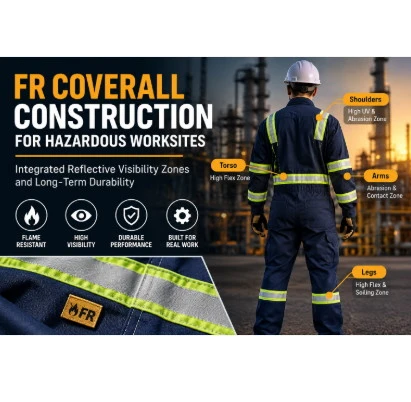

Fireproof coverall material selection should be based on the end-use hazard, wash program, abrasion level, comfort requirement and target compliance standard. 100% cotton FR fabric is often selected for breathable industrial workwear, while 88% cotton 12% nylon FR fabric is normally specified when buyers need higher tear strength, abrasion resistance and longer garment service life.
For oil, petrochemical, utility and industrial maintenance programs, fabric composition alone is not enough for approval. Buyers should confirm FR performance, anti-static requirement, fabric weight, shrinkage, seam strength, reflective trim type, closure system, labeling and bulk inspection criteria before releasing production.
Buyers comparing fabric structures can review this OEM fireproof coverall before confirming fabric weight, pocket layout, concealed zipper type, reflective trim position and size grading.
FR Fabric Architecture, Fiber Blend Ratio and End-Use Risk Mapping for 100% Cotton and 88% Cotton 12% Nylon Coveralls
100% Cotton FR Fabric for Breathability and Wearer Acceptance
100% cotton FR coverall fabric is commonly selected where comfort, breathability and moisture absorption are important. It is suitable for general industrial maintenance, oil and gas support teams, workshop use, utility crews and hot-climate workwear programs where workers wear the garment for long shifts.
The main procurement points are:
fabric weight, commonly specified in gsm or oz/yd²;
FR treatment or inherent FR mechanism;
shrinkage after repeated washing;
colorfastness after laundering;
seam strength after wear;
handfeel and breathability;
care-label accuracy;
compatibility with reflective trim, FR thread and closures.
100% cotton is comfortable, but it can shrink, fade and lose surface strength if the finishing, washing method or garment construction is not controlled. Buyers should not approve the garment only by handfeel or initial appearance.
88% Cotton 12% Nylon FR Fabric for Abrasion and Tear Resistance
88% cotton 12% nylon FR fabric is often used where the coverall will face higher abrasion, mechanical contact, repeated kneeling, climbing, crawling or tool-belt friction. The nylon content improves wear resistance and tear strength compared with standard cotton constructions, while the cotton portion maintains a more familiar workwear handfeel than synthetic-dominant fabrics.
This option is suitable for:
oilfield workwear;
petrochemical maintenance;
mining support;
mechanical repair;
utility work;
industrial engineering teams;
long-term replacement programs.
Where stronger FR workwear is required, buyers can compare an 88% cotton 12% nylon FR boiler suit against 100% cotton FR coverall options.
Fabric Selection Matrix for Industrial FR Coverall Programs
|
Evaluation Item |
100% Cotton FR Coverall |
88% Cotton 12% Nylon FR Coverall |
Buyer Decision Point |
|
Comfort |
Strong skin comfort and breathability |
Good comfort with higher structure |
Hot climate and long-shift use |
|
Abrasion resistance |
Moderate |
Higher due to nylon content |
Kneeling, crawling, mechanical work |
|
Tear strength |
Depends heavily on fabric weight |
Usually stronger at similar weight |
Oilfield, mining, maintenance |
|
Shrinkage control |
Requires close wash validation |
Usually more stable when properly finished |
Size chart and wash program |
|
Cost level |
Often lower at entry level |
Usually higher per garment |
Compare replacement cost |
|
Service life |
Shorter in heavy-abrasion use |
Longer in high-wear environments |
Total procurement cost |
|
Handfeel |
Softer cotton hand |
Slightly firmer structure |
Worker acceptance testing |
|
FR validation |
Must match target standard |
Must match target standard |
Do not assume from fiber ratio |
|
End-use fit |
General FR workwear |
Heavy-duty FR workwear |
Hazard and durability mapping |
Garment Construction Areas That Drive Fabric Choice
FR coveralls fail first at high-stress garment zones. The fabric choice should therefore be reviewed together with the coverall design.
|
Coverall Area |
Engineering Stress |
Material Selection Impact |
|
Shoulder seam |
Pulling during arm movement |
Requires stable seam strength |
|
Elbow area |
Repeated bending and abrasion |
88/12 may support longer wear |
|
Chest pockets |
Tool and document storage |
Needs bar-tack reinforcement |
|
Crotch seam |
Squatting and climbing stress |
Requires seam strength and fit allowance |
|
Knee area |
Kneeling and floor contact |
Abrasion resistance is important |
|
Sleeve opening |
Tool contact and washing stress |
Check edge wear and closure durability |
|
Front closure |
Repeated opening and contamination |
Concealed FR zipper or protected placket |
|
Reflective trim |
Washing and surface abrasion |
FR-rated tape and stitching control |
For coveralls using a concealed FR heavy-duty two-way brass zipper with protective placket, the zipper tape, teeth, puller, placket fabric and seam thread should be checked as part of the complete FR garment system.
Flame Resistance, Anti-Static Function, Shrinkage and Wash-Durability Test Matrix for FR Coverall Approval
FR Standard Selection Must Match the Hazard
The word "fireproof" should not be used as the only technical basis for a bulk order. Project buyers must specify the intended standard and hazard type before fabric sourcing.
Common FR workwear standard references may include:
EN ISO 11612 for heat and flame protective clothing;
NFPA 2112 for flash fire protective garments;
ASTM F1506 for flame-resistant clothing used by electrical workers;
IEC 61482 for arc flash protective clothing;
EN 1149 where anti-static properties are required.
A fabric that passes one test scope should not automatically be accepted for another hazard. The required standard depends on the workplace risk assessment, destination market, tender document and end-user safety policy.
Anti-Static Function for Oil and Petrochemical Workwear
Oil, gas, refinery and petrochemical environments may require anti-static performance in addition to flame resistance. Anti-static properties should be confirmed by test reports and garment construction, not only by fabric marketing language.
Procurement teams should confirm:
whether EN 1149 or another anti-static requirement applies;
whether the anti-static function is built into the fabric;
whether trims, zippers and labels are compatible with the requirement;
whether washing may reduce the anti-static performance;
whether the finished garment, not only fabric, requires validation.
For broader sourcing across FR workwear types, buyers can review the FR clothing product range by garment type, fabric composition, anti-static function and reflective trim requirement.
Wash Durability and Shrinkage Control
FR coverall approval should include washing and drying validation. Fit failure after laundering can create compliance and worker-acceptance problems even if the fabric passes initial flame tests.
|
Test / Check Item |
100% Cotton FR Risk |
88% Cotton 12% Nylon FR Risk |
Acceptance Evidence |
|
Dimensional shrinkage |
Higher shrinkage risk if finishing is weak |
Usually better stability when controlled |
Wash test and size chart update |
|
FR performance after wash |
Treatment durability must be confirmed |
FR system must match blend structure |
Post-wash FR report |
|
Tear strength |
May decline after repeated wear |
Typically stronger retention |
Tear-strength report |
|
Seam strength |
Cotton fabric stress at seam line |
Stronger base fabric but seam still critical |
Seam-strength test |
|
Colorfastness |
Fading or shade change |
Depends on dye and finish |
Colorfastness report |
|
Anti-static function |
May change after washing |
Must be validated after laundering |
Anti-static test report |
|
Reflective trim |
Edge lift or dull surface |
Same risk if tape is not FR-rated |
Trim wash inspection |
|
Zipper and placket |
Shrinkage mismatch |
Hardware weight and tape compatibility |
Post-wash garment review |
Reflective Trim Must Be FR-Compatible
Reflective trim on FR coveralls should not be ordinary reflective tape unless the end-use allows it and the risk assessment approves it. When the garment is specified for FR environments, reflective trim should be reviewed for flame resistance, wash durability, attachment method and placement.
When reflective trim is required on FR coveralls, the tape should be specified as <u><a href="https://www.asafetyproducts.com/reflective-material/fr-reflective-tape/flame-resistant-reflective-tape.html">flame resistant reflective tape</a></u>, not standard reflective tape sewn onto FR fabric.
Reflective trim also does not automatically make a coverall EN ISO 20471 compliant. High-visibility garment compliance depends on fluorescent background area, retroreflective area, tape placement, garment design and finished-garment certification.
FR Coverall Approval Test Matrix
|
Approval Area |
Required Check |
Production Control Point |
|
Fabric composition |
100% cotton or 88% cotton 12% nylon |
Match approved fabric lot |
|
FR performance |
Standard required by tender or buyer |
Test scope and report validity |
|
Anti-static function |
Required for petrochemical or refinery use |
Fabric and garment compatibility |
|
Shrinkage |
After defined wash cycles |
Pattern allowance and size grading |
|
Seam strength |
Main seam and stress-point testing |
Thread, stitch density, bar-tack |
|
Reflective trim |
FR rating, width, placement, wash resistance |
Tape lot and sewing alignment |
|
Closure |
Zipper, snap or button specification |
FR zipper and placket construction |
|
Labeling |
Care, size, FR warning and private label |
Correct content and placement |
|
Fit |
Full coverall movement test |
Shoulder, crotch, sleeve and inseam |
Request FR Coverall Material Review
Need to decide between 100% cotton and 88% cotton 12% nylon for an oil, petrochemical or utility coverall program? Send the fabric weight, target FR standard, anti-static requirement, wash cycle, reflective trim layout, zipper type, size chart and order quantity. We can review the specification before sample development and bulk quotation.
OEM Specification Control, Reflective Trim Layout and Bulk Production Acceptance Criteria for Industrial FR Coverall Programs
Production Specification Sheet
A production-ready FR coverall specification should define the full garment system, not only the fabric blend.
|
Specification Item |
Required Detail |
|
Garment type |
One-piece coverall, unisex or project-specific fit |
|
Fabric composition |
100% cotton / 88% cotton, 12% nylon |
|
Fabric weight |
gsm or oz/yd² |
|
FR standard |
EN ISO 11612, NFPA 2112, ASTM F1506, IEC 61482 or buyer standard |
|
Anti-static requirement |
EN 1149 or project-specific requirement |
|
Color |
Navy, orange, grey, green or project color |
|
Closure |
Concealed FR heavy-duty two-way brass zipper with protective placket |
|
Thread |
FR sewing thread or specified thread type |
|
Reflective trim |
FR reflective tape, width and placement |
|
Pocket layout |
Chest, side, rear, tool or cargo pockets |
|
Waist structure |
Elastic inserts or straight waist |
|
Labels |
Size, care, FR warning, private label |
|
Packing |
1 pc/polybag, size sticker, carton marking |
|
Sample approval |
Pre-production sample and signed golden sample |
Reflective Trim Layout and Garment Design Control
Reflective trim placement must support visibility without interfering with FR garment performance, pocket access, seam strength or worker movement.
Common trim positions include:
shoulder trim;
sleeve bands;
leg bands;
chest or back panels where specified;
combined trim layout for low-light industrial sites.
The buyer should confirm trim width, trim material, stitch line, edge distance, color, wash durability and whether the finished garment is intended only for added visibility or for a defined high-visibility class.
Bulk Production Acceptance Criteria
|
Inspection Stage |
Acceptance Item |
Key Risk |
|
Fabric inspection |
Composition, shade, defects, handfeel |
Wrong fabric lot |
|
Cutting |
Pattern direction and size allowance |
Shrinkage not considered |
|
Sewing |
Seam strength and stitch density |
Weak seam or skipped stitch |
|
Pocket assembly |
Symmetry and bar-tack position |
Tool-pocket failure |
|
Zipper installation |
Concealed FR two-way brass zipper |
Misalignment or poor placket cover |
|
Reflective trim |
Placement and secure stitching |
Poor alignment or non-FR trim |
|
Measurement |
Chest, waist, sleeve, inseam, length |
Fit failure after wash |
|
Labeling |
FR, care, size and private label |
Incorrect claim or market issue |
|
Packing |
Size ratio, carton mark, polybag |
Shipment and distribution error |
Cost and Replacement-Cycle Evaluation
The lower initial fabric cost is not always the lower procurement cost. Buyers should compare garment life, replacement rate, wash performance and field complaint risk.
|
Cost Factor |
100% Cotton FR |
88% Cotton 12% Nylon FR |
|
Initial unit cost |
Usually lower |
Usually higher |
|
Worker comfort |
Strong |
Good |
|
Abrasion life |
Moderate |
Higher |
|
Tear resistance |
Moderate |
Higher |
|
Replacement frequency |
May be higher in heavy-duty use |
May be lower in abrasive environments |
|
Best fit |
Hot climate, general FR workwear |
Oilfield, mining, maintenance, mechanical work |
For long-term industrial supply, 88/12 fabric may reduce replacement frequency where abrasion and tear damage drive garment failure. For short-cycle or hot-climate programs, 100% cotton FR fabric may remain the preferred option when comfort and budget are stronger drivers.
Traceability and Change Control
FR coverall programs should keep traceability focused on the approved garment system.
Required records include:
approved fabric swatch;
fabric composition report;
FR performance report;
anti-static report where required;
trim and zipper specification;
approved size chart;
signed golden sample;
care label content;
packing instruction;
batch inspection record.
Any change to fabric supplier, fiber blend, FR treatment, fabric weight, reflective trim, zipper, thread, pocket layout, size chart or production site should trigger buyer approval and renewed sample validation.
Procurement Decision Criteria for FR Coverall Material Selection
100% cotton FR fabric is normally suitable where wearer comfort, breathability and short-to-medium service life are the main priorities. 88% cotton 12% nylon FR fabric is more suitable where abrasion resistance, tear strength and longer replacement intervals are required.
A practical sourcing decision should follow this sequence:
define hazard type and target standard;
confirm fabric composition and weight;
define anti-static requirement;
choose closure, pocket and trim construction;
specify FR reflective tape if visibility trim is needed;
test shrinkage and wash durability;
approve a pre-production sample;
verify labels, packing and traceability;
release bulk production.
For FR coverall programs, material selection should be made before pattern grading and trim approval. Share the target standard, fabric weight, worksite risk, wash requirement and annual quantity so the garment construction can be reviewed before mass production.
FAQ
Is 88% cotton 12% nylon better than 100% cotton for fireproof coveralls?
It depends on the worksite. 88/12 fabric usually provides better abrasion and tear resistance, while 100% cotton offers stronger breathability and comfort. For oilfield, mining and maintenance work, 88/12 is often preferred for longer garment service life.
Does reflective trim make an FR coverall high-visibility compliant?
No. Reflective trim improves wearer recognition, but EN ISO 20471 compliance depends on certified garment design, fluorescent background area, retroreflective area and tape placement. If a high-visibility class is required, the complete coverall design must be evaluated.
What information should buyers send before requesting OEM FR coverall pricing?
Send fabric composition, fabric weight, target FR standard, anti-static requirement, size chart, color, closure type, pocket layout, reflective trim position, logo method, care label requirement, packing method and estimated order quantity. This reduces sampling errors and quotation revisions.