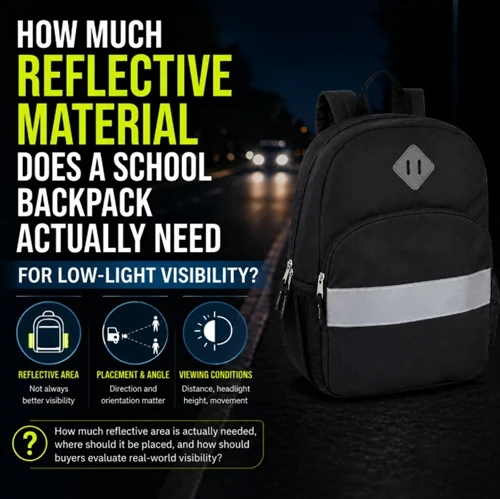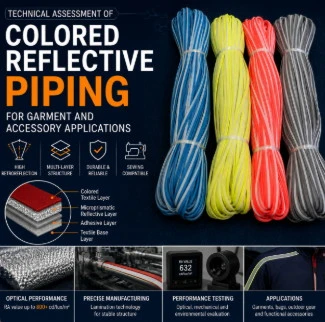
More reflective material does not automatically mean better visibility. For a school backpack, the useful result depends on how much reflective material is actually exposed to incident light, how efficiently that material returns light, where it is positioned, and how the backpack is oriented while the user is moving.
This means there is no technically defensible universal statement such as "20% reflective coverage is enough" for every school backpack. A better engineering approach evaluates four variables together: reflective performance × placement × viewing conditions × product geometry. Buyers should therefore specify effective reflective coverage rather than selecting material area only from a flat artwork drawing.
A reflective school backpack can contain a relatively large silver panel yet still provide limited return from some directions if the panel curves around the bag, becomes covered by the wearer, or faces away from the incoming headlight. Conversely, well-positioned reflective zones can provide useful directional recognition without covering most of the backpack surface.
Reflective Area and Retroreflective Performance Are Not the Same Measurement
Reflective area describes how much material is present, normally expressed in square centimetres or as a percentage of a defined exterior panel. Retroreflective performance describes how efficiently the material returns incident light toward its source. For retroreflective material, this optical performance is commonly expressed as the coefficient of retroreflection, RA, in cd/lux/m².
A buyer therefore needs at least two independent specifications: how much reflective material is exposed and what retroreflective performance that material must achieve under a defined test geometry.
For example, two backpacks may each contain 120 cm² of silver reflective material. If one material produces a substantially higher RA under the same observation and entrance angles, the two backpacks should not be assumed to provide equivalent optical response simply because their reflective areas are equal.
The opposite is also true. A material with a high laboratory RA value does not guarantee that a finished backpack will be equally conspicuous from every direction. A laboratory specimen is normally flat and positioned at controlled angles. A backpack is three-dimensional, flexible and moving.
| Parameter | What Is Measured | Typical Unit | Buyer Interpretation |
|---|---|---|---|
| Reflective area | Physical exposed retroreflective surface | cm² | Shows how much reflective material is available to receive light |
| RA | Returned light relative to incident illumination and area | cd/lux/m² | Indicates retroreflective efficiency under defined geometry |
| Observation angle | Angular separation between illumination and viewing axes | Degrees | Changes the measured retroreflective response |
| Entrance angle | Angle between incident light and the retroreflector axis | Degrees | Helps evaluate performance when material is not facing the light source directly |
| Effective exposed area | Reflective surface actually visible from a specified direction | cm² or % | More useful for finished-product layout evaluation than nominal material consumption alone |
As an example of how test geometry must be stated, retroreflective materials are often characterized at conditions such as a 0.2° observation angle and +5° entrance angle. A buyer may also establish an RA acceptance requirement such as 100, 200 or 330 cd/lux/m² according to the selected material and intended claim. These numbers should be treated as project specifications or requirements from an applicable material standard, not as universal school-backpack thresholds.
How Much Reflective Area Is Technically Useful on a School Backpack?
The more useful question is not "what percentage of the backpack should be reflective?" but "how much reflective material remains exposed from the directions relevant to the intended use?"
For development work, reflective coverage can be recorded in several ways. The simplest method measures the actual area of all reflective pieces in cm². A second calculation records reflective area as a percentage of the exterior panel. A more useful design review separates rear-facing, left-side, right-side and, where applicable, front-facing reflective areas.
For example, a project could evaluate prototype layouts using 50–100 cm², 100–200 cm² and more than 200 cm² of exposed reflective material. These are useful prototype bands for comparing layouts, not regulatory minimums. The purpose is to determine whether increasing area produces additional useful directional exposure or merely increases material consumption on surfaces that are already adequately represented.
A 180 cm² rear panel and three 60 cm² zones positioned across rear and side surfaces both total 180 cm², but their directional behavior can be very different. The first concentrates return toward observers behind the wearer. The second can provide a broader geometric distribution when the backpack is viewed while the user crosses or turns.
Buyers should therefore record both nominal material area and effective direction-specific area during sample approval.
Where Should Reflective Material Be Positioned for Useful Directional Visibility?
Rear-Facing Reflective Zones
The largest uninterrupted exterior panel on a conventional backpack normally faces rearward. This makes it a logical location for a major reflective zone when the intended scenario includes vehicles, bicycles or other road users approaching from behind.
Placement should account for pockets, zipper curves and the way the loaded backpack changes shape. A reflective panel that appears flat in a CAD drawing can become tilted once the main compartment is filled.
Side-Facing Reflective Zones
Side visibility becomes more relevant when a user crosses a road, walks through an intersection or rotates relative to approaching traffic. Adding reflective elements to side panels, edge zones or suitable piping can increase the probability that some retroreflective surface remains favorably oriented during these movements.
This principle is especially relevant when developing a backpack with reflective strip. Strip width alone does not define the result. The designer also needs to control strip direction, exposed length, angle relative to the panel and whether the strip remains visible when the bag is worn.
Shoulder-Strap and Front-Facing Details
Reflective material on shoulder straps can add forward-facing or oblique visibility, but its contribution must be evaluated on a wearer. Arms, clothing and strap rotation can cover a considerable portion of the nominal area.
For commuting or cycling-related designs, a reflective backpack cycling configuration may use several orientations rather than one large rear-only panel. This allows the layout to address changes in body direction and vehicle approach geometry.
| Reflective Layout | Main Visibility Direction | Engineering Advantage | Design Limitation |
|---|---|---|---|
| Large central rear panel | Rear | Large continuous exposed region under rear illumination | Limited side contribution and reduced branding space |
| Horizontal rear strips | Primarily rear | Simple sewing and dimensional inspection | May be interrupted by pockets or zipper construction |
| Rear plus side strips | Rear and lateral | Improves direction-specific coverage | Higher cutting and sewing complexity |
| Reflective piping | Multiple oblique directions | Can follow bag edges and contours | Narrow exposed area produces limited nominal surface |
| Combination layout | Rear, side and selected front angles | Balances large-area return with directional distribution | Requires more detailed tech-pack control |
Why Viewing Geometry Changes the Performance of a Reflective Backpack
Retroreflection works by returning a significant portion of incident light toward the direction from which it arrived. The relationship between the light source, the reflective surface and the observer therefore matters.
The entrance angle describes how obliquely light strikes the retroreflective surface. The observation angle represents the angular relationship between the light source axis and the observer. Changing either can alter measured RA.
A vehicle presents a practical example. Headlamps are below and separated from the driver's eyes. At greater distances, the angular separation is relatively small. As geometry changes, the optical condition changes as well. A flat laboratory specimen tested at one specified angle cannot represent every real backpack orientation.
Backpack movement adds another variable. Walking causes shoulder rotation, vertical displacement and intermittent changes in panel angle. Loading also changes the shape of soft 600D polyester panels. A reflective strip can therefore move through favorable and unfavorable orientations during normal use.
For this reason, RA should be treated as an important component-material parameter rather than a complete measurement of finished-backpack visibility.
Why More Reflective Area Is Not Always the Better Design
Increasing reflective coverage generally increases the amount of surface available to receive and return directional light, but the relationship is not infinitely useful. Additional material can reach diminishing practical value when it is positioned in the same viewing zone, obscured in use or oriented poorly.
Consider a design with a large central rear reflective panel. Adding another panel directly beside it can increase total area while doing little to improve lateral coverage. Moving part of the additional material toward the side panels may provide a more useful geometric change.
There are also product-development consequences. Large reflective fabric sections can alter surface appearance, reduce print or embroidery space and increase reflective material consumption. Some constructions can also change panel hand or stiffness. Sewn components add cutting and sewing operations, while heat-transfer designs introduce application temperature, pressure, dwell-time and adhesion-control requirements.
The objective is therefore not maximum nominal area. It is sufficient effective reflective exposure in the intended viewing directions.
Another option is to separate the visibility function from the backpack itself. For projects where users need substantially greater external reflective coverage only in certain conditions, a reflective safety waterproof backpack cover can provide a different design route. This allows the underlying backpack to retain its normal branding and material construction while the removable outer layer supplies additional exposed visibility area when required.
How Backpack Construction Changes Effective Reflective Coverage
A school backpack should be assessed as a three-dimensional sewn product. Flat-pattern area calculations are useful for material consumption, but they do not accurately predict every reflective surface that an observer can see after assembly.
On a typical 600D polyester backpack, panel stiffness depends not only on the 600 denier yarn designation but also on weave construction, coating or backing, lining, interfacing and internal loading. A full backpack can bow outward, while an empty backpack may collapse inward. Both conditions alter reflective orientation.
Seam position also matters. Sewing through a reflective strip consumes a small part of its nominal width and may distort the area near curved seams. Zippers, pockets and decorative overlays can interrupt what appeared to be a continuous reflective zone during material planning.
This is why Topmatched's development approach should evaluate reflective placement on the assembled sample rather than approving only a flat design drawing. The related product platform uses a 600D polyester shell and a large exterior reflective strip, making placement and finished-product orientation particularly relevant to sample review.
Different Integration Methods Produce Different Results
Sewn reflective tape provides clearly measurable width and position and can be suitable for straight or gently curved panel locations. Reflective fabric panels can create larger continuous zones. Reflective piping places narrow reflective material along structural edges. Heat-transfer reflective material can produce customized shapes but requires compatible fabric surfaces and controlled transfer conditions.
| Integration Method | Typical Design Use | Production Control Point | Visibility Consideration |
|---|---|---|---|
| Sewn reflective tape | Panel strips and geometric layouts | Width, stitch position and alignment | Good control of exposed strip dimensions |
| Reflective fabric panel | Large continuous reflective zones | Pattern dimensions and seam allowance | Provides larger nominal area |
| Reflective piping | Edges and contour lines | Piping exposure and seam consistency | Small area but useful directional distribution |
| Heat-transfer reflective material | Logos, shapes and engineered patterns | Temperature, pressure, dwell time and adhesion | Flexible layout with substrate-dependent durability |
The same principle applies beyond school backpacks. Products such as a reflective handbag may use reflective fabric or localized reflective components differently because panel orientation, carrying height and intended viewing directions differ from a two-strap backpack.
How Should Buyers Test Reflective Performance Before Bulk Production?
Professional evaluation should separate component verification from finished-product inspection.
Verify the Reflective Material First
If quantified retroreflective performance is required, the buyer should define RA, the test method and the test geometry. A requirement such as "high reflective silver tape" is insufficient for a controlled OEM program.
One possible specification format is "initial RA ≥330 cd/lux/m² at 0.2° observation and +5° entrance angle," but that number should only be used when it matches the selected material, applicable specification and project requirement. Lower or different targets may be appropriate for other material categories. What matters is that the acceptance condition is measurable and agreed before sampling.
Measure the Finished Reflective Area
Reflective strip width can be checked in millimetres, while exposed area can be calculated in cm² from the approved finished sample. Buyers should define whether seam allowance is excluded and whether reflective zones obscured by other components count toward the specified area.
Inspect Multiple Viewing Directions
A low-light sample review can be structured rather than relying on an informal mobile-phone photograph. Position the completed backpack consistently, illuminate it from defined directions, and compare rear, left-side, right-side and selected oblique views against the approved reference sample.
Condition the Reflective Component When Durability Matters
Abrasion, flexing and surface contamination can reduce optical performance. The required conditioning should reflect the product claim and expected use. A component specification might require RA measurement before and after a defined abrasion or flexing procedure. The acceptance threshold should be agreed rather than described simply as "still reflective."
| Parameter | Measurement Method | Unit / Example Condition | Buyer Interpretation |
|---|---|---|---|
| Initial RA | Retroreflectometer or defined laboratory method | cd/lux/m²; e.g. 0.2° observation, +5° entrance | Verifies optical performance of selected material under controlled geometry |
| Reflective strip width | Dimensional inspection | mm | Controls both appearance and nominal reflective area |
| Exposed reflective area | Pattern or finished-product area calculation | cm² | Quantifies actual available surface rather than vague "large strip" wording |
| Placement tolerance | Measurement against approved drawing | mm | Controls consistency between production units |
| Post-conditioning RA | RA measurement after defined conditioning | cd/lux/m² | Shows whether optical performance is retained after the specified durability exposure |
| Directional visual check | Controlled illumination of assembled sample | Rear / left / right / oblique views | Identifies obstruction and orientation problems not visible in flat material testing |
Do EN ISO 20471, EN 17353 or Other Visibility Standards Define the Answer?
Standards must be applied according to their stated scope rather than used as generic reflective-product marketing labels.
EN ISO 20471 is associated with high-visibility clothing for high-risk situations. A conventional school backpack is not automatically high-visibility clothing simply because reflective tape is sewn onto it.
EN 17353 addresses enhanced-visibility equipment for medium-risk situations and contains requirements concerning visibility materials and their placement for products within its scope. It should still not be assumed that every reflective school backpack automatically complies. The specific product configuration, intended claim, classification and applicable conformity requirements need to be reviewed.
EN 13356 historically addressed visibility accessories for non-professional use, but buyers working on current European specifications should verify the current EN 17353 framework rather than continuing to cite an older standard without checking its status.
The practical distinction is important: a test report for one roll of reflective material demonstrates defined properties of that component. It does not automatically certify the construction, reflective area or visibility performance of the finished backpack.
How Should Reflective Area Be Balanced Against Branding, Construction and Cost?
Reflective material consumes physical panel space. On school and promotional backpack projects, this space may compete with school emblems, campaign graphics, screen-printed logos or heat-transfer artwork.
Instead of treating this as a simple conflict between safety and branding, the layout can be engineered by zone. A large logo may occupy the central upper panel while reflective strips are positioned lower and toward lateral zones. Another design may use a central reflective shape as part of the visual identity itself.
Material consumption also influences unit cost. A larger panel requires more reflective material per unit and may reduce cutting efficiency. Complex segmented layouts can add sewing operations. Heat-transfer graphics require separate application control and may increase rejection risk if adhesion is inconsistent.
Cost analysis therefore needs to ask whether each additional reflective zone creates a new visibility direction or measurable functional contribution. If it simply enlarges an already large rear-facing region, the additional material may have less value than relocating part of the area to the side.
What Should Buyers Put in a Reflective Backpack Tech Pack?
"Add reflective tape to front panel" leaves too much room for interpretation. A repeatable OEM specification should convert the visual concept into measurable production requirements.
| Specification Item | What Buyer Should Define | Production Risk If Undefined |
|---|---|---|
| Reflective material type | Tape, fabric, piping or heat-transfer construction | Different materials may produce different appearance, durability and RA |
| Optical requirement | RA target and defined measurement geometry where required | Visual description cannot control optical consistency |
| Reflective color | Approved color and reference sample | Batch appearance may vary |
| Width | Finished exposed width in mm | Reflective area and appearance can drift |
| Total area | Specified exposed area in cm² where relevant | Material quantity may meet artwork but not functional objective |
| Placement | Dimensioned drawing referenced to seams or panel edges | Direction-specific visibility changes between units |
| Placement tolerance | Buyer-approved dimensional tolerance | Production alignment becomes subjective |
| Attachment | Stitching, piping construction or transfer parameters | Detachment, distortion or inconsistent exposure |
| Inspection | Measurement and visual evaluation procedure | Factory and buyer may apply different acceptance criteria |
The pre-production sample should then become the physical reference for placement, exposed width, symmetry, optical appearance, logo relationship and workmanship. For repeat orders, this gives QC teams a more reliable benchmark than written descriptions alone.
A Practical Selection Framework for Reflective School Backpack Development
Reflective layout should begin with the application environment rather than with a fixed percentage.
| Application | Main Visibility Requirement | Suggested Design Priority | Verification Focus |
|---|---|---|---|
| Daily school commute | Repeated rear and lateral exposure | Substantial rear zone plus useful side coverage | Rear/side sample visibility and attachment durability |
| Urban walking | Changing traffic directions | Distributed multi-directional reflective zones | Oblique and side viewing evaluation |
| Promotional school program | Visibility plus clear branding | Defined reflective zones around protected logo area | Artwork-to-reflective placement tolerance |
| Cycling-related use | Greater movement and changing orientation | Rear, side and edge distribution | Evaluation on worn and loaded backpack |
The engineering sequence is straightforward: define the application environment, determine relevant viewing directions, specify the required reflective material performance, allocate reflective zones, calculate effective exposed area, and then verify the assembled sample.
This process gives buyers a stronger specification than selecting a reflective percentage first and trying to make the product fit that number later.
So, How Much Reflective Material Does a School Backpack Actually Need?
There is no universal reflective percentage that can be applied to every school backpack. The technically useful amount is the area required to create adequate exposed retroreflective zones in the intended viewing directions when combined with a defined material performance level.
A buyer should therefore avoid specifications based only on "large reflective area" or "X% reflective material." Instead, define RA where quantified optical performance is needed, measure exposed area in cm², separate rear and side coverage, control placement dimensions, and inspect the complete loaded backpack under defined low-light conditions.
Strategic placement is usually more meaningful than increasing total area without considering geometry. A balanced design can use a major rear reflective zone for recognition from behind, smaller lateral elements for changing viewing directions, and carefully selected front or shoulder details where they remain exposed during use.
Does more reflective material always improve school backpack visibility?
No. Increasing exposed area can improve the amount of surface available to return light, but only when that material is positioned and oriented usefully. An additional 50 cm² hidden around a curved side panel may contribute less from the rear than a smaller zone facing the observer directly. Area, RA, entrance angle and finished-product geometry should be evaluated together.
How should buyers measure reflective area on a backpack?
Measure the finished exposed reflective surfaces in cm² and separate the result by viewing direction where practical. The calculation should state whether stitched edges, hidden seam allowance and partially covered sections are excluded. For repeat production, use a dimensioned tech-pack drawing plus an approved assembled sample so QC can verify both reflective quantity and placement.
Is RA more important than reflective surface area?
Neither parameter should be used alone. RA describes returned-light efficiency under a defined optical geometry, while area describes the amount of exposed material. For example, a buyer might specify RA at a 0.2° observation angle and +5° entrance angle, then separately define the required cm² and location. Finished visibility depends on both parameters plus orientation.
Where should reflective strips be positioned on a school backpack?
A rear-facing zone generally addresses observers approaching from behind, while lateral strips or piping can support visibility as the wearer crosses or turns. Shoulder-strap elements may provide additional forward or oblique exposure but can be covered by arms or clothing. Buyers should assess rear, side and oblique views on the assembled, worn backpack rather than relying only on flat artwork.
How should reflective performance be inspected before bulk production?
Begin with a defined reflective material specification, including RA and measurement geometry when quantified performance is required. Then verify strip width, cm² of exposed area, placement tolerance and attachment on the finished sample. After agreed abrasion or flex conditioning, optical retention can also be measured. A controlled directional low-light review helps identify obstruction and orientation problems before production approval.
Need to define reflective coverage for a school backpack project? Submit the intended application, reflective material requirement, layout drawing and target performance for specification review, OEM development, sample verification and bulk production planning.
Submit Reflective Backpack Specifications