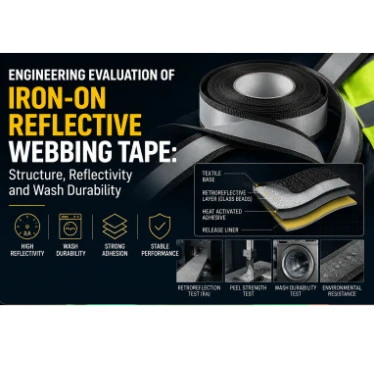
Iron-on reflective webbing tape combines a textile reinforcement layer with a retroreflective optical surface and heat-activated adhesive system. The engineering challenge is maintaining stable reflectivity, bonding strength, and mechanical performance after repeated washing, abrasion, and environmental exposure. For PPE manufacturers and sourcing teams, evaluation should include reflective coefficient testing, adhesion strength measurement, textile durability analysis, and production consistency verification before bulk manufacturing.
Unlike traditional sewn reflective tape, iron-on reflective webbing tape integrates a heat transfer bonding structure that allows reflective elements to be applied onto garments, bags, and safety accessories without additional stitching. Buyers should evaluate the complete structure, including reflective layer design, adhesive performance, textile strength, and compliance requirements for the final application.
Explore Reflective Webbing Solutions
Reflective Webbing Tape Material Structure and Functional Layer Design
Iron-on reflective webbing tape is a multi-layer composite material designed to combine mechanical reinforcement with optical visibility performance. The final performance depends on how each layer interacts during manufacturing and end-use conditions.
A typical structure consists of a carrier textile layer, reflective optical layer, protective coating, and heat-activated adhesive backing. Each layer has a specific function and influences durability, flexibility, and application compatibility.
| Layer Structure | Typical Material | Function | Engineering Evaluation |
|---|---|---|---|
| Base Webbing Layer | Polyester or nylon webbing | Provides tensile strength and dimensional stability | Measured by tensile strength (N), elongation (%) and abrasion resistance |
| Reflective Optical Layer | Glass bead or microprismatic structure | Returns incident light toward the source | Evaluated by coefficient of retroreflection RA (cd/lux/m²) |
| Protective Film | PU or polymer protective coating | Protects optical elements from abrasion and moisture | Evaluated through abrasion and weathering tests |
| Heat Activated Adhesive | Thermoplastic adhesive film | Bonds reflective webbing to textile surfaces | Measured by peel strength (N/16mm or N/cm) |
Fiber Structure and Mechanical Performance
Polyester webbing is commonly selected because polyester fibers provide good dimensional stability, low moisture absorption, and resistance to stretching. Nylon webbing can provide higher flexibility and impact resistance but may absorb more moisture under humid conditions.
| Webbing Material | Fiber Characteristics | Typical Tensile Range | Application Consideration |
|---|---|---|---|
| Polyester Webbing | Low moisture absorption, stable molecular structure | 300-1500 N depending on width and thickness | Suitable for safety apparel and accessories requiring dimensional stability |
| Nylon Webbing | Higher flexibility and impact absorption | 400-1800 N depending on construction | Suitable for dynamic applications requiring flexibility |
For PPE applications, buyers should evaluate whether the webbing structure maintains mechanical strength after heat transfer processing, because excessive bonding temperature may influence textile properties.
Reflective Heat Transfer Film Structure and Optical Performance Evaluation
The reflective heat transfer film layer determines the visibility performance of iron-on reflective webbing tape. Optical structures commonly include glass bead technology or microprismatic technology, each using different light-return mechanisms.
Glass Bead and Microprismatic Reflective Structures
| Reflective Technology | Structure | Typical RA Performance | Application Characteristics |
|---|---|---|---|
| Glass Bead Reflective Layer | Transparent beads embedded in polymer resin | 100-330 cd/lux/m² typical range | Flexible, cost-effective, commonly used for general visibility products |
| Microprismatic Reflective Layer | Precision molded microprism optical cells | 330-800+ cd/lux/m² depending on specification | Higher brightness and long-distance visibility performance |
Optical Performance Factors
Retroreflection performance depends on prism geometry, optical surface quality, viewing angle, entrance angle, and protective layer transparency. A higher RA value indicates stronger light return under standardized testing conditions.
For safety apparel applications, buyers commonly evaluate reflective materials according to EN ISO 20471 or ANSI/ISEA 107 requirements. These standards define minimum visibility performance requirements for high visibility clothing components.
For projects requiring customized reflective components, buyers can evaluate different reflective heat transfer film structures based on garment material, application environment, and durability expectations.
Retroreflection Performance Testing and Reflective Coefficient Evaluation
Retroreflection testing measures how effectively a reflective material returns incident light back toward the original light source. For iron-on reflective webbing tape, this performance directly affects nighttime visibility when illuminated by vehicle headlights or industrial lighting systems.
The primary measurement parameter is the coefficient of retroreflection (RA), expressed in cd/lux/m². The value represents the luminous intensity returned by the reflective surface under standardized observation and entrance angle conditions.
Retroreflection Test Method and Evaluation Parameters
| Test Parameter | Testing Method | Measurement Unit | Engineering Meaning |
|---|---|---|---|
| Coefficient of Retroreflection (RA) | Photometric measurement under controlled entrance and observation angles | cd/lux/m² | Measures returned light intensity from reflective surface |
| Initial Reflectivity | New material optical testing | cd/lux/m² | Evaluates original reflective performance |
| Reflective Retention | Before and after environmental testing comparison | % retention | Shows performance stability after aging, washing, or abrasion |
Reference Reflective Performance Range
| Reflective Material Category | Typical RA Range | Application Reference |
|---|---|---|
| General Reflective Material | 100-330 cd/lux/m² | Consumer visibility accessories and general safety applications |
| High Performance Reflective Material | 330-500 cd/lux/m² | Professional safety apparel and industrial PPE |
| Premium Microprismatic Reflective Material | 500+ cd/lux/m² | High-risk visibility applications requiring extended detection distance |
When evaluating reflective webbing tape, buyers should not only compare initial RA values. A material with high initial reflectivity but poor durability may lose performance after washing, abrasion, or UV exposure.
Common Reflective Performance Failure Mechanisms
Optical Layer Damage: Abrasion or chemical exposure can damage glass beads or microprismatic structures, reducing light return efficiency.
Surface Contamination: Dust, oil, or coating residue can reduce optical efficiency by blocking reflective elements.
Protective Layer Degradation: UV exposure and repeated washing may reduce transparency and lower RA performance.
For PPE applications, reflective performance should be evaluated together with garment standards such as reflective tape requirements used in high visibility workwear systems.
Heat Transfer Bonding Process and Adhesion Performance Analysis
The bonding process determines whether iron-on reflective webbing tape remains securely attached to textile substrates during washing, stretching, and mechanical stress. Adhesive selection, activation temperature, pressure, and bonding time directly influence final adhesion strength.
Heat Transfer Bonding Parameters
| Parameter | Typical Range | Impact on Performance |
|---|---|---|
| Activation Temperature | 120-180°C | Controls adhesive melting and surface penetration |
| Bonding Pressure | 0.2-0.5 MPa typical range | Influences adhesive contact area |
| Bonding Time | 10-30 seconds | Affects adhesive activation and final strength |
| Peel Strength | Common evaluation range: 5-15 N/16mm | Indicates resistance against delamination |
Adhesion Failure Analysis
| Failure Cause | Performance Impact | Prevention Method |
|---|---|---|
| Insufficient Heat Activation | Weak bonding and edge lifting | Verify temperature, pressure, and bonding time |
| Fabric Surface Contamination | Reduced adhesive contact area | Clean substrate before application |
| Incorrect Adhesive Compatibility | Delamination after washing | Select adhesive according to textile composition |
| Excessive Heat Exposure | Fabric deformation or adhesive degradation | Validate bonding temperature through testing |
For polyester, nylon, and coated fabrics, adhesive chemistry must be matched with substrate surface energy. Incorrect matching can cause early failure even when reflective performance meets specification.
Wash Durability and Environmental Resistance Testing
Wash durability is one of the most important evaluation factors for iron-on reflective webbing tape used in safety apparel. Repeated laundering can affect reflective brightness, adhesive bonding, and textile structure.
Professional buyers commonly evaluate performance after 25, 50, or 75 washing cycles depending on product application and service requirements.
Washing Performance Evaluation
| Test Item | Standard / Method | Testing Condition | Evaluation Criteria |
|---|---|---|---|
| Reflective Retention | ISO 6330 washing simulation | 25-75 washing cycles | Maintain required percentage of original RA value |
| Adhesion Retention | Peel strength comparison | Before and after washing | No significant delamination or edge lifting |
| Appearance Stability | Visual inspection | After repeated laundering | No cracking, peeling, or surface damage |
Environmental Resistance Factors
Reflective webbing tape used outdoors may experience UV exposure, humidity, temperature changes, and abrasion. These conditions can gradually reduce optical and mechanical performance.
UV Exposure: Polymer degradation may reduce flexibility and reflective layer stability.
Moisture Exposure: Poor adhesive systems may absorb moisture and weaken bonding.
Low Temperature: Some polymer layers may become less flexible below freezing conditions.
Abrasion: Surface wear can damage optical structures and reduce RA values.
Mechanical Performance Evaluation: Tensile Strength, Flexibility and Wear Resistance
Mechanical performance determines whether iron-on reflective webbing tape can maintain functional integrity during repeated bending, stretching, handling, and outdoor exposure. Unlike reflective films applied on flat surfaces, reflective webbing must combine optical performance with textile reinforcement properties.
For PPE manufacturers and industrial buyers, mechanical evaluation should include tensile strength, elongation, flexibility retention, abrasion resistance, and dimensional stability. These parameters indicate whether the reflective component can withstand real working conditions.
Tensile Strength and Elongation Evaluation
Tensile testing measures the maximum force a webbing structure can withstand before breaking. The test is commonly performed according to textile tensile standards such as ISO 13934 or ASTM D5034 depending on the material category and laboratory procedure.
| Performance Parameter | Test Method | Typical Engineering Range | Buyer Evaluation Purpose |
|---|---|---|---|
| Tensile Strength | ISO 13934 / ASTM D5034 | 300-1800 N depending on width and construction | Evaluates load resistance of webbing structure |
| Elongation at Break | Tensile extension measurement | 10%-30% typical range | Indicates flexibility and deformation behavior |
| Thickness Tolerance | Thickness measurement | ±5%-10% depending on specification | Controls application consistency |
| Dimensional Stability | Heat and moisture exposure testing | Low shrinkage after conditioning | Prevents size variation during production |
Flexibility and Bending Resistance
Reflective webbing tape used on garments and accessories must maintain flexibility because workers frequently bend, stretch, and move during operation. Excessive stiffness can reduce comfort and create stress concentration points around seams and attachment areas.
Flexibility evaluation normally includes repeated bending tests, surface observation, and reflective performance comparison before and after mechanical stress.
Abrasion Resistance and Wear Performance
| Test Item | Testing Method | Measured Result | Failure Risk |
|---|---|---|---|
| Abrasion Resistance | Martindale or rotary abrasion testing | Cycles until visible damage | Loss of reflective layer or surface cracking |
| Flex Crack Resistance | Repeated bending evaluation | Number of bending cycles | Reflective layer fracture |
| Surface Wear | Visual and optical inspection | RA value change after abrasion | Reduced nighttime visibility |
Mechanical Failure Mechanisms
Webbing Fiber Breakage: Excessive loading or insufficient tensile strength may cause yarn damage and reduce structural reliability.
Reflective Layer Cracking: Repeated bending stress may damage the optical layer and reduce retroreflection performance.
Edge Fraying: Poor cutting or insufficient edge treatment may cause dimensional instability during use.
Adhesive Fatigue: Repeated deformation can weaken the bonding interface between reflective film and textile substrate.
When selecting reflective webbing tape for industrial applications, buyers should evaluate mechanical properties together with optical performance because a reflective component must remain visible throughout its expected service life.
OEM Customization Requirements for Reflective Webbing Production
OEM reflective webbing development requires coordination between material selection, optical performance targets, textile construction, adhesive compatibility, and production quality control. Professional buyers usually evaluate suppliers based on engineering capability rather than only product appearance.
Key OEM Specification Parameters
| Customization Item | Available Options | Engineering Consideration |
|---|---|---|
| Webbing Base Material | Polyester, nylon, customized textile structures | Determines tensile strength, flexibility, and durability |
| Reflective Technology | Glass bead, microprismatic, customized optical layer | Controls RA performance and visibility distance |
| Width Selection | 10mm, 15mm, 20mm, 25mm, 50mm and customized sizes | Affects application method and visibility area |
| Backing Adhesive | Heat transfer adhesive systems | Must match garment fabric composition |
| Color Options | Silver, fluorescent combinations, custom colors | Requires color consistency evaluation |
OEM Development and Production Validation
A reliable OEM process normally includes specification confirmation, material testing, prototype evaluation, pilot production, and bulk quality inspection.
- Technical specification review including width, material structure, reflective target, and application method.
- Laboratory testing of reflective performance, adhesion strength, and mechanical properties.
- Prototype validation on the final substrate such as polyester fabric, nylon fabric, or coated textile.
- Mass production inspection to maintain batch-to-batch consistency.
For customized reflective components, buyers can evaluate reflective materials according to required optical performance, textile compatibility, and production volume.
Production Quality Control Considerations
| Quality Control Stage | Inspection Focus | Reference Parameter |
|---|---|---|
| Raw Material Inspection | Film, adhesive, and webbing consistency | Thickness, appearance, material specification |
| Production Process Control | Heat transfer temperature and pressure | Bonding parameter verification |
| Finished Product Testing | Reflectivity and mechanical performance | RA value, peel strength, tensile strength |
| Batch Inspection | Production consistency | Color, dimension, optical performance comparison |
Technical Evaluation Support for Reflective Webbing Tape Projects
Topmatched provides OEM development and bulk production support for reflective webbing tape, reflective textile components, and customized visibility products. Our engineering process covers material selection, optical performance evaluation, heat transfer compatibility testing, and production quality control.
Buyers can submit technical specifications including webbing width, target RA performance, application fabric, washing requirements, and production quantity for evaluation. Our team can review suitable reflective structures and recommend production solutions based on application requirements.
Frequently Asked Questions
How should buyers evaluate reflective webbing tape performance before bulk production?
Buyers should evaluate RA value, adhesion strength, tensile performance, and washing durability before approval. Typical evaluation includes retroreflection testing in cd/lux/m², peel strength testing in N/16mm, and performance comparison after 25-75 washing cycles.
What causes iron-on reflective webbing tape to peel after garment washing?
Peeling usually results from incorrect adhesive selection, insufficient heat activation, contaminated textile surfaces, or unsuitable bonding parameters. Buyers should validate temperature, pressure, and peel strength performance using the final garment fabric before mass production.
Which reflective webbing structure is suitable for high visibility safety apparel?
Selection depends on visibility requirements, washing conditions, and application environment. Microprismatic structures commonly provide RA values above 330 cd/lux/m², while glass bead systems may be selected for flexible and cost-controlled safety apparel applications.