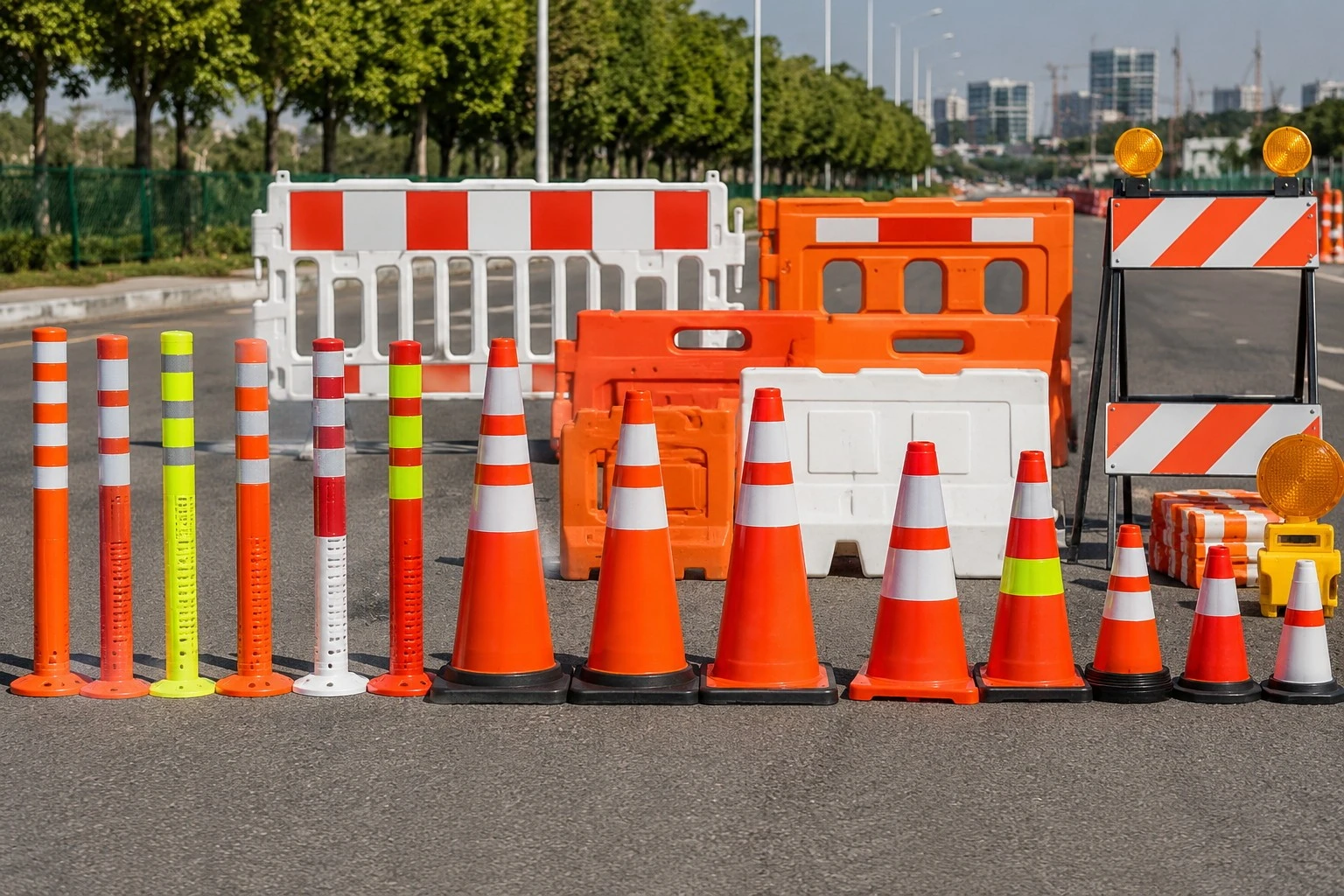
Traffic safety facilities are temporary or semi-permanent channelizing devices used to separate vehicles, workers, pedestrians, and work zones. For B2B procurement, the buying decision should be based on polymer impact resistance, UV aging performance, reflective sleeve grade, base stability, nesting ratio, and MUTCD / EN / local highway authority requirements.
For distributors and project buyers, cones, bollards, delineators, barricades, and road barriers are not single-SKU commodity items. The correct specification depends on road speed, lane closure geometry, night visibility distance, wind load, storage density, and replacement cycle.
1. Traffic Facilities Procurement Scope for Road Safety Equipment Buyers
Traffic facilities procurement normally covers cone-type channelizers, vertical panels, bollards, barricades, warning posts, water-filled barriers, and portable delineation systems. For international sourcing, the procurement file should define material, height, base weight, reflective sheeting, packing density, test method, logo printing, and container loading plan before price comparison.
| Product Type | Common Height / Size | Main Material | Typical Use Case | Procurement Risk |
| Traffic cone | 300 mm, 450 mm, 700 mm, 900 mm | PVC, PE, EVA, rubber base | Roadworks, parking, construction access | Low-grade plastic cracking under UV or cold impact |
| Flexible bollard | 750–1,200 mm | PU, TPU, PE, PVC | Lane separation, parking guidance, bike lane protection | Poor rebound after repeated vehicle contact |
| Type I / II barricade | Rail width often 200–300 mm | PE panel, steel frame, PP board | Sidewalk work zone, utility maintenance | Insufficient ballast or low reflective area |
| Type III barricade | Large multi-rail barricade | PE board, metal legs, reflective sheeting | Road closure, detour entrance, lane blocking | Weak frame welding or poor night visibility |
| Water-filled barrier | 1,000–2,000 mm modular sections | HDPE / PE | Temporary traffic separation | Leakage, unstable interlocking, poor stackability |
For sourcing teams building a supplier list, group cones, barricades, bollards, reflective panels, and work-zone devices under Traffic Facilities to simplify RFQ comparison, inspection files, and container consolidation.
Request Bulk Pricing for Traffic Safety Facilities
Source traffic cones, bollards, barricades, and reflective road safety equipment with OEM logo printing, custom colors, export packing, and mixed-container shipment options.
2. PVC vs PE Traffic Cones: Impact Resistance, UV Aging, and Cold-Weather Behavior
PVC and PE traffic cones look similar in product photos, but they behave differently under wheel contact, low temperature, and long-term outdoor exposure. PVC is heavier and more flexible at normal temperatures. PE has better chemical stability and lower material odor, but thin-wall PE cones may deform or whiten after repeated impact if wall thickness is reduced to cut cost.
| Parameter | PVC Traffic Cone | PE Traffic Cone | Buyer Specification Note |
| Typical structure | Soft PVC body, black base or integrated base | Blow-molded or injection-molded PE body | Confirm one-piece or two-piece construction |
| Impact recovery | Good rebound at 20°C when wall thickness is controlled | Good shape stability, less rubber-like flexibility | Test by vehicle pass-over or drop impact |
| Cold resistance | May harden below 0°C depending on plasticizer | Better low-temperature stability in many grades | Ask for -10°C or -20°C bend / impact test if used in winter regions |
| UV aging risk | Color fading and brittleness if UV stabilizer is low | Better weatherability with UV package | Require UV-resistant orange pigment and aging test record |
| Weight range | 700 mm cone often 2.5–4.5 kg depending on base | 700 mm cone often 1.8–3.5 kg depending on design | Weight affects wind stability and freight cost |
| Odor / VOC concern | Low-grade PVC may have plasticizer odor | Usually lower odor | Important for indoor warehouse or retail packing |
| Cost position | Usually competitive for heavy-duty road cones | Competitive for light to medium duty | Compare by weight, not only by unit price |
2.1 PVC Cone Buying Specification: 700 mm / 900 mm with Weighted Base
For highway contractors and rental fleets, PVC cones should be specified by height, total weight, base dimension, body thickness, reflective collar width, and rebound test. A 700 mm cone with a 4.0–4.5 kg weighted base is different from a 700 mm cone at 2.2 kg, even when the visual design is similar.
Key procurement points:
· Height tolerance: 700 mm or 900 mm, with ±10 mm production tolerance stated in the PO.
· Base weight: specify net cone weight, not only "heavy duty."
· Color: fluorescent orange or red-orange with UV-stabilized pigment.
· Reflective sleeve: PVC film, glass bead sheeting, or micro-prismatic sheeting.
· Packing: nested cone stack height and pallet loading plan for 20GP / 40HQ containers.
2.2 PE Cone Buying Specification: Light-Duty and Medium-Duty Use
PE cones are often selected for parking lots, warehouse traffic control, events, schools, and low-speed construction areas. For PE cones used outdoors longer than 6 months, the procurement file should require UV-stabilized material and outdoor aging samples, not only catalog photos.
| Application | Suggested Cone Type | Height | Weight Focus | Sleeve Requirement |
| Warehouse aisle | PE or PVC | 300–450 mm | Light, easy relocation | Optional reflective band |
| Parking control | PE / PVC | 450–700 mm | Medium base stability | 1 reflective band recommended |
| Urban roadworks | PVC heavy-duty | 700 mm | Wind and vehicle-contact resistance | 1–2 reflective collars |
| Highway work zone | Heavy PVC or rubber-base cone | 900 mm | Higher base weight | High-intensity or micro-prismatic sleeve |
3. Reflective Cone Sleeves: Micro-Prismatic Layer and Retroreflection Requirements
Reflective sleeves determine whether the cone remains visible during night work, rain, low-beam headlight approach, and curved road alignment. The sleeve should not be treated as decoration. It is a functional optical component with retroreflective performance, adhesion strength, weathering resistance, and wash durability requirements.
| Reflective Sleeve Type | Optical Structure | Typical Performance Position | Suitable Procurement Use |
| PVC reflective film | Reflective surface laminated on flexible PVC | Basic visibility | Indoor, parking, low-speed areas |
| Glass bead reflective sheeting | Embedded glass bead retroreflection | Medium-grade visibility | General roadworks and utility sites |
| Micro-prismatic reflective sheeting | Prism cube-corner optical structure | Higher brightness at longer viewing distance | Highway, night construction, high-speed zones |
| Fluorescent reflective sheeting | High daytime conspicuity plus night reflection | Better daytime recognition | Urban work zones, emergency access, temporary lane shift |
3.1 Micro-Prismatic Cone Sleeve Specification: Adhesion, Angle, and Weathering
Micro-prismatic reflective tape uses engineered prism geometry to return headlamp light toward the driver. For cone sleeves, the buyer should confirm sheeting type, reflective area, collar width, bonding method, edge sealing, and outdoor durability.
| Test Item | Suggested RFQ Requirement | Why It Matters |
| Retroreflection | Supplier to declare sheeting grade and test method, such as ASTM D4956 or local road authority equivalent | Prevents low-brightness film substitution |
| Sleeve width | Common 100 mm + 150 mm for 900 mm cones, or project-specific size | Affects visible reflective area |
| Adhesion | Peel resistance after 24 h bonding and heat aging | Reduces sleeve lifting during storage |
| Weathering | UV aging and rain exposure sample check | Controls fading, cracking, and delamination |
| Edge sealing | Required for long outdoor use or wet regions | Prevents moisture ingress at sleeve edge |
| Packing protection | Avoid sleeve abrasion during nesting | Reduces scuffing before installation |
3.2 Reflective Sleeve Failure Modes in Bulk Orders
The most common failures are not visible during pre-shipment photo inspection. They appear after storage, heat exposure, or field use.
| Failure Mode | Likely Cause | Inspection Method |
| Sleeve edge lifting | Low adhesive tack, dusty cone surface, poor lamination pressure | Manual peel test after heat conditioning |
| Reflective surface dullness | Low-grade film or abrasion during stacking | Night beam comparison sample |
| Cracking at cone curvature | Film too rigid or poor cold flexibility | Bend test at low temperature |
| Color fading | Non-UV-stabilized film or pigment | Accelerated aging sample review |
| Sleeve misalignment | Manual application without positioning jig | AQL visual inspection by angle and height |
4. Standardized Work-Zone Layout for High-Speed Road Construction
Highway work-zone layout is not only a product issue. It is a spacing, taper, warning, and channelization system. OSHA construction rules reference traffic control devices including signs, signals, markings, barricades, and other devices used for worker protection, and U.S. work-zone design is commonly aligned with MUTCD Part 6 requirements.
For B2B buyers, product procurement should match the traffic control plan. Cone height, barricade size, reflective grade, spacing, taper length, arrow board use, and temporary barrier selection must be defined before ordering.
| Work-Zone Area | Function | Common Devices | Procurement Control Point |
| Advance warning area | Warn drivers before lane shift or closure | Warning signs, arrow board, cones | Sign size, reflectivity, stand stability |
| Transition area | Move traffic out of normal path | Cones, drums, delineators, taper devices | Spacing and cone height by speed |
| Buffer space | Separate traffic from workers | Cones, barricades, temporary barriers | No storage or work activity inside buffer |
| Activity area | Protect workers and machinery | Barricades, barriers, delineators | Impact exposure and night visibility |
| Termination area | Return traffic to normal lane | Cones, signs, end-road-work devices | Driver re-entry clarity |
4.1 Lane Closure Taper Planning: Speed, Lane Width, and Device Spacing
For procurement estimation, taper length is usually tied to speed and lane width. A common planning method uses longer tapers for high-speed roads and shorter tapers for low-speed urban sites. Final layout must follow the project traffic control plan and local road authority approval.
| Speed Range | Typical Procurement Impact | Device Spacing Logic |
| Low-speed urban road | More devices per short work zone due to intersections and pedestrians | Closer cone spacing and high daytime visibility |
| 40–45 mph road | Higher cone height and stronger base stability | Spacing often follows speed-based intervals |
| Highway / expressway | Larger devices, higher reflective grade, arrow boards, barriers | Longer taper, higher device count, stricter night visibility |
4.2 Barricades and Road Closure Devices: Rail Width, Reflective Area, and Frame Strength
Barricades should be specified by type, rail length, rail width, reflective sheeting, frame material, leg design, ballast method, and foldability. For export orders, weak hinge points and thin steel legs are common causes of field failure.
| Barricade Item | RFQ Specification | Inspection Focus |
| Type I barricade | Single rail, portable frame | Rail straightness, reflective film adhesion |
| Type II barricade | Double rail, higher warning surface | Frame welding, leg lock, reflective alignment |
| Type III barricade | Multi-rail road closure device | Rail length, wind resistance, base stability |
| A-frame barricade | Foldable construction barricade | Hinge strength, stacking density |
| Water-filled barricade | HDPE body with interlocking ends | Leakage test, wall thickness, cap sealing |
5. Supplier Qualification Checklist for China Traffic Facilities Manufacturer Orders
A road safety equipment supplier should be audited by product category, not only by company profile. A supplier strong in reflective vests may not automatically control cone molding, bollard rebound, barricade welding, or reflective sheeting lamination.
| Audit Area | Required Evidence | Buyer Benefit |
| Material control | PVC / PE / HDPE / rubber material record | Reduces batch variation |
| Reflective sheeting control | Sheeting grade, supplier source, lamination record | Prevents brightness downgrade |
| Mold control | Cone mold size, wall thickness stability | Keeps nesting and weight consistent |
| Assembly process | Sleeve application jig, welding fixture, bolt torque | Reduces visible defects |
| QC inspection | AQL report, weight check, drop test, packing test | Reduces project rejection risk |
| Export packing | Pallet plan, carton strength, nested loading data | Reduces freight damage |
| OEM capability | Logo printing, color matching, private label packing | Supports distributor branding |
5.1 Bulk Order Lead Time and Container Loading Control
Traffic facilities are freight-sensitive products. Unit price alone can mislead procurement teams because cones and barricades occupy large volume. A supplier should provide loading simulation for nested cones, palletized barricades, and mixed-container shipments.
| Order Type | Typical Production Focus | Procurement Control |
| Traffic cones bulk order | Molding, reflective sleeve application, nesting | Confirm height, weight, sleeve size, loading quantity |
| Bollard order | Injection / extrusion, rebound test, base assembly | Confirm post material, base diameter, bolt holes |
| Barricade order | Panel forming, frame welding, reflective lamination | Confirm rail size, folding structure, packing |
| Mixed traffic facilities container | Multi-SKU coordination | Confirm carton marks, pallet sequence, spare parts |
Request a Structured OEM Quotation for Road Safety Equipment
Send us your traffic control plan, cone height, reflective sleeve grade, barricade type, and annual forecast. Our team will prepare an OEM quotation covering material options, reflective specifications, packing method, and bulk shipment planning.
6. Procurement Decision Matrix: Price, Compliance, and Field Life
The lowest cone price is usually achieved by reducing cone weight, plastic thickness, UV stabilizer, reflective sleeve grade, or base size. These changes can pass a photo review but fail in outdoor storage, winter work zones, and high-speed night operation.
| Buyer Priority | Recommended Product Direction | Avoid |
| Lowest landed cost | Light PE cone, basic sleeve, compact nesting | Using light-duty cones on highways |
| Long outdoor use | UV-stabilized PVC / PE, better sleeve, stronger base | Non-UV orange pigment |
| Highway visibility | 900 mm cone, high-intensity or micro-prismatic sleeve | Narrow low-grade reflective collar |
| Rental fleet reuse | Heavy PVC cone, replaceable sleeve, durable base | Thin-wall body with poor rebound |
| Public project tender | Documented specification, test record, traceable QC | Unverified "standard quality" wording |
| Distributor private label | OEM logo, barcode label, carton mark, color control | Mixed shade across batches |
7. Final Buying Notes for Traffic Facilities Procurement
A technical RFQ for traffic cones, bollards, and barricades should include more than product name and quantity. The minimum purchasing file should specify material, dimensions, total weight, base structure, reflective sleeve type, sheeting grade, UV resistance, logo method, packaging, inspection standard, and shipment plan.
For PPE and road safety distributors, the best supplier is not the one offering the shortest quote sheet. It is the supplier that can keep polymer formulation, reflective performance, mold dimensions, packing density, and batch inspection stable across repeat orders.
FAQ
Q: What is the MOQ for traffic cones bulk orders from a China road safety equipment supplier?
A: MOQ depends on height, weight, color, and reflective sleeve. For standard traffic cones, bulk orders usually start from pallet or mixed-container quantities. OEM logo, private label packing, and custom colors require higher MOQ.
Q: Can reflective cone sleeves be customized with micro-prismatic tape for highway projects?
A: Yes. Buyers can specify micro-prismatic reflective sleeves, collar width, sleeve position, and sheeting test method. Highway projects should avoid basic decorative reflective film and require documented reflective performance.
Q: What factory documents should buyers request before ordering barricades and traffic safety facilities?
A: Request material records, product drawings, AQL inspection reports, packing photos, loading plan, reflective sheeting specification, and previous export records. For public tenders, ask for project-specific compliance documents before mass production.