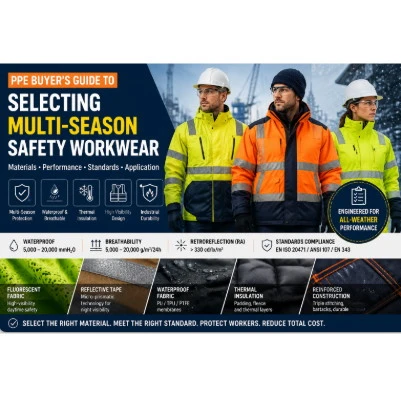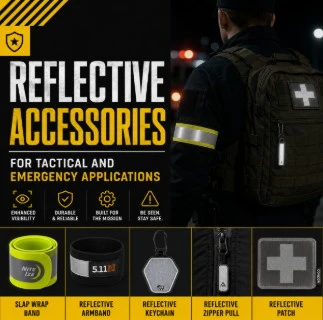
Reflective accessories play an important role in tactical operations, emergency response, outdoor rescue, and personal safety applications where visibility in low-light environments is required. Unlike ordinary decorative reflective products, professional reflective accessories are developed based on optical performance, material durability, environmental resistance, and operational requirements.
For product developers and safety equipment buyers, selecting suitable reflective components requires understanding how reflective materials work, how retroreflection performance is measured, and how different structures perform under field conditions. Material selection directly affects nighttime detection distance, product lifespan, and reliability in demanding environments.
This guide explains the engineering principles behind tactical reflective gear materials, retroreflective testing methods, structural design considerations, and sourcing factors for emergency visibility safety accessories.
Develop Custom Reflective Accessories
How Reflective Materials Are Engineered for Tactical and Emergency Visibility Requirements
Reflective materials used in tactical and emergency applications are designed to return incident light back toward the original light source, allowing users to be detected in dark environments. The core function depends on optical structure, surface durability, and material stability.
Modern reflective accessories typically use structures based on glass bead technology or microprismatic technology. These structures are integrated into films, tapes, fabrics, or polymer components to improve visibility when illuminated by headlights, flashlights, or search equipment.
Glass bead reflective materials use thousands of microscopic glass spheres embedded within a reflective layer. Light enters the beads, reflects from the backing layer, and returns toward the light source. Microprismatic materials use precisely formed prism structures that provide efficient light return through controlled optical geometry.
The performance of reflective materials is commonly evaluated through the coefficient of retroreflection (RA), measured in candela per lux per square meter (cd/lux/m²). A higher RA value indicates stronger reflected brightness under defined testing conditions.
| Reflective Technology | Material Structure | Performance Characteristics | Typical Application |
|---|---|---|---|
| Glass Bead Reflective Material | Microscopic glass spheres embedded in coating | Reliable reflection with flexible application options | Safety garments, accessories, promotional safety products |
| Microprismatic Reflective Material | Engineered prism optical structure | Higher brightness efficiency and directional reflection | Professional visibility equipment and high-performance applications |
| Reflective Film | Polymer film with reflective layer | Lightweight and suitable for molded or flexible products | Safety accessories, labels, equipment marking |
For tactical and emergency applications, material selection must consider more than brightness. Flexibility, abrasion resistance, weather stability, attachment method, and long-term optical performance are equally important.
Professional suppliers often combine reflective components with textile substrates, polymer films, elastic materials, or hardware systems to create complete visibility solutions. Products such as reflective materials are selected according to application environment, expected service life, and required visibility performance.
How Retroreflective Structures Improve Low-Light Detection Performance
Retroreflection is different from normal reflection because reflected light is directed back toward the original light source rather than spreading randomly. This characteristic allows drivers, rescue teams, and operators using lighting equipment to identify reflective objects from greater distances.
The optical performance of reflective materials depends on several factors:
- Coefficient of retroreflection (RA)
- Observation angle
- Entrance angle
- Reflective surface quality
- Environmental contamination
The observation angle describes the angle between the illumination source and the observer position. Entrance angle describes the angle at which light reaches the reflective surface. Different angles can significantly influence measured brightness because reflective structures are designed for specific optical conditions.
For example, a reflective accessory positioned on a moving person may experience changing angles during walking or running. Therefore, products used in emergency response or outdoor activities require stable reflection performance across different positions and movements.
Reflective performance testing normally uses controlled laboratory equipment to measure returned light intensity. The result is expressed as RA values, allowing engineers to compare different reflective technologies.
| Parameter | Measurement Method | Engineering Meaning |
|---|---|---|
| RA Value | Retroreflection testing equipment | Measures reflected brightness efficiency |
| Observation Angle | Controlled optical testing angle | Evaluates performance from different viewing positions |
| Entrance Angle | Controlled light incidence testing | Determines directional reflection behavior |
In professional visibility applications, reflective performance must be considered together with product positioning, movement conditions, and expected operating environment.
How Tactical Reflective Accessories Combine Fabric, Polymer and Hardware Structures
Tactical and emergency reflective accessories are usually multi-material products rather than simple reflective components. Their final performance depends on how reflective films, textile substrates, polymer layers, fastening systems, and protective structures are combined.
A typical reflective accessory may include a retroreflective layer, adhesive or laminated backing, textile carrier, elastic components, and hardware elements such as buckles or clips. Each layer has a specific function that affects durability, comfort, and operational reliability.
Reflective Layer Structure
The reflective layer provides the primary visibility function. Common structures include glass bead reflective coatings and microprismatic films. The selection depends on required brightness, flexibility, production method, and application environment.
Microprismatic reflective films generally provide higher optical efficiency because their prism geometry controls light return more precisely. However, they may require more careful handling during manufacturing because surface damage can affect optical performance.
Glass bead reflective materials usually provide better flexibility and are widely used in products requiring repeated bending, wrapping, or curved installation.
Textile and Polymer Substrate Selection
The substrate supporting the reflective layer influences mechanical performance. Common base materials include polyester fabric, nylon fabric, TPU film, PVC film, and elastic webbing.
| Material Component | Performance Function | Typical Selection Reason |
|---|---|---|
| Polyester Fabric | Provides dimensional stability and abrasion resistance | Suitable for durable safety accessories |
| Nylon Fabric | Higher flexibility and impact resistance | Used where bending and movement are frequent |
| TPU Film | Flexible waterproof protective layer | Suitable for outdoor and weather-resistant products |
| PVC Film | Cost-effective protective surface layer | Common in promotional and general safety accessories |
Hardware and Attachment Systems
Attachment design directly affects product reliability. Tactical and emergency accessories may use elastic straps, hook-and-loop systems, clips, buckles, magnetic closures, or slap mechanisms depending on the intended application.
For example, a reflective armband used during emergency response requires secure attachment during movement, while a promotional safety accessory may prioritize lightweight design and easy distribution.
Common structural failure points include:
- Reflective layer separation from the substrate
- Elastic strap fatigue after repeated stretching
- Buckle or clip breakage under mechanical stress
- Adhesive failure caused by moisture or temperature changes
Preventing these failures requires compatibility testing between reflective materials, polymers, adhesives, and mechanical components.
How Durability Testing Evaluates Reflective Accessories Under Extreme Field Conditions
Reflective accessories used in tactical, emergency, and outdoor environments must maintain performance after repeated mechanical stress and environmental exposure. Laboratory testing helps evaluate whether materials can withstand realistic operating conditions.
Durability evaluation commonly includes:
- Abrasion resistance testing
- Bending and flex cycle testing
- UV exposure testing
- Temperature resistance testing
- Water and humidity exposure testing
Abrasion Resistance Testing
Abrasion testing evaluates how quickly a material surface wears under repeated friction. This is important for accessories attached to clothing, backpacks, tactical equipment, or outdoor gear.
A reflective surface may maintain initial brightness but lose performance after surface damage. Therefore, buyers should evaluate both initial RA value and retained reflective performance after abrasion exposure.
Flexibility and Bending Durability
Many reflective accessories experience repeated bending during use. Examples include slap armbands, reflective straps, and wearable visibility products.
Flex testing evaluates whether repeated deformation causes:
- Cracking of reflective coatings
- Delamination between layers
- Loss of optical performance
Environmental Aging Evaluation
Outdoor exposure can affect polymers, adhesives, and reflective coatings. UV radiation may cause discoloration, while moisture can weaken bonding layers.
A reliable reflective accessory should maintain structural integrity and acceptable visibility performance after environmental aging tests.
For professional applications, durability testing provides evidence that the product can perform consistently during extended field use rather than only during initial inspection.
How Reflective Accessories Perform in Rain, Dust and Harsh Environmental Conditions
Emergency and tactical environments often involve unpredictable weather conditions, including rain, dust, mud, temperature changes, and prolonged outdoor exposure. Reflective accessories must be designed to maintain both visibility and mechanical performance under these conditions.
Water exposure can affect reflective products through:
- Adhesive weakening
- Layer separation
- Surface contamination
- Reduced optical efficiency caused by dirt or moisture film
Protective coatings and laminated structures are commonly used to improve environmental resistance. TPU protective layers, sealed edges, and durable adhesives can help reduce moisture penetration and improve service life.
Dust resistance is also important for emergency equipment used in construction, rescue, and outdoor operations. Contaminants on the reflective surface can reduce returned light intensity, especially when fine particles block optical structures.
| Environmental Factor | Potential Failure | Prevention Method |
|---|---|---|
| Rain and Moisture | Adhesive failure or reduced reflection | Water-resistant lamination and sealing |
| Dust Exposure | Reduced reflective brightness | Protective surface treatment and cleaning design |
| UV Exposure | Material aging and color change | UV-resistant polymers and coatings |
| Low Temperature | Polymer stiffness or cracking | Cold-resistant material selection |
Material selection should therefore consider the complete operating environment rather than only reflective brightness specifications.
How Active LED and Passive Reflective Technologies Are Compared for Emergency Visibility
Reflective accessories can use passive visibility technology, active lighting technology, or a combination of both. Understanding their differences helps buyers select suitable solutions for different safety applications.
| Technology | Working Principle | Advantages | Limitations |
|---|---|---|---|
| Passive Reflective Material | Returns external light toward the source | No power required, lightweight, low maintenance | Requires external light source |
| LED Active Lighting | Produces independent visible light | Visible without headlights or external illumination | Requires batteries and electronic components |
| Hybrid Reflective LED System | Combines reflection and active illumination | Improved visibility in multiple conditions | Higher complexity and cost |
Passive reflective materials are widely used in safety clothing and accessories because they provide reliable visibility without maintenance requirements. LED systems provide additional identification capability in environments where external lighting is limited.
Products such as LED reflective armband combine active lighting with reflective surfaces, making them suitable for running safety, outdoor activities, emergency awareness programs, and promotional safety applications.
How International Safety Standards Evaluate Reflective Accessories for Professional Applications
Professional reflective accessories used in safety-related applications must be evaluated according to relevant visibility and performance standards. These standards help buyers understand whether reflective materials provide consistent visibility performance under controlled testing conditions.
Different markets apply different requirements depending on product category and intended use. Reflective accessories integrated into safety garments may need to comply with high visibility clothing standards, while standalone visibility accessories may be evaluated according to specific reflective material or personal safety product requirements.
EN ISO 20471 High Visibility Requirements
EN ISO 20471 evaluates high visibility clothing and related visibility performance. The standard focuses on fluorescent background materials, retroreflective materials, and the minimum visible surface area required for professional protective garments.
Although many standalone reflective accessories are not classified as complete high visibility garments, understanding EN ISO 20471 requirements helps product developers select suitable reflective components when designing safety equipment systems.
ANSI/ISEA 107 Visibility Evaluation
ANSI/ISEA 107 is widely used in North America for high visibility apparel and accessories. The standard evaluates visibility performance through material classification, reflective properties, and durability requirements.
For buyers sourcing reflective components, compliance information helps determine whether a product is suitable for professional environments such as construction sites, road maintenance, emergency response, and traffic management.
Reflective Material Performance Testing
Reflective materials are commonly tested through optical measurement systems that evaluate retroreflection values. Testing determines how much light is returned under specific observation and entrance angles.
| Standard / Test Area | Evaluation Purpose | Why It Matters |
|---|---|---|
| Retroreflection Testing | Measures reflected light intensity | Determines nighttime visibility performance |
| Abrasion Testing | Evaluates surface wear resistance | Predicts long-term optical durability |
| Environmental Testing | Evaluates resistance to moisture, UV and temperature changes | Confirms field reliability |
| Adhesion Testing | Measures bonding strength between layers | Prevents reflective layer separation |
For professional buyers, standards should not be viewed only as certification labels. The more important consideration is whether the tested performance matches the actual operating environment.
How Tactical and Emergency Teams Select Reflective Accessories Based on Operational Requirements
Different operational environments require different reflective accessory designs. Tactical teams, emergency responders, outdoor professionals, and industrial users may have different priorities depending on movement conditions, lighting environment, and mission requirements.
Tactical Applications
Tactical equipment users often require low-profile, lightweight, and durable visibility solutions. Reflective accessories may need to attach securely to uniforms, backpacks, equipment cases, or protective gear without interfering with movement.
Important selection factors include:
- Low weight and compact design
- Secure attachment methods
- Abrasion resistance
- Resistance to outdoor exposure
- Reliable visibility performance
Emergency Response Applications
Emergency personnel often operate in unpredictable environments where fast identification is important. Reflective accessories used in rescue operations should provide strong visibility during nighttime operations, roadside incidents, and disaster response situations.
Selection factors include:
- High reflective performance
- Quick attachment and removal
- Compatibility with gloves and equipment
- Resistance to rain and contamination
Outdoor and Personal Safety Applications
Outdoor users such as runners, cyclists, and hikers typically prioritize comfort, lightweight construction, and easy wearing methods. Reflective accessories should provide visibility improvement without creating unnecessary weight or restriction.
Products connected with high visibility workwear systems can also be evaluated as part of a broader personal visibility strategy where clothing, accessories, and equipment work together.
How Buyers Evaluate Reflective Accessory Manufacturers Through Material and Production Capability
Selecting a reflective accessory manufacturer requires evaluation beyond product appearance. Professional buyers should review material capability, production control, testing processes, and customization experience before starting bulk production.
Key evaluation areas include:
- Reflective material sourcing capability
- Understanding of optical performance requirements
- Material compatibility evaluation
- Production consistency
- Customization capability
- Quality inspection procedures
A reliable manufacturer should understand the relationship between material structure and final product performance. For example, selecting a reflective film with high initial brightness is not enough if the product design causes cracking, peeling, or performance loss during actual use.
Buyers should also evaluate manufacturing capability for different customization requirements, including:
- Custom colors and product dimensions
- Logo printing or branding methods
- Packaging development
- Material alternatives for different markets
- Prototype and sampling support
Quality control should include incoming material inspection, production monitoring, and finished product testing. These steps help maintain consistent performance between samples and mass production batches.
For companies developing branded visibility products, reflective tape selection should consider optical performance, durability requirements, attachment method, and application environment.
Frequently Asked Questions
What reflective material is suitable for tactical and emergency equipment?
Suitable reflective materials depend on the operating environment, visibility requirements, and mechanical conditions. Microprismatic materials provide high optical performance, while glass bead materials offer flexibility for curved or moving applications. Buyers should evaluate RA values, durability testing results, and attachment methods before selecting materials.
How is reflective performance measured for safety accessories?
Reflective performance is commonly measured through retroreflection testing, which evaluates how efficiently a material returns light toward the source. Results are usually expressed as coefficient of retroreflection (RA) in cd/lux/m². Testing considers observation angle, entrance angle, and material condition.
Do LED reflective accessories replace traditional reflective materials?
LED reflective accessories provide active illumination and can improve visibility when external light sources are limited. However, traditional reflective materials remain important because they require no power source and provide reliable visibility when illuminated by headlights. Many products combine both technologies for improved performance.
What durability tests should buyers request for reflective accessories?
Buyers should review abrasion resistance, bending cycle testing, environmental aging evaluation, and adhesion testing. These tests help determine whether reflective layers, polymer structures, and attachment components can maintain performance after repeated use in outdoor or professional environments.
How should companies select a reflective accessory supplier?
Companies should evaluate supplier capability in reflective material selection, production control, customization support, and quality testing. A qualified manufacturer should provide technical recommendations based on application requirements rather than only offering standard products without performance evaluation.
Technical Support for Reflective Accessory Development
Topmatched supports reflective accessory development through material selection guidance, product customization, and manufacturing solutions for safety, outdoor, and promotional applications. Buyers can evaluate reflective structures, attachment methods, testing requirements, and production specifications based on their target market and application environment.
Share your product requirements, technical specifications, or customization plans to discuss suitable reflective materials and production options.