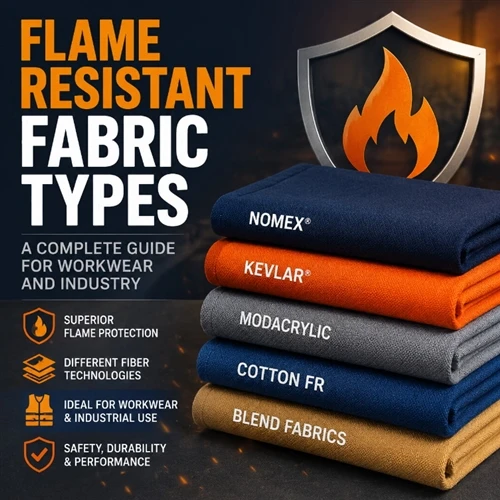
Flame resistant textile performance depends on whether protection comes from chemical treatment applied to cotton fibers or from the molecular structure of inherently flame resistant polymers. The difference affects thermal decomposition behavior, washing durability, mechanical properties, and long-term PPE reliability. For industrial buyers selecting protective garments, the key evaluation factors are not only initial flame resistance values but also how the material maintains protection after repeated laundering, mechanical stress, and workplace exposure.
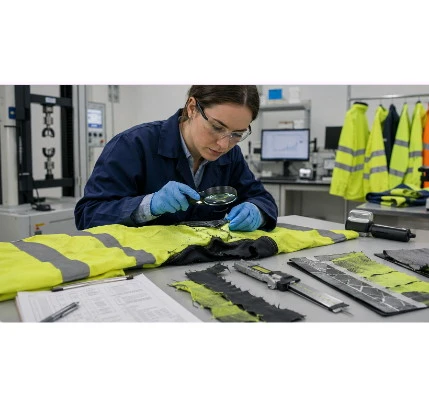
FR-treated cotton relies on chemical modification of cellulose fibers to promote char formation and reduce flame propagation, while inherent FR fibers such as aramid maintain resistance through polymer backbone stability. Engineers evaluate these differences through standardized testing including vertical flame testing, thermal analysis, tensile testing, and laundering durability evaluation before approving materials for industrial protective clothing.
How FR Treatment Changes Cotton Fiber Performance at the Molecular Level
Cotton is primarily composed of cellulose, a natural polymer containing hydroxyl groups that can support rapid combustion under elevated temperatures. Flame resistant treatment modifies the combustion behavior of cellulose by introducing chemical systems that promote dehydration, char formation, and reduced combustible gas generation.
Most FR cotton systems use phosphorus-based or phosphorus/nitrogen-based chemistry. During thermal exposure, these chemicals accelerate cellulose dehydration and create a carbon-rich protective layer that reduces heat transfer between the flame source and the underlying textile structure.
The engineering difference is that FR treatment modifies the behavior of the fiber surface and internal structure through chemical interaction, but the original cellulose polymer backbone remains present.
| Parameter | Testing Method | Typical Value | Engineering Interpretation |
|---|---|---|---|
| Limiting Oxygen Index (LOI) | ASTM D2863 / ISO 4589 | FR cotton: approximately 26-32% | Higher LOI indicates the material requires more oxygen concentration to sustain combustion |
| Afterflame Time | ASTM D6413 Vertical Flame Test | Typically ≤2 seconds for certified protective textiles | Measures how quickly flame extinguishes after ignition source removal |
| Char Length | ASTM D6413 | Common requirement ≤15 cm depending on application | Indicates resistance against flame damage propagation |
For PPE manufacturers, the critical evaluation point is whether the FR treatment remains chemically stable throughout the garment lifecycle. The treatment must maintain flame performance after washing, abrasion, and environmental exposure.
Failure Mechanism of FR Cotton Treatment
Cause: Loss of FR chemical effectiveness due to repeated laundering, chemical exposure, or insufficient treatment penetration.
Performance Impact: Reduced char formation ability, increased flame spread, and lower protective performance during thermal exposure.
Prevention Method: Validate FR chemical durability through laundering tests, verify fabric performance after 25, 50, or 100 wash cycles, and control finishing process parameters during manufacturing.
For industrial protective clothing development, engineers normally evaluate both treated fabric performance and finished garment construction. Material selection should consider the complete protective system rather than only the initial fabric test result. Technical specifications for flame resistant fabric should include fiber composition, treatment chemistry, thermal performance, and durability requirements.
How Inherent FR Fibers Maintain Flame Resistance Through Polymer Structure Modification
Inherent flame resistant fibers achieve protection through their molecular structure rather than through additional chemical treatment. The polymer itself is engineered with thermal stability characteristics that reduce ignition, melting, and flame propagation.
Common inherent FR fibers include aramid fibers, such as meta-aramid and para-aramid. These materials contain aromatic polymer structures with strong chemical bonds that provide higher resistance to thermal degradation compared with conventional textile polymers.
Unlike treated cotton, the flame resistant characteristics are integrated into the polymer chain. Washing does not remove the protective mechanism because the resistance originates from fiber chemistry itself.
| Material Type | Protection Mechanism | Thermal Behavior | Typical Application |
|---|---|---|---|
| FR Treated Cotton | Chemical treatment promotes char formation | Cellulose decomposes but protective carbon layer develops | Industrial workwear, maintenance garments |
| Meta-Aramid Fiber | Aromatic polymer structure provides thermal stability | High thermal resistance without melting | Fire service, electrical and industrial PPE |
| Para-Aramid Fiber | High molecular strength and heat resistance | Maintains mechanical strength under heat exposure | High-performance protective applications |
Engineers evaluate inherent FR fibers through thermal decomposition testing, tensile retention testing after heat exposure, and flame resistance testing according to application standards.
Thermogravimetric analysis (TGA) is often used to evaluate polymer degradation behavior. The test measures weight loss as temperature increases under controlled atmosphere conditions. Materials with higher thermal stability generally maintain structural integrity at elevated temperatures for longer periods.
Polymer Structure Evaluation Factors
- Thermal decomposition temperature measured through TGA analysis.
- Residual char percentage after controlled heating.
- Tensile strength retention after thermal exposure.
- Fiber shrinkage percentage under elevated temperature conditions.
The main engineering difference between treated cotton and inherent FR fibers is the protection mechanism. Treated cotton creates a protective response during combustion, while inherent FR fibers resist degradation because the polymer itself is designed for thermal stability.
How Thermal Degradation Mechanisms Differ Between Treated Cotton and Inherent FR Fibers
Thermal degradation analysis explains why different flame resistant materials behave differently when exposed to heat. Engineers use thermal analysis methods to study decomposition temperature, mass loss, and structural changes during controlled heating.
For protective clothing development, understanding thermal degradation is important because flame exposure involves rapid temperature increases that can exceed several hundred degrees Celsius within seconds.
| Evaluation Method | Standard | Measurement | Engineering Purpose |
|---|---|---|---|
| Thermogravimetric Analysis (TGA) | ASTM E1131 | Weight loss (%) versus temperature (℃) | Evaluates polymer thermal stability |
| Differential Scanning Calorimetry (DSC) | ASTM D3418 | Thermal transition temperature (℃) | Analyzes polymer transition behavior |
| Vertical Flame Test | ASTM D6413 / ISO 15025 | Afterflame time and char length | Measures flame propagation resistance |
FR-treated cotton typically undergoes cellulose dehydration during heating. The treatment promotes earlier char formation, which reduces combustible gases and slows flame propagation.
Inherent FR fibers behave differently because the polymer structure contains thermally stable molecular bonds. Instead of depending on added chemicals, the fiber maintains protective behavior through resistance to decomposition.
Thermal Failure Mechanism Comparison
FR Cotton Cause: Depletion or degradation of flame retardant chemistry after extended service conditions.
Performance Impact: Reduced char formation and increased heat penetration during flame exposure.
Prevention Method: Conduct thermal performance testing after simulated aging and laundering cycles.
Inherent FR Fiber Cause: Excessive temperature exposure beyond the designed thermal resistance range.
Performance Impact: Polymer degradation, mechanical strength reduction, and possible fiber embrittlement.
Prevention Method: Select fiber systems according to ATPV requirements, workplace hazard assessment, and expected service temperature.
How Washing Durability Testing Reveals Long-Term FR Performance Differences
Flame resistant clothing is evaluated not only by its initial flame performance but also by its ability to maintain protection throughout repeated laundering cycles. For industrial PPE buyers, washing durability testing is one of the most important indicators when comparing treated cotton and inherent FR fiber systems.
FR-treated cotton depends on chemical treatment retention, while inherent FR fibers maintain protection through polymer structure. Therefore, repeated washing creates different aging mechanisms between the two material systems.
| Test Parameter | Standard | Testing Condition | Engineering Reference Value |
|---|---|---|---|
| Industrial Laundering Durability | ISO 6330 / AATCC 135 | 25, 50, 75 or 100 wash cycles | FR performance should remain within certified requirements after specified cycles |
| Vertical Flame Retention | ASTM D6413 / ISO 15025 | After laundering and conditioning | Afterflame time typically ≤2 seconds for certified protective textiles |
| Fabric Appearance Stability | ISO 5077 | Dimensional change after washing | Common industrial requirement within approximately ±3% shrinkage |
During laundering, FR-treated cotton may experience gradual changes caused by chemical migration, detergent interaction, mechanical abrasion, and repeated thermal exposure during drying. The protective chemistry must remain sufficiently bonded with the cellulose structure to maintain flame performance.
Inherent FR fibers show different aging behavior because the flame resistant mechanism exists inside the polymer structure. Washing primarily affects surface contamination, mechanical wear, and garment construction rather than removing the flame resistance itself.
Washing Failure Mechanism Comparison
FR Cotton Treatment Failure:
Cause: Loss of flame retardant chemical effectiveness after repeated laundering or exposure to unsuitable chemicals.
Performance Impact: Increased flame spread, longer afterflame time, and reduced protective reliability.
Prevention Method: Validate FR retention after required washing cycles and specify compatible laundering procedures.
Inherent FR Fiber Failure:
Cause: Mechanical degradation of fibers caused by abrasion, contamination, or extreme service conditions.
Performance Impact: Reduced fabric strength and garment integrity even though flame resistance remains inherent.
Prevention Method: Evaluate abrasion resistance, tensile retention, and garment construction quality.
For PPE procurement teams, washing durability testing provides a more realistic evaluation than initial certification results alone. A fabric passing a first-time flame test may not provide the same protection after months of industrial laundering unless durability data has been verified.
How Mechanical Properties Change After Flame Retardant Treatment and Thermal Exposure
Flame resistance is only one part of protective clothing performance. Industrial garments must also maintain mechanical properties including tensile strength, tear resistance, abrasion resistance, and dimensional stability during daily use.
Flame retardant treatment can influence cotton fiber behavior because chemical finishing changes the interaction between cellulose chains. Thermal exposure can also reduce polymer strength by causing molecular degradation.
| Mechanical Property | Testing Standard | Measurement Unit | Typical Evaluation Range |
|---|---|---|---|
| Tensile Strength | ISO 13934-1 / ASTM D5034 | N | Depends on fabric weight and construction; industrial fabrics commonly evaluated above 300 N |
| Tear Strength | ISO 13937 | N | Measures resistance against tear propagation during use |
| Abrasion Resistance | ISO 12947 / ASTM D3884 | Cycles | Higher cycle resistance indicates improved wear durability |
| Heat Exposure Strength Retention | Internal thermal aging evaluation | % retention | Higher retained strength indicates better thermal stability |
FR cotton may show changes in flexibility, tensile strength, and moisture behavior after chemical treatment. The finishing process must be controlled to avoid excessive stiffness or reduced mechanical performance.
Inherent FR fibers generally maintain stronger thermal stability because aromatic polymer structures resist chain breakdown at elevated temperatures. However, mechanical performance still depends on fiber type, fabric construction, blend ratio, and garment design.
Mechanical Failure Mechanisms
Cause: Chemical treatment effects, thermal degradation, or insufficient fabric construction strength.
Performance Impact: Reduced tear resistance, seam failure, garment damage, and shortened service life.
Prevention Method: Combine flame testing with mechanical evaluation before selecting materials for industrial PPE applications.
How PPE Standards Evaluate Treated Cotton and Inherent FR Fiber Performance
Protective clothing standards evaluate flame resistant materials through measurable performance requirements rather than material names alone. Treated cotton and inherent FR fibers must demonstrate compliance according to their intended application and hazard exposure level.
Common industrial standards include EN ISO 11612 for heat and flame protective clothing, ISO 15025 for limited flame spread testing, ASTM F1959 for arc thermal performance value (ATPV), and NFPA 2112 for industrial flash fire protective garments.
| Standard | Measured Parameter | Typical Requirement | Buyer Evaluation Purpose |
|---|---|---|---|
| EN ISO 11612 | Flame spread, heat transfer, radiant heat resistance | Performance classification depends on exposure type | Confirms garment suitability for thermal hazards |
| ISO 15025 | Afterflame time, flame spread, hole formation | Limited flame spread evaluation | Measures basic flame propagation resistance |
| ASTM F1959 | ATPV / cal/cm² | Application dependent, commonly industrial arc protection evaluation | Determines electrical arc protection capability |
| NFPA 2112 | Flash fire garment performance | Thermal protection performance requirements | Used for oil, gas, and industrial applications |
For example, FR garments used in welding applications may require different performance characteristics compared with garments designed for electrical arc protection. Material selection must consider the actual hazard instead of selecting based only on fiber type.
For industrial applications requiring full-body thermal protection, buyers often evaluate certified products such as FR coveralls according to workplace risk assessment and applicable PPE standards.
How Manufacturers Select FR Materials Based on Application Risk and Service Life Requirements
Material selection for flame resistant clothing requires balancing thermal protection, mechanical durability, washing frequency, comfort requirements, and lifecycle cost. There is no single material system suitable for every industrial environment.
| Application | Material Consideration | Key Evaluation Parameter |
|---|---|---|
| Oil & Gas Operations | High thermal protection materials | Flash fire resistance, NFPA 2112 compliance |
| Welding Operations | Abrasion-resistant FR fabrics | Heat exposure resistance and mechanical durability |
| Electrical Maintenance | Arc-rated FR systems | ATPV value (cal/cm²) |
| Industrial Manufacturing | Balanced protection and comfort | Wash durability and service life |
Manufacturers evaluate material selection by combining laboratory data with real working conditions. Important factors include:
- Required protection standard such as EN ISO 11612 or NFPA 2112.
- Expected washing frequency and maintenance method.
- Required ATPV rating for electrical hazards.
- Mechanical stress level during daily operation.
For companies sourcing industrial PPE programs, selecting a qualified supplier requires evaluation beyond fabric specifications. Production capability, testing experience, and quality systems directly influence final garment reliability.
Topmatched provides OEM development and bulk production support for flame resistant garments and industrial protective apparel. Buyers can request technical evaluation, review material options, and discuss production requirements for customized PPE programs.
For complete safety apparel solutions, buyers can also review safety workwear options developed for industrial environments.
Frequently Asked Questions
How should buyers compare treated cotton and inherent FR fibers for industrial PPE selection?
Buyers should compare flame testing results, wash durability data, mechanical strength retention, and application requirements. Treated cotton requires evaluation after laundering cycles, while inherent FR fibers require polymer stability assessment. Material selection should match hazard level, service conditions, and expected garment replacement cycle.
How many washing cycles should FR fabric testing include before bulk production approval?
The required washing cycles depend on application standards and maintenance conditions. Many industrial buyers evaluate FR performance after 25, 50, or 100 laundering cycles. Testing should confirm flame resistance, dimensional stability, and mechanical performance retention before approving bulk production.
What technical documents should buyers request from FR clothing manufacturers?
Buyers should request fabric specifications, laboratory reports, certification documents, washing durability data, and production quality records. These documents help verify compliance with standards such as EN ISO 11612, ASTM F1959, or NFPA 2112 before large-scale PPE purchasing decisions.
Technical Evaluation and OEM Production Support
Topmatched provides OEM capability for flame resistant garments, protective workwear, and industrial PPE solutions. Our production process supports material evaluation, prototype development, customization, testing verification, and bulk manufacturing based on customer specifications.
Submit your material requirements, protection standards, and application details to request technical evaluation and review suitable FR fabric options for your PPE project.