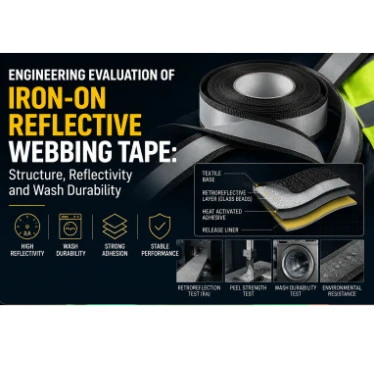
Iron-on reflective heat transfer film is a laminated reflective marking material applied to fabric by heat, pressure, and dwell time instead of sewing. For activewear and PPE manufacturing, the main procurement variables are press temperature, adhesive compatibility, peel strength after washing, retroreflection retention, and fabric distortion control.
For OEM safety apparel manufacturing, reflective heat transfer film should be qualified on the actual fabric before bulk cutting. Birdseye polyester mesh, knitted sports fabric, PU-coated softshell, Oxford fabric, elastic activewear fabric, and FR-treated fabric can show different bonding behavior under the same heat press setting.

Reflective Heat Transfer Film Construction for OEM Safety Apparel
Reflective heat transfer film normally combines a retroreflective optical layer, polymer carrier, hot-melt adhesive layer, and release liner. The optical layer may use glass bead reflective technology or micro-prismatic reflective film, depending on brightness requirement, flexibility, and garment category.
|
Layer |
Common Structure |
Engineering Function |
Buyer Verification Point |
|
Optical surface |
Glass bead or micro-prismatic reflective layer |
Returns light toward the source |
Initial and post-wash retroreflection |
|
Carrier film |
PU, PET, or project-specific polymer film |
Controls film stability during cutting and pressing |
Flexibility, thickness, stretch behavior |
|
Adhesive layer |
Hot-melt PU or heat-activated adhesive |
Bonds film to textile surface |
Peel strength after washing and flexing |
|
Release liner |
PET liner or paper liner |
Supports cutting, weeding, and transfer |
Clean removal after pressing |
|
Protective finish |
Smooth, segmented, stretch, or printable surface |
Supports different garment uses |
Abrasion resistance and hand feel |
For buyers sourcing reflective film, reflective tape, or iron on reflective tape from a China OEM manufacturer, the purchase decision should not be based only on roll price. The film must be matched to fabric base, heat press equipment, washing route, stretch ratio, garment design, and final compliance claim.
Buyers can review related Reflective Material options when comparing heat transfer reflective film, sew-on reflective tape, printable reflective film, segmented reflective tape, and micro-prismatic reflective film for different safety apparel programs.
Heat Press Processing Parameters: Temperature, Pressure, and Dwell Time Control Curve
Heat transfer bonding depends on a controlled combination of platen temperature, pressure, dwell time, peel timing, and fabric surface condition. A higher temperature does not always improve bonding; it may deform elastic fabric, mark coated textiles, shrink knitted fabric, or damage the reflective optical layer.
Typical Press Window for Reflective Heat Transfer Film
|
Parameter |
Common Working Range |
Procurement Meaning |
Process Risk |
|
Press temperature |
145–160°C |
Activates adhesive layer |
Too low causes weak bonding; too high may damage fabric |
|
Pressure |
0.3–0.5 MPa |
Forces adhesive into fabric surface |
Too low causes edge lifting; too high may create platen marks |
|
Dwell time |
12–18 seconds |
Allows adhesive flow and wet-out |
Short dwell weakens peel strength; long dwell may harden film |
|
Peel timing |
Warm peel or cold peel by film type |
Controls liner removal and surface finish |
Wrong peel timing may lift edges |
|
Second press |
3–5 seconds where specified |
Improves edge bonding |
Excess heat can affect hand feel |
|
Conditioning time |
24 hours before wash test |
Allows adhesive stabilization |
Early washing may understate final bond strength |
Heat Transfer Control Curve for Bulk Production
|
Stage |
Control Point |
Factory Action |
|
Pre-test |
Confirm fabric composition and surface coating |
Run trial press on actual fabric |
|
Temperature setting |
Set machine to target range, not display-only value |
Verify platen surface temperature |
|
Pressure setting |
Confirm pressure by machine scale or test strip |
Keep pressure stable across garment panels |
|
Dwell time |
Apply controlled seconds per press cycle |
Avoid operator-dependent timing variation |
|
Liner removal |
Follow warm or cold peel instruction |
Check edge lift and surface clarity |
|
Post-press inspection |
Inspect edge bonding and reflective surface |
Reject bubbles, wrinkles, offset marks |
|
Wash validation |
Wash after conditioning period |
Record peel strength and reflectivity retention |
145–160°C Press Trial on Polyester Mesh and Activewear Knit
Birdseye polyester mesh and elastic activewear knit require lower distortion risk than woven workwear fabric. For these fabrics, buyers should request press trials at multiple points, such as 145°C, 150°C, 155°C, and 160°C, with fixed pressure and dwell time. The final setting should balance peel strength, stretch recovery, film smoothness, and fabric shrinkage.
0.3–0.5 MPa Pressure Control for Reflective Logo and Tape Layouts
For custom logo, private label, and custom printing programs, pressure consistency matters as much as artwork accuracy. Uneven pressure can create partial bonding, edge lift, blurred reflective logo edges, or visible platen marks on coated fabric. Bulk production should use stable platen pressure and a confirmed fixture for repeat positioning.
Need Reflective Heat Transfer Film for OEM Safety Apparel?
Send your fabric composition, garment type, press equipment, wash requirement, logo artwork, roll width, and bulk quantity to confirm the heat press window before sample order and mass production.
Request Film Pressing Parameters
Adhesion Testing on Knitted and Coated Fabric Substrates
Reflective heat transfer film adhesion is strongly affected by the substrate. Knitted activewear fabric has yarn movement and stretch recovery. Coated PPE fabric may have PU, TPU, PVC, WR, or anti-wicking finishes that reduce adhesive wet-out. A film that bonds well to plain polyester may fail on a coated softshell or stretch sports fabric.
Substrate Compatibility Table
|
Fabric Base |
Common Use |
Adhesion Risk |
Recommended Buyer Test |
|
Birdseye polyester mesh |
Safety vests, summer PPE |
Open structure and low bonding area |
Peel test after 25–50 wash cycles |
|
Polyester knit |
Activewear, running gear |
Stretch and recovery stress |
Stretch-flex test after pressing |
|
Spandex blend |
Sportswear, compression panels |
Heat shrinkage and film cracking |
Low-temperature trial and elongation test |
|
PU-coated polyester |
Softshell, rainwear, work jackets |
Coating blocks adhesive penetration |
Peel test and coating compatibility check |
|
Oxford fabric |
Workwear, bags, outerwear |
Surface texture and coating variation |
Edge-lift inspection after wash |
|
FR-treated fabric |
FR workwear and industrial PPE |
Finish chemistry may affect bonding |
FR compatibility review before approval |
Crosslink Adhesion Test Logic
|
Test Item |
Suggested Method |
Buyer Acceptance Focus |
|
Initial peel strength |
180° peel test, ASTM D903-style or buyer method |
Stable bond before washing |
|
Post-wash peel strength |
After ISO 6330 or ISO 15797 route |
No major edge lifting or delamination |
|
Stretch recovery |
Manual or machine stretch-flex test |
No cracking on activewear panels |
|
Coating compatibility |
Press and peel on actual coated fabric |
No coating lift or adhesive failure |
|
Edge bonding |
Visual inspection after wash and flex |
No curling, lifting, or bubbling |
|
Reflective retention |
Measure before and after washing |
Meets buyer visibility target |
For safety apparel manufacturing, the most reliable method is not testing the film alone. The film should be pressed onto the actual production fabric, washed under the buyer's route, flexed, and inspected for peel strength, edge condition, and retroreflection.

Micro-Prismatic vs Glass Bead Reflective Heat Transfer Film
Reflective heat transfer films are often selected by brightness, but brightness alone does not define the correct material. Flexibility, cutability, wash durability, garment stretch, and hand feel can decide whether a film is suitable for activewear or PPE.
|
Film Type |
Optical Structure |
Strength |
Limitation |
Common Use |
|
Glass bead reflective HTV |
Embedded glass bead retroreflection |
Flexible hand feel, garment-friendly |
Brightness may reduce with abrasion or contamination |
Safety apparel, sportswear, logos |
|
Micro-prismatic reflective HTV |
Prismatic cube-corner geometry |
High brightness at controlled angles |
May be stiffer depending on film build |
High-visibility panels, technical PPE |
|
Stretch reflective HTV |
Elastic carrier and adhesive |
Better recovery on knit fabric |
Requires controlled press setting |
Activewear and running apparel |
|
Segmented reflective HTV |
Reflective blocks with gaps |
Better breathability and flexibility |
More cutting and alignment control needed |
Sportswear, performance workwear |
|
Printable reflective HTV |
Print-receptive reflective surface |
Supports custom logo and graphics |
Ink and wash testing required |
Private label apparel, custom printing |
For activewear, stretch reflective heat transfer film is often more suitable than rigid reflective tape. For PPE, buyers should confirm whether the film can support the required retroreflection value, wash cycles, and garment standard before using it as a visibility component.
Industrial Washing and Reflective Peel Strength Evaluation
Industrial washing creates higher stress than domestic laundering. Heat, detergent chemistry, mechanical agitation, drying temperature, and repeated flexing can weaken adhesive bonding and reduce reflectivity. For workwear and PPE programs, post-wash data is more valuable than initial brightness.
Suggested Wash Evaluation Plan
|
Test Stage |
Test Condition |
Inspection Item |
|
Baseline |
Before washing |
Retroreflection, surface finish, peel strength |
|
5 wash cycles |
Initial stability check |
Edge lift, bubbles, print clarity |
|
25 wash cycles |
Mid-life review |
Peel strength and surface abrasion |
|
50 wash cycles |
Buyer-defined durability target |
Retroreflection retention and delamination |
|
Industrial wash |
ISO 15797 route where required |
High-temperature wash and drying stress |
|
Domestic wash |
ISO 6330 route where required |
Retail and activewear wash simulation |
Peel Strength and Retention Targets for Buyer Specification
|
Performance Item |
Typical Buyer Target |
Notes |
|
Initial peel strength |
Buyer-defined, often ≥10 N/25 mm |
Must be tested on actual fabric |
|
Post-wash peel strength |
Buyer-defined, often ≥7 N/25 mm |
Depends on fabric and wash route |
|
Edge lift after 25 cycles |
No visible lifting over agreed limit |
Inspect corners and narrow strips |
|
Retroreflection retention |
Often ≥70% of initial value |
Use buyer's target and standard route |
|
Surface cracking |
No severe cracking under normal flex |
Important for activewear panels |
|
Delamination |
No film separation from adhesive layer |
Critical for PPE acceptance |
ISO 15797 Industrial Wash Risk for Workwear Programs
ISO 15797-style industrial laundering can expose reflective film to higher wash and drying stress than home laundering. Buyers sourcing reflective heat transfer film for workwear should ask whether the film has been tested under an industrial wash route or only under domestic wash conditions.
25–50 Cycle Wash Review for Private Label Activewear
Private label activewear buyers should confirm wash durability before approving custom reflective logos. A reflective logo may look clean after pressing but fail after repeated stretch, sweat exposure, detergent contact, and tumble drying. Sample approval should include post-wash photos and peel review.
OEM Sourcing Checklist for Reflective Heat Transfer Film from China
When sourcing reflective heat transfer film from a China manufacturer, supplier, factory, or wholesale supplier, the RFQ should include more than roll width and price. The supplier needs fabric type, garment application, wash route, logo shape, cutting method, press equipment, and target lead time.
|
RFQ Item |
Buyer Should Provide |
Why It Matters |
|
Fabric base |
Polyester mesh, knit, softshell, coated fabric, FR fabric |
Adhesive compatibility changes by substrate |
|
Film type |
Glass bead, micro-prismatic, stretch, segmented, printable |
Determines brightness and flexibility |
|
Roll width |
50 cm, 100 cm, or custom width |
Affects cutting yield and production cost |
|
Artwork |
Vector logo or tape layout |
Controls cutting, weeding, and press accuracy |
|
Press equipment |
Flat press, rotary press, continuous press |
Determines process settings |
|
Wash route |
ISO 6330, ISO 15797, or buyer method |
Defines durability target |
|
Quantity |
Sample order, bulk order, private label program |
Affects price and lead time |
|
Packaging |
Roll packing, carton mark, private label |
Supports warehouse and distributor handling |
Production Planning Table
|
Production Step |
Normal Control Point |
Bulk Order Risk |
|
Sample order |
Confirm film type and press setting |
Wrong setting causes weak adhesion |
|
Pre-production sample |
Apply film to actual garment fabric |
Avoid lab-swatch-only approval |
|
Bulk cutting |
Control roll direction and artwork nesting |
Reduce waste and edge defects |
|
Heat press operation |
Record temperature, pressure, dwell time |
Prevent operator variation |
|
Final inspection |
Check reflectivity, edge lift, surface defects |
Avoid mixed-quality shipment |
|
Packing |
Protect rolls from pressure and humidity |
Prevent deformation and contamination |
For custom logo, custom printing, and private label safety apparel programs, buyers should keep one approved film sample and one pressed garment panel as the reference for bulk inspection.
Schedule Management and Lead Time Control
Reflective heat transfer film lead time depends on film structure, roll width, color, logo printing, order quantity, testing requirement, and packing method. Standard silver reflective film is usually faster than custom color, printable, segmented, or high-stretch film.
|
Order Type |
Typical Buyer Need |
Lead Time Factor |
|
Sample order |
Test fabric compatibility and press settings |
Film availability and cutting requirement |
|
Low MOQ trial order |
Small production run for buyer validation |
Roll stock and packing method |
|
Bulk order |
Workwear or activewear production |
Material planning and QC time |
|
Private label order |
Buyer label, carton mark, custom packing |
Artwork and packaging approval |
|
Custom printing order |
Reflective logo, printed surface, special colors |
Print testing and wash review |
Buyers should confirm sample order timing before bulk ordering because heat transfer film testing must include fabric pressing, conditioning, washing, and peel review. Skipping this stage may reduce lead time on paper but increase claim risk after garment production.
FAQ
Q: How should buyers test reflective heat transfer film before bulk PPE production?
A: Buyers should press the film onto the actual garment fabric, condition it for 24 hours, then test peel strength, edge lift, reflectivity, wash durability, and fabric distortion. Testing only on a supplier swatch is not enough for coated or stretch fabrics.
Q: What heat press setting is normally used for iron on reflective tape?
A: A common starting range is 145–160°C, 0.3–0.5 MPa, and 12–18 seconds. Final settings depend on film type, adhesive layer, fabric base, coating, press equipment, and peel method. Buyers should approve settings after sample testing.
Q: Can custom reflective logos survive industrial washing?
A: Yes, if the film, adhesive, fabric, and press setting are qualified together. For workwear, buyers should request ISO 15797 or buyer-defined wash testing, post-wash peel review, and retroreflection retention data before approving private label bulk production.
Need Reflective Heat Transfer Film for OEM Safety Apparel?
Send your fabric type, garment category, logo artwork, wash requirement and target quantity. We can review suitable reflective heat transfer film options before your sample order or bulk production.