Colored reflective piping tape is a functional textile component combining a narrow textile carrier, reflective optical layer, polymer protection system, and bonding structure. Unlike simple decorative trims, its performance depends on the interaction between fiber selection, textile construction, reflective technology, and surface protection. Professional buyers evaluate these factors to ensure consistent appearance, reliable sewing performance, optical visibility, and durability during product use.
The engineering challenge of reflective piping tape is balancing flexibility with structural stability while maintaining reflective performance after repeated bending, abrasion, washing, and environmental exposure. Material composition, polymer structure, lamination control, and quality testing directly influence whether the final component meets garment and accessory manufacturing requirements.
How Colored Reflective Piping Tape Is Engineered Through Material Selection and Layer Structure
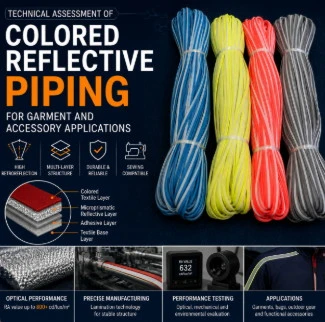
Colored reflective piping tape is manufactured as a multi-layer textile component. Each layer performs a specific engineering function: the textile carrier provides dimensional stability, the reflective layer provides optical performance, and the polymer protection layer improves surface durability.
Material Composition and Functional Layer Design
| Material Layer | Typical Material | Engineering Function |
|---|---|---|
| Narrow Textile Carrier | Polyester or nylon filament textile | Provides flexibility, structural stability, and sewing compatibility |
| Reflective Optical Layer | Glass bead or microprismatic reflective system | Returns incident light through retroreflection |
| Protective Polymer Layer | TPU, PVC, or PU coating | Improves abrasion resistance and environmental protection |
| Bonding Interface | Thermoplastic adhesive system | Maintains layer adhesion during manufacturing and use |
The narrow textile carrier is normally produced from synthetic filament yarns because polyester and nylon provide controlled mechanical properties required for piping construction. Polyester offers low moisture absorption and strong dimensional stability, while nylon provides higher flexibility and impact resistance due to its polyamide molecular structure.
Fiber and Yarn Selection Influence
The performance of colored reflective piping tape begins with polymer fiber selection. Synthetic polymers are converted into filament yarns through spinning, drawing, and orientation processes. Yarn parameters such as denier, filament count, and uniformity affect the final textile substrate performance.
| Parameter | Typical Range | Engineering Meaning |
|---|---|---|
| Filament Yarn Denier | 50D-600D depending on construction | Controls textile thickness, flexibility, and surface coverage |
| Filament Count | 24-288 filaments commonly used | Influences softness, appearance, and yarn uniformity |
| Finished Piping Width | 5-15 mm commonly used | Determines sewing compatibility and visual edge effect |
| Finished Thickness | 0.5-2.0 mm depending on structure | Affects flexibility and integration with finished products |
Manufacturers producing reflective piping must control yarn consistency, textile density, and dimensional tolerance because small variations can influence edge formation, sewing accuracy, and final product appearance.
How Polymer and Optical Structures Determine Reflective Piping Tape Performance
The performance of colored reflective piping tape is determined by two major engineering systems: polymer material behavior and optical reflection structure. Polymer selection controls flexibility, environmental resistance, and surface durability, while optical structure determines visibility performance.
Polymer Structure and Textile Performance Relationship
Polyester belongs to the polyether-free aromatic polyester family, while nylon belongs to the polyamide polymer family. Their molecular structures create different bonding characteristics that influence textile performance.
| Polymer Material | Molecular Characteristics | Performance Influence |
|---|---|---|
| Polyester | Aromatic polyester chains with high dimensional stability | Low moisture absorption, stable shape retention, good color consistency |
| Nylon | Polyamide chains containing amide bonding groups | Higher flexibility, impact resistance, and bending durability |
| TPU | Segmented polyurethane polymer structure | Elastic recovery, abrasion resistance, and flexible protection |
The relationship can be summarized as:
Polymer Structure → Fiber Behavior → Textile Performance → Application Reliability
Reflective Optical Structure Evaluation
Reflective performance depends on how the optical layer redirects incoming light. Glass bead and microprismatic technologies use different physical mechanisms to return light toward the observer.
| Reflective Technology | Optical Structure | Typical RA Performance |
|---|---|---|
| Glass Bead Reflective Layer | Spherical glass elements embedded in resin | 100-330 cd/lux/m² |
| Microprismatic Reflective Layer | Precision prism optical cells | 330-800+ cd/lux/m² |
RA (coefficient of retroreflection) is measured through photometric testing and indicates how effectively a reflective surface returns light toward its source. Higher values generally indicate stronger visibility performance under controlled testing conditions.
For different reflective structures and applications, buyers can evaluate suitable reflective piping tape options according to required optical and mechanical specifications.
How Colored Reflective Piping Tape Is Manufactured: From Textile Base Production to Reflective Lamination
The manufacturing process of colored reflective piping tape requires precise control from textile substrate preparation to reflective layer integration. Unlike ordinary decorative piping, reflective piping combines textile construction and optical functionality, which means each production stage can influence final appearance, durability, and reflective performance.
Stage 1: Fiber and Yarn Preparation
Production begins with selecting suitable synthetic fiber materials and converting polymer materials into filament yarns. Polyester and nylon are commonly selected because their filament structures provide stable textile performance for narrow fabric construction.
Polymer Selection: Fiber grade determines mechanical properties, thermal behavior, and chemical resistance.
Filament Formation: Melt spinning produces continuous filaments with controlled diameter and orientation.
Yarn Specification Control: Denier, filament count, and yarn uniformity influence the surface structure of the textile carrier.
For example, higher filament density can improve surface coverage and appearance consistency, while optimized yarn orientation improves resistance to deformation during sewing and product assembly.
Stage 2: Textile Construction and Piping Formation
The textile substrate is formed through narrow fabric construction processes. The arrangement of warp and weft yarns controls the stability, flexibility, and dimensional accuracy of the piping structure.
| Production Parameter | Typical Range | Engineering Meaning |
|---|---|---|
| Piping Width | 5-15 mm commonly used | Controls sewing compatibility, edge appearance, and integration with finished products |
| Textile Construction Density | Controlled by yarn count and weaving parameters | Influences carrier stability and dimensional consistency |
| Finished Thickness | 0.5-2.0 mm depending on structure | Determines flexibility and compatibility with product assembly |
| Width Tolerance | Typically ±0.5-1.0 mm | Maintains consistent assembly quality during manufacturing |
Unlike load-bearing webbing products, reflective piping tape is designed primarily for edge integration, visual enhancement, and functional reinforcement. Therefore, manufacturers focus on dimensional stability, flexibility, surface consistency, and sewing performance rather than maximum tensile load.
Stage 3: Reflective Layer Integration and Lamination
The reflective layer is integrated onto the textile substrate through controlled lamination processes. Temperature, pressure, and bonding time must be optimized to achieve stable adhesion while protecting the optical structure.
| Lamination Parameter | Typical Range | Performance Influence |
|---|---|---|
| Bonding Temperature | 120-180°C depending on adhesive system | Activates adhesive layer without damaging reflective components |
| Lamination Pressure | 0.2-0.5 MPa | Improves contact between reflective layer and textile substrate |
| Bonding Time | 10-30 seconds | Controls bonding stability and production consistency |
Incorrect lamination parameters may cause several quality issues:
Insufficient bonding pressure may lead to reflective layer separation.
Excessive temperature may affect polymer stability or optical performance.
Uneven adhesive distribution may create surface defects or inconsistent reflection.
Stage 4: Surface Treatment and Functional Enhancement
Depending on the application environment, reflective piping tape may receive additional surface treatments including protective polymer coating, UV resistance enhancement, and water-resistant finishing.
These treatments are evaluated according to:
- Surface abrasion resistance
- Reflective performance retention
- Color stability
- Environmental durability
- Compatibility with sewing processes
- Stage 5: Inspection and Quality Verification
Before bulk production approval, manufacturers evaluate finished reflective piping tape through dimensional inspection, appearance control, optical testing, and mechanical performance verification.
Typical inspection items include:
- Piping width and thickness measurement
- Reflective surface uniformity inspection
- Color consistency evaluation
- Adhesion strength testing
- Retroreflection performance measurement
Colored Reflective Piping Tape Types and Performance Comparison Based on Material Construction
Different colored reflective piping tape structures are developed according to application requirements, including garment flexibility, accessory durability, environmental exposure, and appearance expectations. The main differences come from textile substrate selection, reflective technology, and protective polymer design.
| Piping Structure | Textile / Polymer Construction | Performance Characteristics | Typical Applications |
|---|---|---|---|
| Polyester Reflective Piping | Polyester narrow textile carrier with reflective laminated surface | Stable dimensions, consistent appearance, good sewing compatibility | Garments, uniforms, accessories |
| Nylon Reflective Piping | Nylon textile substrate combined with reflective layer | Higher flexibility and bending resistance | Outdoor apparel, functional equipment |
| TPU Reflective Piping | TPU protective layer integrated with reflective structure | Improved abrasion resistance and weather durability | Outdoor products and premium accessories |
| PVC Reflective Piping | PVC polymer coating with reflective elements | Durable surface protection and cost-controlled production | General accessories and industrial products |
Material Selection Based on Application Requirements
The correct reflective piping structure depends on the operating environment and manufacturing requirements.
| Requirement | Recommended Structure Consideration | Engineering Reason |
|---|---|---|
| Flexible Garments | Soft textile carrier with flexible reflective layer | Reduces restriction during movement and improves sewing performance |
| Outdoor Accessories | Abrasion-resistant polymer protection | Improves resistance against repeated surface contact |
| Frequent Cleaning | Stable adhesive bonding structure | Reduces risk of reflective layer separation |
| Premium Appearance Products | Controlled color matching and surface consistency | Maintains visual quality during mass production |
For different product development requirements, buyers can compare reflective piping trim structures designed for garment and accessory manufacturing applications.
How Reflective Piping Tape Performance Is Evaluated Through Optical, Mechanical and Environmental Testing
Professional buyers evaluate colored reflective piping tape through measurable testing methods to confirm optical performance, structural stability, and long-term durability. Testing data helps determine whether a material is suitable for specific garment or accessory applications before bulk production.
Optical Performance Evaluation
The reflective performance of piping tape is measured through the coefficient of retroreflection (RA). RA represents the amount of reflected light returned toward the light source under defined testing conditions.
| Test Item | Testing Method | Typical Value | Engineering Meaning |
|---|---|---|---|
| Retroreflection Coefficient (RA) | Photometric retroreflection measurement | 100-800+ cd/lux/m² depending on optical technology | Evaluates nighttime visibility performance of reflective layer |
| Reflective Retention | Comparison before and after durability testing | 80-90% retention commonly targeted for demanding applications | Measures optical performance stability after aging |
| Color Appearance | Visual inspection and color measurement | Controlled according to approved color sample | Ensures appearance consistency during production batches |
Higher initial RA values do not always indicate better product suitability. Buyers should also evaluate how reflective performance changes after washing, abrasion, bending, and environmental exposure.
Mechanical Performance Evaluation
Although reflective piping tape is not designed as a load-bearing component, its textile substrate requires sufficient mechanical stability to maintain shape, edge appearance, and sewing performance during product manufacturing and use.
| Test Item | Testing Method | Typical Value | Engineering Meaning |
|---|---|---|---|
| Tensile Strength | ISO textile tensile testing method | 100-800N depending on construction | Evaluates textile substrate integrity and deformation resistance |
| Elongation at Break | ISO textile tensile testing method | 10-40% depending on fiber structure | Indicates flexibility and deformation behavior |
| Peel Adhesion Strength | 180° peel testing | 5-15 N/16mm typical range | Evaluates bonding stability between reflective layer and substrate |
| Abrasion Resistance | Wear cycle testing | Evaluated by cycles until visible damage | Measures surface durability under repeated contact |
Environmental Resistance Testing
Reflective piping tape used in outdoor products may experience sunlight, moisture, temperature changes, and repeated cleaning. Environmental testing helps buyers evaluate expected service performance.
Washing Durability: Reflective retention and adhesion are evaluated after repeated laundering cycles. Industrial references often include 25, 50, or 75 wash cycles depending on application requirements.
UV Exposure: Polymer layers are evaluated for color stability and surface degradation after controlled UV aging.
Temperature Resistance: Materials are evaluated according to application conditions, commonly ranging from approximately -20°C to 80°C depending on polymer selection.
Dimensional Stability: Width and thickness changes are measured after environmental exposure to verify manufacturing consistency.
Common Failure Mechanisms and Prevention Methods
| Failure Mechanism | Cause | Performance Impact | Prevention Method |
|---|---|---|---|
| Reflective Layer Delamination | Insufficient bonding control or incompatible materials | Reduced reflective performance and visible separation | Control lamination temperature, pressure, and adhesive compatibility |
| Optical Surface Damage | Abrasion, folding stress, or improper handling | Lower RA value and reduced visibility | Select suitable protective layers and evaluate abrasion resistance |
| Color Fading | UV exposure or chemical influence | Appearance inconsistency | Use suitable polymer protection and verify color fastness |
| Dimensional Instability | Uncontrolled textile construction parameters | Difficulty during sewing and assembly | Control yarn quality, construction density, and width tolerance |
How Colored Reflective Piping Tape Maintains Performance Under Garment and Accessory Manufacturing Conditions
The final performance of colored reflective piping tape depends on the interaction between material design and manufacturing conditions. During garment and accessory production, the piping component must maintain dimensional accuracy, reflective performance, and sewing compatibility after integration into the final product.
Application Engineering for Garment Manufacturing
In garment applications, reflective piping tape is commonly used around seams, pockets, panels, and edges where visibility enhancement and decorative structure are required. The material must remain flexible while maintaining stable reflective performance after repeated movement and cleaning.
| Application Requirement | Required Material Performance | Engineering Evaluation |
|---|---|---|
| Repeated Bending | Flexible reflective layer and stable textile substrate | Reduces cracking and optical performance loss |
| Sewing Integration | Controlled width and thickness tolerance | Improves assembly accuracy and product appearance |
| Industrial Washing | Strong adhesive bonding and surface protection | Maintains reflective retention after cleaning cycles |
| Outdoor Exposure | Weather-resistant polymer protection | Reduces UV and moisture-related degradation |
Application Engineering for Bags and Accessories
For backpacks, luggage, outdoor equipment, and functional accessories, reflective piping tape is commonly positioned along edges and structural seams. These areas experience frequent contact, friction, and deformation, requiring stable edge reinforcement and abrasion resistance.
Manufacturers developing reflective accessory products can evaluate application examples through reflective bags solutions where reflective components are integrated into functional product structures.
OEM Material Evaluation Before Bulk Production
Before mass production, professional buyers should define technical requirements including textile carrier composition, reflective technology, piping dimensions, color specification, application method, and expected environmental conditions.
Material Evaluation: Confirm fiber type, yarn specification, reflective structure, and polymer protection system.
Sample Validation: Verify appearance, sewing compatibility, adhesion performance, and reflective output.
Production Control: Monitor raw material consistency, manufacturing parameters, and inspection standards during bulk production.
Application Testing: Evaluate finished product performance under actual use conditions.
Technical Evaluation Support for Colored Reflective Piping Tape Development
Topmatched provides OEM development and bulk production support for reflective textile components, including colored reflective piping tape for garment and accessory applications. Our manufacturing capability covers textile substrate selection, reflective layer integration, production control, and quality verification.
Buyers can submit product specifications including material requirements, piping dimensions, reflective performance targets, application environment, and production volume. Our technical team can review suitable material structures and manufacturing options based on project requirements.
Request technical evaluation for colored reflective piping tape development based on your application requirements and bulk production specifications.
Frequently Asked Questions
How should buyers evaluate colored reflective piping tape before approving bulk production?
Buyers should review textile substrate composition, reflective RA performance, adhesion strength, dimensional stability, and durability test results. Key evaluation data includes RA values in cd/lux/m², peel strength in N/16mm, width tolerance, and performance retention after washing or abrasion testing.
Which material factors influence the durability of reflective piping tape?
Durability depends on fiber selection, textile construction density, reflective layer protection, and bonding quality. Polyester and nylon substrates provide different flexibility characteristics, while TPU or PU protection layers can improve abrasion resistance and environmental stability for demanding applications.
How can manufacturers ensure consistent quality during reflective piping tape production?
Manufacturers should control yarn specifications, textile construction parameters, lamination conditions, color consistency, and finished product inspection. Buyers should verify production records, testing methods, dimensional tolerances, and sample validation results before confirming large-scale manufacturing.