OEM cooler bag manufacturing requires buyers to confirm the outer fabric, lining material, insulation thickness, zipper structure, logo printing method, loaded carrying strength and packing method before bulk production. Two cooler bags may look similar in photos but differ sharply in thermal retention, seam durability, printing stability and final unit cost. A clear technical specification reduces sample revision time and makes quotations from different cooler bag suppliers easier to compare.
For B2B buyers sourcing custom cooler bags, the main risk is not only price. The larger risk is approving a sample with unclear material structure, then receiving bulk goods with weaker fabric, thinner insulation, unstable logo printing or lower usable capacity than expected. This guide explains the engineering checks that importers, promotional gift buyers, outdoor brands, supermarket buyers and private label cooler bag distributors should complete before placing an OEM order.
Fabric Denier, Coating Weight and Seam Stress Distribution in OEM Cooler Bag Shell Construction
The outer shell of an insulated cooler bag is not only a visual layer. It controls abrasion resistance, water resistance, logo printing compatibility, folding behavior, handle reinforcement and seam stability under loaded conditions. In OEM cooler bag manufacturing, the buyer should confirm the fabric type, denier, coating method, color standard, surface texture and expected loading weight before sampling.
A small lunch cooler bag may work with lighter polyester or non-woven fabric, but a large cooler tote bag used for cans, bottles, lunch boxes, wine, beer and ice packs needs stronger shell fabric and better seam reinforcement. If the bag is promoted as a 48-can cooler bag or 60L cooler tote, handle root strength and bottom panel structure become more important than appearance alone.
| Outer Fabric | Typical Use | Procurement Checkpoint | Production Risk |
|---|---|---|---|
| 600D Polyester | Promotional cooler bags, lunch cooler bags | Coating type, print compatibility, color fastness | Logo ink may crack or rub off if coating is unstable |
| 600D Oxford | Outdoor cooler bags, picnic cooler totes | Abrasion resistance, water resistance, handle strength | Weak coating may peel after repeated folding |
| Non-woven Fabric | Cost-controlled promotional cooler bags | GSM, seam strength, expected loading weight | Handle tearing under heavy drink load |
| RPET Polyester | Eco-focused retail programs | Recycled claim, document support, color consistency | Unclear recycled content may block buyer approval |
| TPU / PVC Coated Fabric | Water-resistant outdoor cooler bags | Coating thickness, odor control, welding suitability | Strong smell or coating defects may cause rejection |
| Canvas / Cotton Blend | Lifestyle cooler tote bags | Shrinkage, stain resistance, logo method | Higher moisture absorption and dimensional variation |
600D Polyester and Oxford Fabric for 24-Can to 60L Cooler Bags
For wholesale cooler bags, 600D polyester and 600D Oxford are common because they balance cost, surface strength and print compatibility. The buyer should not only ask for "600D fabric." The supplier should confirm whether the fabric is plain polyester, Oxford weave, PVC coated, PU coated or water-resistant treated. Coating changes fabric stiffness, printing adhesion, folding marks and odor control.
For larger insulated cooler bags, the shell fabric must handle repeated lifting and weight concentration. Cans, bottles, food boxes and ice packs create downward force at the handle roots and side seams. If the body fabric is strong but the handle reinforcement is weak, the product may fail during real use. A cooler bag manufacturer should confirm bartack reinforcement, stitch density and bottom seam structure before mass production.
Coated Fabric Surface Control for Custom Logo Cooler Bags
Custom logo cooler bags require a stable printing surface. Silk screen printing performs better on flat panels with controlled coating. Heat transfer printing needs correct temperature, pressure and peeling control. Rubber patches and woven labels need a stable sewing position that does not damage insulation layers or distort the front panel.
For promotional cooler bags, the front pocket or main front panel is usually the safest logo area. Curved side panels, heavily textured fabric and folded corners can cause logo distortion. Buyers should approve logo size, print color, placement tolerance and artwork file before the pre-production sample.
Handle Root Reinforcement and Bottom Panel Load Transfer
Loaded carrying strength is one of the most important checks in OEM cooler bag manufacturing. The handle root, shoulder strap anchor, D-ring, zipper end, side seam and bottom panel should be reviewed as one load-bearing system. A large cooler tote bag can pass visual inspection but fail when filled with cans and bottles.
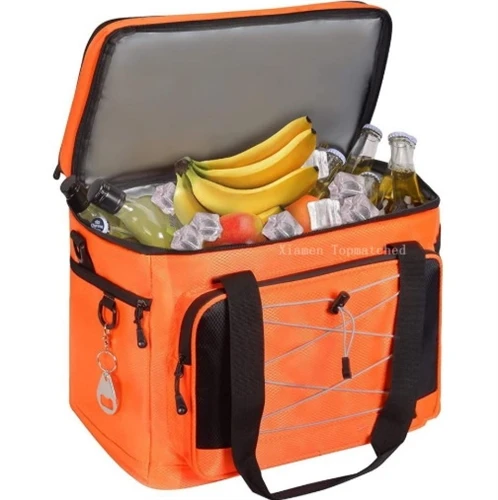
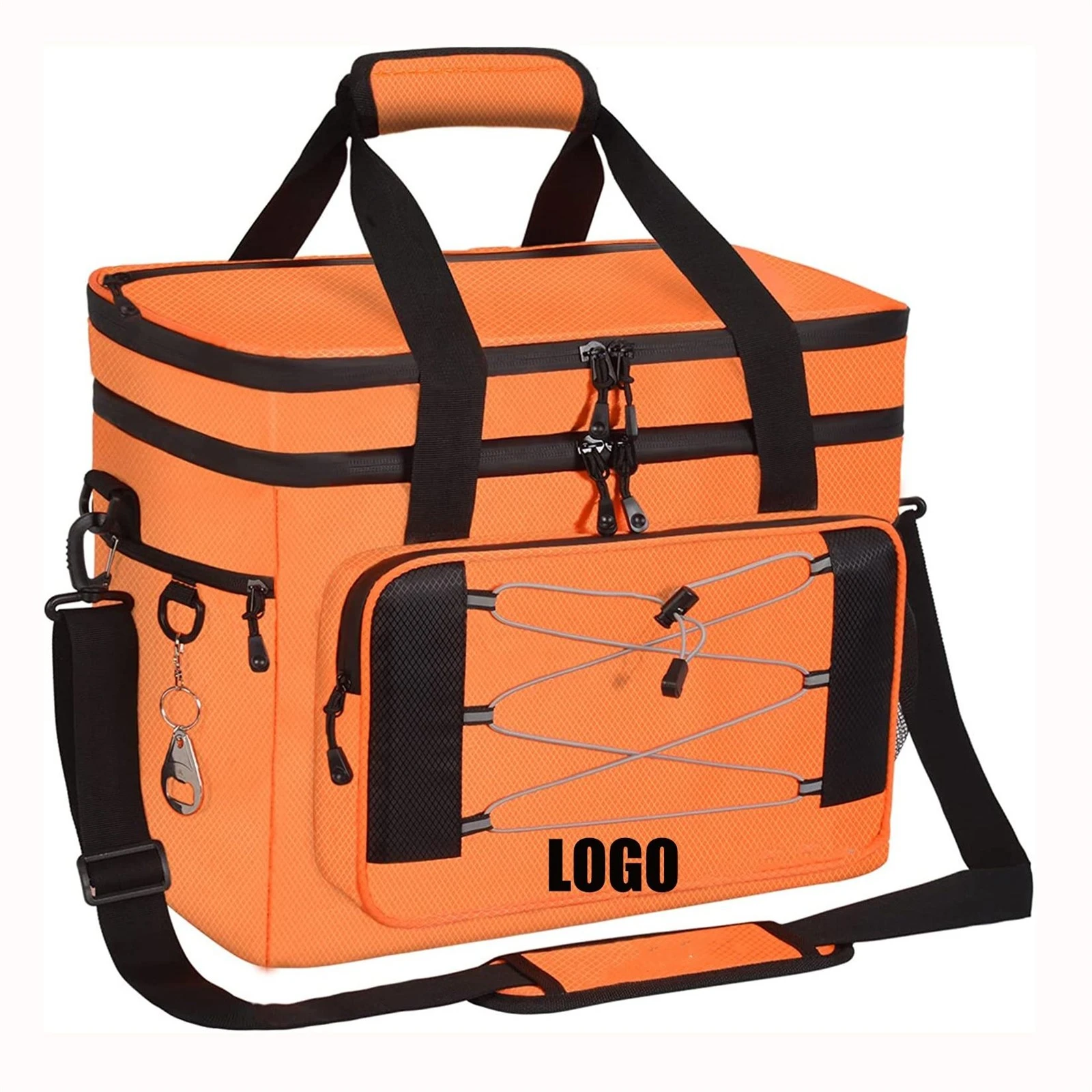
For buyers sourcing a high-capacity outdoor model, our large picnic cooler tote bag shows how a handled cooler tote can combine aluminum foil insulation, zipper closure, shoulder strap support and 48-can or 60L storage positioning for picnic, beach and outdoor food storage programs.
Aluminum Foil, PEVA and EPE Foam Layering: Thermal Retention Variables Buyers Must Specify Before Sampling
The thermal performance of insulated cooler bags depends on the full material stack, not only the visible inner lining. A typical cooler bag structure includes an outer shell, a middle insulation layer and an inner lining. The lid structure, zipper closure, seam binding and bottom panel insulation also affect heat exchange.
In OEM cooler bag manufacturing, buyers should specify the lining material, foam type, insulation thickness and closure structure in measurable terms. Phrases such as "thick insulation" or "keeps food cool" are not enough for quotation or quality control. A buyer should ask for thickness in millimeters, lining type, foam type and sample confirmation under the target use condition.
| Insulation Layer | Common Material | Technical Function | Buyer Confirmation Point |
|---|---|---|---|
| Inner Lining | Aluminum Foil | Reflective heat barrier and wipeable inner surface | Check puncture risk, wrinkle level and bonding quality |
| Inner Lining | PEVA | Softer food-storage lining with clean appearance | Confirm thickness, odor control and food-contact requirement |
| Middle Layer | EPE Foam | Main thermal buffer layer | Specify thickness in mm and check uniformity |
| Middle Layer | Pearl Cotton | Soft insulation and structure support | Check compression recovery after folding |
| Middle Layer | Sponge | Soft padded thermal layer | Check water absorption risk and odor |
| Outer Shell | Polyester / Oxford / RPET / PVC | Appearance, durability and printing base | Match with target use and logo method |
| Closure System | Zipper / Flap / Roll-Top | Controls air exchange | Check zipper smoothness, lid fit and corner movement |
| Seam Structure | Sewing / Binding / Heat Sealing | Affects leakage and durability | Confirm whether water-resistant or waterproof claim is valid |
Aluminum Foil Lining for Picnic and Promotional Cooler Bags
Aluminum foil lining is widely used in picnic cooler bags, beverage cooler bags and promotional cooler bags because it provides a reflective inner surface, helps reduce radiant heat transfer and is easy to wipe after use. For bulk production, the buyer should inspect whether the foil surface has punctures, heavy wrinkles, delamination or weak bonding around corners.
An aluminum foil cooler bag is not automatically waterproof. If the bag is sewn with binding tape, liquid may still pass through seams or zipper areas. Buyers should avoid using "waterproof" in product claims unless the supplier confirms the fabric coating, seam construction, zipper structure and leakage test route.
EPE Foam Thickness and Heat Exchange Control
EPE foam is often used as the middle insulation layer in custom cooler bags. Thickness affects thermal buffering, bag shape, folding volume and usable internal capacity. A thicker foam layer may improve insulation, but it reduces inner volume and may make the bag harder to fold for storage or shipping.
For a 48-can cooler bag or 60L cooler tote, buyers should ask whether the stated capacity is based on external dimensions or internal usable dimensions. Foam thickness, lining folds, zipper corners and bottom structure all reduce the real packing space. A physical packing test with the target can size, bottle size or food container is more reliable than a photo-based capacity claim.
Zipper Closure, Lid Fit and Seam Leakage Risk
Zipper closure reduces air exchange better than an open-top structure, but zipper quality still needs inspection. The zipper should move smoothly around corners, the puller should not break under normal force, and the lid should sit flat without large gaps. Poor zipper alignment can reduce thermal performance and create a weak point during daily use.
For outdoor cooler bags, seam structure is equally important. Sewing creates needle holes, while binding can leave gaps at corners. Heat sealing or high-frequency welding may be required for stronger leakage control, depending on material and product design. Buyers should define whether the required claim is water-resistant, splash-resistant or waterproof before sampling.
| Buyer Checklist for Insulation Sampling | Required Confirmation |
|---|---|
| Inner Lining | Aluminum foil, PEVA or buyer-specified material |
| Foam Layer | EPE foam, pearl cotton or sponge with thickness in mm |
| Outer Shell | Polyester, Oxford, RPET, non-woven, TPU or PVC coated fabric |
| Closure | Zipper, flap, lid or roll-top structure |
| Bottom Panel | Insulation thickness and loaded support requirement |
| Cleaning Requirement | Wipe-clean lining, odor control and food-storage expectations |
| Compliance Request | Food-contact documents or chemical test route if required |
Need a Cooler Bag Sample Before Bulk Production?
Send your target size, capacity, outer fabric, lining material, insulation thickness and logo artwork. We can help confirm sample cost, material options and OEM production details before bulk order confirmation.
Logo Printing Durability, Capacity Verification and Pre-Shipment QC Tolerance for Bulk Cooler Bag Orders
Custom logo cooler bags are often used for promotional gifts, beverage campaigns, supermarket programs, outdoor brands and private label retail. The logo method should be confirmed before sample production because it affects fabric selection, production cost, lead time, artwork limitation and final appearance.
Capacity verification and logo durability should be checked together. A cooler bag can have an attractive front logo but fail in real use if the handles tear, the zipper jams, the lining delaminates or the stated 48-can capacity is not physically possible. For wholesale cooler bags, the approved pre-production sample should become the reference for sewing, printing, packing and final inspection.
| Logo Method | Suitable Cooler Bag Type | Buyer Checkpoint | Production Risk |
|---|---|---|---|
| Silk Screen Printing | Promotional cooler bags, simple logos | Flat print area, ink adhesion, color count | Ink cracking or poor rubbing resistance |
| Heat Transfer Printing | Multi-color custom logo cooler bags | Heat pressure, peeling test, edge clarity | Peeling after folding or repeated use |
| Sublimation | Light polyester panels | Fabric color, print area, artwork resolution | Limited use on dark fabric |
| Embroidery | Premium cooler tote bags | Stitch density and backing | Needle holes may affect lining if placed poorly |
| Rubber Patch | Outdoor or tactical cooler bags | Mold cost, patch color, stitch position | Higher cost and longer sampling time |
| Woven Label | Private label cooler bags | Label size and placement | Weak stitching or wrong label position |
Matching Logo Method to Fabric Surface and Promotional Budget
Silk screen printing is usually suitable for cost-controlled promotional cooler bags with simple logos and limited colors. Heat transfer printing is better for multi-color artwork, gradients and retail display graphics, but the sample should be checked for edge peeling, bending resistance and surface bonding after folding.
Sublimation works best on light polyester panels and is less suitable for dark fabric. Embroidery can create a higher-value look, but needle penetration must be reviewed because it may affect insulation layers or create weak points if placed on the wrong panel. Rubber patches and woven labels are often used for outdoor cooler bags and private label programs where buyers need a stronger brand presentation.
Verifying 48-Can and 60L Capacity Claims with Internal Dimensions
Capacity claims should be measured by usable internal dimensions, not only by external product size. Foam thickness, lining folds, zipper structure and bottom panel shape reduce real storage space. If a buyer requests a 48-can cooler bag, the supplier should run a physical packing test using the target can size from the buyer's market.
| Capacity Claim | What Buyer Must Check | QC Method |
|---|---|---|
| 24 Cans | Inner length, width, height and can size | Physical packing test |
| 36 Cans | Usable inner volume after foam thickness | Fill test with sample cans |
| 48 Cans | Handle strength and loaded carrying comfort | Loaded hanging and carrying test |
| 60L | Internal dimensions and calculation route | Measurement and sample packing |
| Bottles and Food Boxes | Mixed storage layout | Real-use packing simulation |
| Ice Packs | Extra internal space requirement | Packing test with ice pack sample |
Pre-Shipment Inspection for Handles, Zippers, Lining and Carton Packing
Pre-shipment inspection should compare bulk goods with the approved sample, material card, artwork file, color standard and packing instruction. For large insulated cooler bags, final inspection should include loaded carrying strength, zipper operation, lining bonding, logo position, inner capacity, carton quantity and carton mark accuracy.
| QC Item | Suggested Control Point | Inspection Focus |
|---|---|---|
| Bag Dimensions | ±1–2 cm depending on size | Match approved sample and size chart |
| Logo Position | ±3–5 mm for flat panels | Centering and visual alignment |
| Zipper Operation | 100% functional check or AQL sampling | Smooth opening and no tooth break |
| Handle Strength | Loaded pull test by project weight | No tearing at handle root |
| Lining Bonding | Visual and manual check | No delamination or puncture |
| Carton Packing | Quantity and carton mark check | Correct size ratio and export marks |
Final Buyer Checklist Before Confirming OEM Cooler Bag Manufacturing
Before confirming bulk production, buyers should send a structured specification instead of relying on product photos. A complete RFQ should include dimensions, target capacity, outer fabric, lining material, insulation thickness, logo method, packaging requirement and order quantity. This allows the cooler bag manufacturer to quote based on the same technical baseline.
| Buyer Requirement | Information to Send Supplier |
|---|---|
| Bag Size | Length, width, height or reference sample |
| Capacity | Cans, liters, lunch boxes, bottles or mixed packing target |
| Fabric | Polyester, Oxford, RPET, non-woven, TPU or PVC coated fabric |
| Insulation | Aluminum foil, PEVA, EPE foam thickness or buyer-specified structure |
| Logo | Artwork file, size, color, placement and printing method |
| Color | Pantone reference, physical sample or approved product photo |
| Packing | Polybag, hangtag, retail card, barcode, carton mark |
| Testing | Load test, thermal test, material compliance or food-contact document if required |
| Quantity | Sample order, first bulk order and annual forecast if available |
Buyers comparing different cooler bags should separate lunch cooler bags, picnic cooler totes, delivery cooler backpacks and promotional cooler bags by capacity, insulation structure and end-use channel. For broader OEM programs, cooler bags can also be developed together with custom bags such as tote bags, travel bags, dry bags and promotional packaging bags.
FAQ
Q: What should buyers confirm before starting OEM cooler bag manufacturing?
A: Buyers should confirm outer fabric, lining material, insulation thickness, internal dimensions, capacity target, zipper type, handle structure, logo method, packaging and order quantity. These details affect quotation accuracy, sample cost, thermal performance and bulk production quality.
Q: Which insulation structure is commonly used for custom cooler bags?
A: Common cooler bag structures use aluminum foil or PEVA lining with EPE foam, pearl cotton or sponge as the middle insulation layer. Buyers should specify foam thickness, lining type and closure design because these factors affect thermal retention and usable inner capacity.
Q: How can buyers check whether a 48-can or 60L cooler bag claim is accurate?
A: Buyers should request internal dimensions and a physical packing test using the target can size, bottles, food boxes or ice packs. Foam thickness and zipper shape reduce usable space, so external bag size should not be used as the only capacity reference.
Start Your OEM Cooler Bag Project
Share your cooler bag dimensions, target capacity, fabric choice, insulation structure, logo artwork and packaging plan. Our team can support sample development, material matching, custom printing and wholesale production planning.