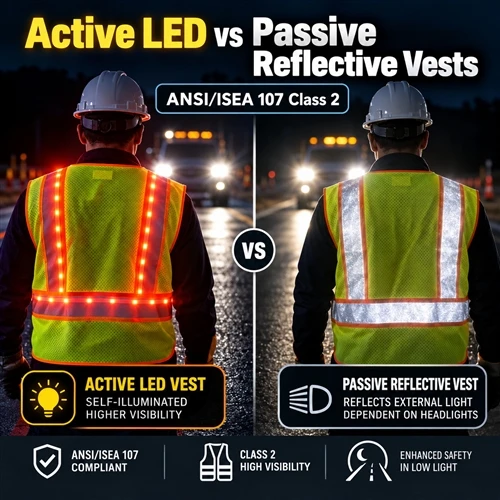

EN ISO 20471 and ANSI/ISEA 107 do the same job at a high level: they define performance requirements for high-visibility clothing used to improve wearer conspicuity in daylight and under vehicle headlights in low-light conditions. The technical split is this: EN ISO 20471 classifies garments mainly by minimum visible material area and placement, while ANSI/ISEA 107-2020 classifies garments by Type and Performance Class, linking the garment more directly to off-road, roadway, or public-safety use.
For procurement, this is not a label-change issue. It affects pattern engineering, logo allowance, smallest-size compliance, certification files, tender wording, and factory QA release criteria. A China manufacturer or supplier serving both EU and U.S. accounts should build separate technical packs, labels, and inspection checkpoints for each destination market rather than selling one "global hi-vis vest" spec. This is an engineering and compliance inference based on the two standards' different classification models and legal use contexts.
Core standard definitions and revision history
EN ISO 20471:2013 / EN ISO 20471:2013+A1:2016 - high-risk visibility clothing
ISO 20471:2013 specifies requirements for high-visibility clothing intended to provide conspicuity of the wearer in daylight and under headlights in darkness. ISO states that the standard includes requirements for colour, retroreflection, minimum material areas, and placement of materials. In Europe, the market reference commonly used by PPE buyers and testing bodies is EN ISO 20471:2013+A1:2016, which is the European implementation of ISO 20471:2013 with Amendment 1:2016.
ANSI/ISEA 107-2020 - high-visibility safety apparel for U.S. use settings
ANSI/ISEA 107-2020 is the fifth edition of the U.S. high-visibility apparel standard. ANSI's preview states that the 2020 edition retains the long-standing Type-Performance Class designation, where Type is based on the expected use setting and Performance Class is based on visible material quantity and design attributes in the finished garment. The same foreword notes changes including removal of accessory criteria, addition of criteria for single-use disposable coveralls, and optional language for nighttime luminance testing under ASTM E1501.
Procurement implication: version control must be explicit
A purchase order that only says "ANSI 107 compliant" or "EN 20471 certified" is too loose for serious PPE sourcing. The factory quotation, tech pack, test file, carton mark, and sewn-in label should state the exact standard reference, such as:
- EN ISO 20471:2013+A1:2016 Class 2
- ANSI/ISEA 107-2020 Type R Class 3
This prevents approval errors when the buyer audits pre-production samples against tender documents or jobsite HSE requirements.
Fluorescent background material area comparison: Class 1 / 2 / 3
EN ISO 20471 minimum visible material areas
ISO 20471 Table 1 sets the minimum required visible areas measured on the smallest garment size available with fasteners adjusted to the smallest configuration. The class is determined by the lowest area of visible material, and logos or labels must not reduce the minimum visible area required for classification.
| EN ISO 20471 Class | Background Material | Retroreflective Material | Combined Performance Material |
|---|---|---|---|
| Class 1 | 0.14 m² | 0.10 m² | n.a. |
| Class 2 | 0.50 m² | 0.13 m² | n.a. |
| Class 3 | 0.80 m² | 0.20 m² | 0.20 m² |
ANSI/ISEA 107-2020 minimum visible material areas
ANSI/ISEA 107-2020 uses Type O, Type R, and Type P with separate area thresholds by performance class. Industry summaries aligned to the 2020 edition show the following minimum areas:
| ANSI/ISEA 107-2020 Designation | Background Material | Retroreflective Material |
|---|---|---|
| Type O Class 1 | 217 in² | 155 in² |
| Type R Class 2 | 775 in² | 201 in² |
| Type R Class 3 | 1240 in² | 310 in² |
| Type P Class 2 | 450 in² | 201 in² |
| Type P Class 3 | 775 in² | 310 in² |
| Class E Supplemental Item | 465 in² | 109 in² |
For the smallest size offered, ANSI 107-2020 also allows reduced background area for Type R Class 2 and Type R Class 3 garments to accommodate smaller workers: 540 in² for the smallest Type R Class 2 size and 1000 in² for the smallest Type R Class 3 size; larger sizes must return to the full thresholds.
Direct technical comparison
A common sourcing mistake is treating EN ISO Class 2 as equivalent to ANSI Class 2. That is inaccurate because ANSI Class 2 exists inside a Type-based framework, while EN ISO 20471 does not use the O/R/P split. The finished garment may need different panel geometry, sleeve treatment, or logo limitation even when fluorescent fabric area looks similar on paper.
Pattern engineering effect on OEM development
For a China factory developing OEM high-visibility garments, the following variables directly affect final class approval:
- Birdseye polyester mesh open-area ratio on safety vests, because mesh cutouts reduce countable background area.
- Chest pocket and radio loop footprint, because non-compliant trim interrupts visible area.
- Back print width and screen-print location, because logos cannot reduce the countable minimum area under ISO 20471 Table 1.
- Smallest garment size offered, because both ISO and ANSI tie minimum visible area calculations to the smallest size in the design range.
Request Bulk Pricing for ANSI Class 2 / Class 3 Safety Vests
If your tender file specifies Type R Class 2 or EN ISO 20471 Class 2, request a size-by-size visible area breakdown before sample approval. For related products, review Safety Vest for vest constructions using birdseye mesh, solid polyester, and waterproof shell formats.
Retroreflective material layout and test requirement differences
EN ISO 20471 layout rules are geometry-driven
ISO 20471 requires not only minimum area but also specific layout conditions. From the standard text:
- Background material on torso-only garments must encircle the torso and maintain a minimum width of 50 mm.
- Retroreflective bands must be at least 50 mm wide.
- Horizontal torso bands may have a maximum inclination of ±20° to the horizontal.
- The bottom of the lowest torso band must be at least 50 mm above the bottom edge.
- Where more than one horizontal band is used, the bands must be at least 50 mm apart.
- Gaps in a band caused by fasteners or seams must not exceed 50 mm, and the total gap around the torso in one band must not exceed 100 mm.
For long-sleeve garments, if the sleeve blocks a clear view of the torso band, the sleeve must be encircled by reflective bands; if it is a full-length sleeve garment, the sleeve requires two bands at least 50 mm apart under the specified visibility conditions.
ANSI/ISEA 107-2020 layout rules are use-setting driven
ANSI 107-2020 summaries describe garment visibility by use setting:
- Type O: off-road, non-roadway use
- Type R: roadway and temporary traffic control zones
- Type P: emergency responders and law enforcement
The 2020 ANSI summaries also indicate minimum reflective width by class group:
| ANSI/ISEA 107-2020 Designation | Minimum Reflective Width |
|---|---|
| Type O Class 1 | 1 in. |
| Type R Class 2 | 1.38 in. |
| Type R Class 3 | 2 in. |
| Type P Class 2 | 2 in. |
| Type P Class 3 | 2 in. |
| Class E | 2 in. |
Test requirement mindset: raw tape data is not enough
Both systems are about the finished garment, not just the raw tape roll. ISO explicitly states that the clothing class is determined from the visible area in the garment, measured on the smallest size, and that logos and labels must not compromise the minimum requirement. ANSI defines performance class partly by the amount of visible materials and design attributes incorporated into the finished garment.
That means procurement should not approve a supplier based only on a reflective tape certificate. The audit file should include:
| QA Checkpoint | Why It Matters |
|---|---|
| Finished garment visible-area calculation | Class is assigned on the finished product, not on fabric rolls alone. |
| Tape width verification in mm / inches | ISO and ANSI class outcomes depend on minimum band width. |
| Layout drawing with pocket, zipper, and print zones | Non-compliant interruptions can remove countable area. |
| Smallest-size approval sample | Standards measure the smallest offered size. |
| Wash-care durability statement | Buyer needs a declared maintenance route to protect visible performance over service life. ISO notes that usage, dirt, care, and storage affect conspicuity performance. |
Material selection note for procurement engineers
Where jobsites require rain protection in addition to visibility, the standard comparison should sit alongside shell-construction review: oxford polyester vs PU-coated shell, seam-sealed waterproofing vs stitched-only construction, and tape bonding stability after washing. EN ISO 20471 or ANSI 107 compliance does not by itself prove waterproof performance. That must be checked through the shell specification and any added rainwear standard claimed by the supplier. This is an engineering procurement inference from the scope of the cited visibility standards.
How procurement teams should choose a manufacturer by local compliance requirement
If the destination market is the EU
The factory should support EN ISO 20471:2013+A1:2016 and the PPE placement route under Regulation (EU) 2016/425. The European Commission's harmonised standards page states that harmonised standards listed there provide presumption of conformity under the PPE Regulation, and EN ISO 20471 is one of the high-visibility standards referenced in this framework.
The buyer should request:
- EU declaration and standard reference matching the sales destination.
- Finished-garment test reports to EN ISO 20471.
- Label artwork showing class marking, care route, and size coverage.
- Pre-approval drawing showing where embroidery, heat-transfer logos, or woven badges can be placed without reducing the minimum visible area below class threshold.
If the destination market is the United States
The factory should support ANSI/ISEA 107-2020 designations by Type and Performance Class. For roadway and temporary traffic control use, the U.S. MUTCD 11th Edition states that workers in temporary traffic control zones shall wear high-visibility safety apparel meeting Performance Class 2 or 3 requirements of ANSI/ISEA 107-2015 or equivalent revision, and nighttime flagger wear should meet Class 3. The FHWA interpretation letters also confirm acceptance of subsequent equivalent ANSI revisions.
The buyer should request:
- Label wording such as Type R Class 2 or Type R Class 3.
- Use-setting declaration: off-road, roadway, or public safety.
- Smallest-size area calculation if XS or S sizes are part of the range.
- Packing-list control to prevent mixing Type O stock into Type R purchase orders. This is a procurement control inference based on ANSI's separate type system.
If one supplier is serving both EU and U.S. accounts
A serious China supplier or factory should separate the following documents:
| Document Layer | EU Account | U.S. Account |
|---|---|---|
| Standard Reference | EN ISO 20471:2013+A1:2016 | ANSI/ISEA 107-2020 |
| Classification Logic | Class 1 / 2 / 3 | Type O / R / P + Class |
| Approval Basis | Finished garment visible area + EU conformity route | Finished garment visible area + Type/use-setting designation |
| Artwork Control | Logo area vs EN class area | Logo area vs ANSI type/class area |
| Warehouse SKU Code | EU-only compliance code | U.S.-only compliance code |
This separation is operationally important because the same yellow vest body can fail one market even if it passes the other, depending on reflective width, pattern shape, print size, or end-use label.
Request OEM Capability Spec Sheet
For importer qualification, ask for a document pack showing visible-area calculation sheets, tape-width records, label files, and destination-market test references. Related outerwear constructions are available under Safety Jackets for quilted jackets, waterproof shells, and multi-pocket site jackets built for EN ISO 20471 or ANSI/ISEA 107 programs.
Buyer-side decision matrix for tender drafting
| Tender Situation | Better Technical Reference | Why |
|---|---|---|
| EU construction distributor supplying road crews | EN ISO 20471 Class 2 / 3 | Aligns with EU PPE conformity route and EN classification practice. |
| U.S. roadway contractor or DOT-related distributor | ANSI/ISEA 107 Type R Class 2 / 3 | MUTCD ties TTC worker apparel to ANSI Class 2 or 3 or equivalent revision. |
| Police / emergency response vest programs | ANSI/ISEA 107 Type P | ANSI Type P is defined for emergency responders and law enforcement. |
| Private-label hi-vis vest sold into both EU and U.S. markets | Dual-spec development | Different classification logic and layout constraints. |
Conclusion
The procurement difference between EN ISO 20471 and ANSI/ISEA 107 is technical, not cosmetic. ISO 20471 is area-and-placement centered; ANSI 107-2020 is type-and-use centered. For bulk PPE sourcing, the manufacturer should be selected on the basis of finished-garment calculations, smallest-size compliance, tape layout control, label accuracy, and destination-market documentation discipline.
For distributors, EPC contractors, and HSE-led project buyers, the most reliable sourcing route is to qualify a factory that can run separate EN and ANSI document trees, not a factory that simply changes the hangtag. For category planning, start with Safety Vest and Safety Jackets, then build the broader high-visibility range around the same compliance-control process.
FAQ
Q: What Is The Typical MOQ For OEM High-Visibility Vests Or Jackets From A China Factory?
A: MOQ is factory-specific, not defined by EN ISO 20471 or ANSI/ISEA 107. For OEM orders, buyers should request MOQ by fabric color, tape type, and logo process because these three items drive production batching and compliance control.
Q: Can A Custom Screen Print Or Heat-Transfer Logo Reduce The Garment's Certified Class?
A: Yes. ISO 20471 states that logos, lettering, and labels must not reduce the minimum visible area required for classification. The same engineering logic applies to ANSI finished-garment class approval. Always approve logo size and position before bulk production.
Q: What Documents Should I Ask For Before Approving A New Hi-Vis PPE Supplier?
A: Ask for the exact standard version, finished-garment test report, visible-area calculation sheet, label artwork, smallest-size compliance confirmation, and a destination-market declaration. For U.S. roadway projects, confirm Type R Class 2 or 3 where required by the job scope.