
EN ISO 20471 vs EN 343 vs ANSI/ISEA 107: The Definitive Comparison Guide for Hi-Vis Rainwear
Executive Summary
Specifying high-visibility rainwear isn't as simple as "make it bright and waterproof." Different markets rely on different standards, and each standard tests different things. EN ISO 20471 governs visibility for the EU/UK; EN 343 governs rain protection (water resistance and breathability) for foul-weather garments; and ANSI/ISEA 107 governs visibility for the US/Canada with a type/class system tuned to roadway risks. For B2B buyers, the best practice is to combine a hi-vis standard (EN ISO 20471 or ANSI/ISEA 107) with an environmental standard (EN 343) to match the job's lighting, traffic exposure, precipitation, and duty cycle. This guide unpacks the differences and provides ready-to-use specification language for RFQs and tenders.
1) Scope: What Each Standard Actually Covers
EN ISO 20471 (Hi-Vis for EU/UK)
Purpose: Ensure the wearer is conspicuous in daylight and at night under vehicle headlights.
What it tests: Minimum areas of fluorescent background and retro-reflective material; color performance; retro-reflective performance; placement for 360° visibility; some durability aspects like washing/aging of reflective.
Where it's used: Roadworks, construction, logistics yards, airports/ports, municipal services across EU/UK and many global markets referencing EU norms.
Classes: Class 1–3 for garments; Class 3 provides the highest conspicuity. (Rain suit sets can achieve Class 3 when the combined areas meet requirements.)
Note: EN 471 is obsolete and has been replaced by EN ISO 20471. Use the new designation in specs and on labels.
EN 343 (Rain Protection for EU/UK)
Purpose: Certify garments for protection against rain, including water penetration resistance and water vapor resistance (breathability).
What it tests: Waterproofness of fabric and seams; breathability (often expressed via RET or equivalent); optional additional rain tower tests; class ratings reported as X:Y where X = waterproof class and Y = breathability class (both typically 1–4, higher is better).
Where it's used: Any foul-weather PPE or workwear in wet/windy environments-construction, utilities, road maintenance, marine/port, agriculture.
Classes: Up to Class 4:4 (highest waterproofness and breathability).
ANSI/ISEA 107 (Hi-Vis for North America)
Purpose: Visibility of workers in the US/Canada under vehicular traffic and worksite hazards.
What it tests: Minimum areas and performance of background and retro-reflective materials, placement for 360° visibility, labeling, care instructions, and design features for specific Types/Classes.
Types/Classes:
Type O (Off-Road) – Non-roadway environments.
Type R (Roadway) – Exposed to traffic; Class 2 and Class 3 (Class 3 = highest).
Type P (Public Safety) – Law enforcement/EMS/fire service; Classes vary by role.
Where it's used: DOT/road work, utilities, airport ramp ops, warehousing, emergency response across North America.
2) Quick Comparison Table
Use this as a buyer's snapshot-visibility vs weather, geographies, and how to pair standards in specs.
|
Standard |
Primary Purpose |
Rating System |
Key Performance Focus |
Typical Use Cases |
Common Pairing |
|
EN ISO 20471 |
High visibility (EU/UK) |
Classes 1–3 |
Fluorescent background area, retro-reflective area & performance, placement |
Road & bridge works, logistics yards, utilities, airports/ports |
EN 343 for rain protection |
|
EN 343 |
Rain/foul-weather protection |
X:Y (waterproof:breathability) up to 4:4 |
Fabric & seam waterproofness, breathability (RET), storm protection |
Wet/windy outdoor work: construction, municipal, marine/port |
EN ISO 20471 or ANSI/ISEA 107 for visibility |
|
ANSI/ISEA 107 |
High visibility (US/Canada) |
Type O/P/R; Classes 1–3 |
Background & retro-reflective areas, placement for roadway risks |
DOT/roadside, utilities, public safety, airport ramp ops |
EN 343-equivalent rain protection (or EU buyers use EN 343) |
Recommended combo for EU projects: EN ISO 20471 Class 3 + EN 343 Class 4:4.
Recommended combo for US roadway projects: ANSI/ISEA 107 Type R Class 3 + rainwear meeting high waterproofness with taped seams.
3) Classes & Types Explained (Without the Jargon Trap)
3.1 EN ISO 20471 Classes (1–3)
Class 1–3 correspond to increasing minimum areas of fluorescent and retro-reflective materials and how they are positioned around the torso/limbs to provide 360° conspicuity.
Class 3 offers the highest conspicuity. You can achieve Class 3 via a jacket or via a combination (e.g., jacket + trousers) if the combined areas meet the requirement.
Segmented vs solid reflective tape: Both can comply if the reflective performance and area criteria are met; segmented improves flexibility/breathability.
3.2 EN 343 Classes (X:Y up to 4:4)
X (Waterproofness): Higher numbers indicate better resistance to water penetration for both fabric and seams.
Y (Breathability): Higher numbers indicate better water vapor transmission (often tied to lower RET).
Real-world impact: Higher X means better storm defense; higher Y means reduced sweat buildup during long shifts. For high-exertion tasks in wet weather, 4:4 or 4:3 is a pragmatic target when budgets allow.
3.3 ANSI/ISEA 107 Types & Classes
Type O (Off-Road): Warehouses, yards, non-roadway-lower traffic risk.
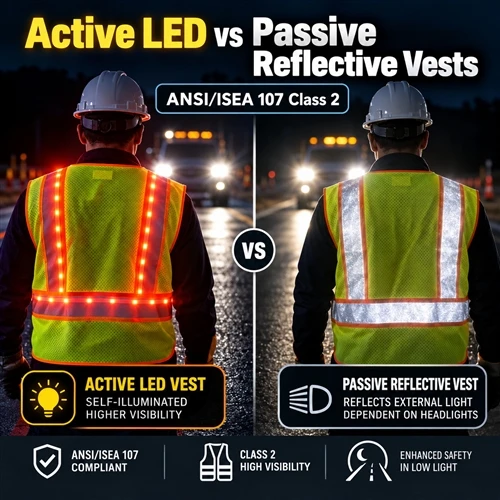
Type R (Roadway): Road/bridge/utility work near moving traffic; Class 2 suits moderate speeds/complex backgrounds; Class 3 adds visibility on arms/legs/torso for higher-risk roadway exposure.
Type P (Public Safety): Law enforcement/EMS/fire, with provisions suited to their operations (e.g., access to duty gear).
Rule of thumb: If your crews are near higher speed traffic or complex lighting/backgrounds (night work, rain), Type R Class 3 provides a safety margin.
4) How to Specify for Real Jobs (Copy-Paste RFQ Language)
Scenario A: Night Roadway Works in Rain (EU Project)
"Hi-vis rain suit to EN ISO 20471 Class 3 with jacket + trousers combination; rain protection to EN 343 Class 4:4. 50 mm retro-reflective tapes providing 360° visibility (segmented acceptable if compliant). Fully seam-sealed construction, storm flap over front zipper, detachable hood, ventilation eyelets/back yoke. Sizes S–4XL with extended sizes on request. Provide DoC and recent third-party test reports."
Scenario B: US DOT Roadside Crews (North America)
"Hi-vis jacket and over-trousers compliant with ANSI/ISEA 107 Type R Class 3. Waterproof outer with fully taped seams; reflective tapes on torso, arms, and legs for 360° visibility. Breathable lining preferred. Custom branding allowed. Provide compliance labeling and care instructions. Sample required for verification."
Scenario C: Airport/Seaport, Intermittent Showers
"Hi-vis shell meeting EN ISO 20471 Class 2 or 3 depending on role; rain jacket to EN 343 Class 3:3 minimum. Detachable hood, pass-through pockets, hem drawcord. Segmented tape acceptable. Provide garment measurement chart and washing guidance."
Buyer Notes
Specify color (fluorescent yellow/orange), tape width (usually 2″/50 mm), tape format (segmented vs solid), seam sealing, lining (mesh/taffeta), hood (detachable/helmet-compatible), pant hem (zip/snap gusset), and size run.
For Class 3 outcomes, indicate whether you intend to achieve it with the jacket alone or set combination.
5) Testing, Labels & Documentation You Should Request
Third-party test reports relevant to the exact configuration you're buying (fabric lot, tape type).
Declaration/Certificate of Conformity (DoC/CoC) where applicable.
Care instructions and anticipated wash durability guidance for the reflective.
AQL and QC checkpoints (e.g., seam-sealing temperature/line checks, tape adhesion tests).
Traceability: Lot/batch IDs on cartons and inner labels to map materials to reports.
Label accuracy: Use EN ISO 20471 (not EN 471), correct EN 343 X:Y, and the correct ANSI/ISEA 107 Type/Class.
6) Cost, Comfort & Lead Time: What Moves the Needle
Higher classes (EN ISO 20471 Class 3, ANSI Type R Class 3) generally require more material area and careful patterning-affects cost.
EN 343 4:4 often means better membranes/coatings, precise seam-sealing, and QA-adds cost but pays back in comfort and compliance.
Comfort trade-offs: Solid tape is robust; segmented tape can improve breathability and freedom of movement.
Lead times: Factor PP sample approval; allow extra time for third-party testing if certificates per lot are required. Plan ahead for seasonal spikes (rainy seasons, Q4 infrastructure projects).
7) FAQs
Q1: Can I meet EN ISO 20471 and EN 343 at the same time?
Yes. They measure different things-visibility vs rain protection. Many rain suits are configured to meet both (e.g., Class 3 + Class 4:4).
Q2: Do I need ANSI/ISEA 107 if I already have EN ISO 20471?
For North American projects, stakeholders typically require ANSI/ISEA 107. For EU/UK projects, EN ISO 20471 is the norm. Choose based on market and contract.
Q3: Is segmented tape compliant?
Segmented tape can be compliant if the area and performance criteria are met. It's popular for comfort and breathability.
Q4: How do I reach Class 3 with a rain suit?
Either use a Class 3 jacket or combine jacket + trousers so the combined areas meet Class 3.
Q5: What does EN 343 Class 4:4 feel like vs 3:1?
Higher waterproofness and breathability (4:4) typically mean better storm defense with less sweat buildup over long shifts-noticeable on active jobs.
Q6: How long does reflectivity last?
It depends on abrasion, washing, and storage. Request wash durability guidance for the chosen tape and inspect safety garments regularly.
8) Practical Checklist for RFQs & Tenders
Market: EU/UK → EN ISO 20471 + EN 343; US/CA → ANSI/ISEA 107 (+ rain spec).
Visibility Target: Class 2 or Class 3 (roadway/night work).
Rain Target: EN 343 3:3 minimum; 4:4 for heavy rain + long shifts.
Design: 2″/50 mm tapes, 360° placement, seam-sealed, storm flap, detachable hood, vented back yoke, pass-through pockets.
Comfort: Mesh lining, segmented tape option, adjustable cuffs/hem.
Docs: DoC/CoC, third-party test reports for your configuration, care/wash guidance.
QA: AQL plan, seam-sealing logs, tape adhesion checks, batch traceability.
Labeling: Correct standard names, type/class, and EN 343 X:Y on tags.
9) Conclusion & Next Steps
For wet, low-light, high-risk work, pairing a hi-vis standard (EN ISO 20471 or ANSI/ISEA 107) with EN 343 is the gold standard. Define your risk profile (traffic speed, background complexity, night work) and your environmental exposure (rain intensity, shift length). Then select Class 3 where roadway risks justify it, and EN 343 4:4 where storms and long shifts challenge comfort and endurance.
Ready to specify? Request our engineering-ready spec sheet and a sample plan based on your class, quantity, and timeline. If you need a turnkey product, we can configure a Reflective Rain Suit (300D Oxford, fully seam-sealed) to your market's standard (EN ISO 20471/EN 343/ANSI/ISEA 107), provide test documentation, and lock in a manufacturing schedule.