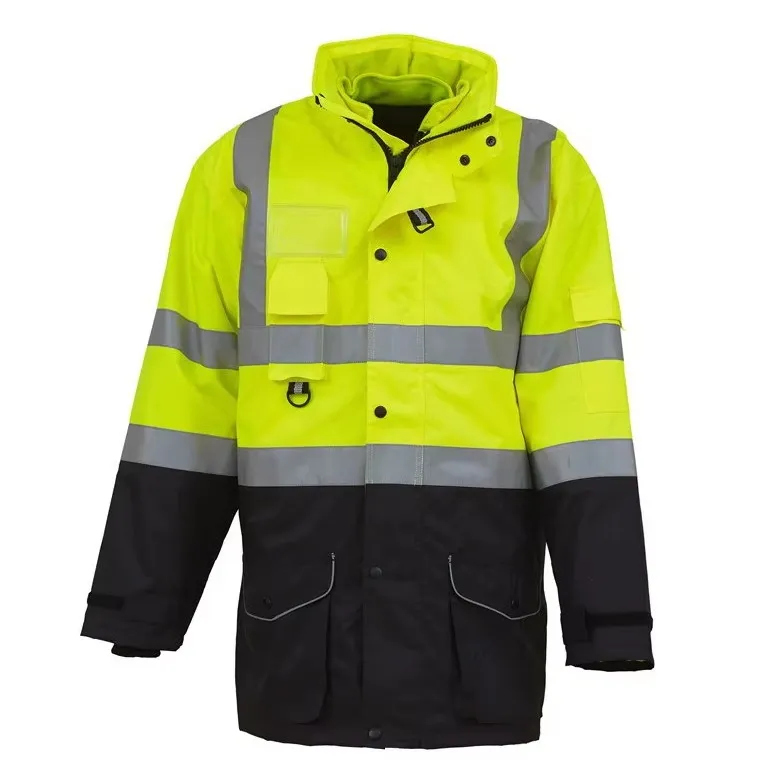
ANSI Class 3 winter workwear is high-visibility cold-weather PPE designed for workers exposed to low temperature, moving equipment, vehicle traffic, wind chill and extended outdoor shifts. For procurement teams, the key engineering decision is not only whether the garment meets ANSI/ISEA 107 visibility rules, but whether its insulation package, liner system, seam construction and wind-blocking structure match the actual work zone temperature, activity level and washing cycle.
For China-based OEM manufacturing, the most important sourcing variables are Clo value, shell fabric denier, reflective tape type, removable liner construction, seam sealing, padding weight, zipper strength and bulk production repeatability.
Clo Value Engineering for ANSI Class 3 Winter Jackets in -5°C to -30°C Work Zones
Clo value measures thermal insulation performance. In PPE procurement, it helps compare winter jackets, thermal workwear and cold storage safety clothing by heat retention rather than only by fabric thickness.
A basic rule: higher Clo value means stronger thermal resistance, but excessive insulation can cause sweat accumulation when workers perform high-mobility tasks such as loading, road repair or equipment inspection.
| Work Environment | Typical Temperature Range | Recommended Clo Range | Suitable Garment Structure | Procurement Risk |
|---|---|---|---|---|
| Outdoor construction in mild winter | 0°C to 10°C | 0.8–1.2 Clo | 300D Oxford shell + light polyester padding | Overheating during active work |
| Roadside maintenance / traffic control | -5°C to 5°C | 1.2–1.8 Clo | ANSI Class 3 shell + quilted lining + storm flap | Poor wind protection at zipper zone |
| Cold storage warehouse | -10°C to -20°C | 1.8–2.5 Clo | Detachable fleece or padded liner + elastic cuff | Condensation from low breathability |
| Mining / oilfield / night winter shift | -20°C to -30°C | 2.5–3.5 Clo | Heavy padding + windproof hood + seam-sealed shell | Reduced mobility and slower evacuation |
| Freezer room with low activity | below -30°C | 3.5 Clo or above | Layered parka system + insulated trousers | Excess garment weight and fatigue |
ANSI/ISEA 107-2020 Class 3 Visibility Must Remain Valid After Adding Insulation
Winter padding increases garment volume, but it must not reduce the required visible background material and reflective material placement. For ANSI Class 3 jackets, procurement teams should confirm:
| Compliance Point | Engineering Check |
| Standard reference | ANSI/ISEA 107-2020, Type R or Type P depending on end use |
| Visibility level | Class 3 for highest body coverage |
| Reflective tape | 50 mm silver tape, glass bead or micro-prismatic |
| Reflective layout | Torso bands, shoulder bands and sleeve bands visible from 360° |
| Background fabric | Fluorescent yellow-green or orange-red polyester Oxford |
| Wash durability | 25–50 industrial or domestic wash cycles depending on tape grade |
| Tape position after padding | No folding, twisting or hidden reflective zones after quilting |
For bulk purchase, the insulation package must be checked together with the reflective layout. A warm jacket that fails Class 3 tape placement is not acceptable for road construction, logistics yards or night maintenance work.
Detachable Liners: Fleece vs. Quilted Padding for OEM Thermal Workwear
Removable liners give PPE distributors one SKU that can cover autumn, winter and early spring. For OEM production, the two most common liner systems are polar fleece and quilted polyester padding.
Request OEM sampling for detachable liner winter jackets here: ANSI Class 3 winter jackets with removable liner
Fleece Liner vs. Quilted Padding: Cost, Weight and Field Use
| Liner Type | Common Specification | Main Advantage | Main Limitation | Best Application |
| Polar fleece liner | 220–320 gsm polyester fleece | Soft hand feel, good warmth-to-weight ratio | Lower wind resistance if used alone | Warehouse, logistics, light outdoor work |
| Quilted polyester padding | 120–220 gsm padding with taffeta lining | Better heat retention in static work | Higher bulk, higher sewing time | Road work, mining, oilfield, traffic duty |
| Sherpa fleece liner | 280–400 gsm polyester sherpa | Strong thermal feel for retail channels | More lint risk and higher volume | Promotional winter safety jackets |
| Detachable softshell liner | 280–350 gsm bonded fabric | Can be worn as independent jacket | Higher material cost | Corporate uniform programs |
| 3-in-1 liner system | Outer shell + zip-out liner | Wider seasonal range | More complex zipper and snap alignment | Distributor stock programs |
Manufacturing Cost Drivers in Detachable Thermal Workwear
| Cost Item | Impact on Unit Cost | Technical Reason |
| Two-way zipper attachment | Medium | Requires accurate liner-to-shell alignment |
| Snap-button fixation | Low to medium | Controls sleeve and hem movement |
| Quilted padding | Medium to high | Adds cutting, quilting and bulk sewing steps |
| Fleece weight above 300 gsm | Medium | Higher fabric consumption and carton volume |
| Seam-sealed shell | High | Requires waterproof tape, hot-air sealing and slower output |
| Micro-prismatic reflective tape | High | Higher tape cost than standard glass bead tape |
| Detachable hood | Medium | Adds zipper, snaps, cord lock and size grading |
For a China manufacturer, supplier or factory quotation, buyers should separate the outer shell cost from the liner cost. This makes price comparison more accurate when changing from 280 gsm fleece to 160 gsm quilted padding or upgrading reflective tape from glass bead to micro-prismatic.
Windproof Cold-Weather Design: Storm Cuffs, Front Placket and Hood Integration
Thermal insulation fails when wind enters through the sleeve opening, front zipper, collar or lower hem. In winter PPE development, windproof construction often improves field comfort more than increasing padding weight by 40–60 gsm.
Storm Cuff Design for -5°C to -20°C Workwear
| Cuff Structure | Recommended Use | Engineering Note |
| Elastic inner cuff | General winter construction | Reduces air entry at wrist |
| Rib-knit storm cuff | Cold storage and outdoor patrol | Better skin contact and heat retention |
| Adjustable Velcro cuff | Workers wearing gloves | Allows fit adjustment over glove cuffs |
| Double cuff system | Mining, oilfield, road work | Combines wind blocking and glove compatibility |
Front Closure System for ANSI Class 3 Winter Jackets
A cold-weather jacket should not rely on the zipper alone. The front closure area is one of the main heat-loss points.
| Component | Recommended Specification | Function |
| Main zipper | No. 5 or No. 8 resin zipper | Higher strength under padded garment stress |
| External storm flap | 5–7 cm width | Blocks wind and rain at zipper line |
| Inner wind guard | Polyester Oxford or taffeta strip | Reduces cold air leakage |
| Chin guard | Brushed tricot or fleece facing | Prevents zipper abrasion near neck |
| Snap closure spacing | 8–12 cm | Keeps storm flap closed during movement |
Hood Integration for Cold Storage Safety Clothing and Outdoor PPE
| Hood Type | Suitable Program | Risk to Control |
| Fixed insulated hood | Extreme cold outdoor work | May reduce helmet compatibility |
| Detachable hood | Distributor stock and OEM programs | Zipper and snap durability must be tested |
| Roll-away hood | Rain and snow exposure | Adds collar bulk |
| Helmet-compatible hood | Construction and utility work | Requires larger pattern and adjustable drawcord |
| High-visibility hood | Road work and traffic control | Reflective trim should not interfere with head movement |
For ANSI Class 3 winter jackets, the hood must not cover shoulder reflective tape or reduce rear visibility when worn. During sample approval, buyers should photograph the garment from front, side and back with the hood up.
Shell Fabric, Waterproofing and Breathability in Thermal Workwear
Cold-weather PPE often faces snow, sleet, freezing rain and condensation. A high-insulation jacket without moisture control can become uncomfortable after 2–4 hours of active work.
| Shell Fabric | Common Specification | Waterproof Option | Best Use |
| Polyester Oxford | 150D, 300D, 600D | PU coating, seam sealing | Construction, logistics, general PPE |
| Polyester pongee | 190T, 210T | PU or PVC coating | Lightweight thermal jackets |
| Softshell fabric | 280–350 gsm bonded polyester | TPU membrane | Supervisor jackets, corporate PPE |
| PVC-coated polyester | 170–300 gsm | Welded or stitched seams | Wet industrial environments |
| Ripstop polyester | 210D–300D | PU coating | Utility and field service work |
Recommended Performance Targets for OEM Winter Workwear
| Parameter | Entry Level | Project Grade | Severe Weather Grade |
| Waterproof pressure | 3,000 mm | 5,000 mm | 10,000 mm |
| Breathability MVP | 1,000–3,000 g/m²/24h | 3,000–5,000 g/m²/24h | 5,000–10,000 g/m²/24h |
| Shell fabric | 150D–300D Oxford | 300D Oxford | 300D–600D Oxford |
| Padding weight | 100–140 gsm | 160–200 gsm | 200–260 gsm |
| Reflective tape width | 50 mm | 50 mm | 50 mm micro-prismatic option |
| Seam construction | Stitched seams | Critical seam sealing | Full seam-sealed waterproofing |
For oilfield, mining and roadside winter PPE, WP 10000 mm and MVP 5000 g/m²/24h are practical targets when the buyer needs both snow resistance and moisture transfer.
Reflective Tape Selection: Glass Bead vs. Micro-Prismatic for Winter PPE
Reflective material must remain visible after bending, washing, low-temperature exposure and repeated sleeve movement.
| Reflective Tape Type | Typical Retroreflection Profile | Advantages | Limitation | Recommended Use |
| Glass bead reflective tape | Common commercial PPE grade | Flexible, lower cost, soft hand feel | Lower brightness than prism tape | General ANSI Class 2 and Class 3 workwear |
| Micro-prismatic reflective tape | Higher angular brightness | Strong visibility under vehicle headlights | Stiffer hand feel, higher cost | Roadside, airport, rail, emergency work |
| Segmented heat transfer tape | Flexible with reduced fabric stiffness | Better mobility and breathability | Requires heat press control | Stretch panels and lightweight jackets |
| FR reflective tape | Tested for flame-resistant garments | Supports arc flash or FR programs | Higher MOQ and higher cost | Utility, oil and gas, electrical work |
For winter jackets, tape stiffness matters. Heavy tape on thick padded sleeves can create poor bending comfort. For high-mobility work, segmented reflective tape or softer glass bead tape may reduce sleeve resistance.
OEM Specification Checklist for Bulk ANSI Class 3 Winter Jackets
| Specification Item | Recommended Buyer Confirmation |
| Standard | ANSI/ISEA 107-2020 Class 3, Type R or Type P |
| Shell fabric | 300D Oxford polyester with PU coating |
| Waterproof target | WP 5000–10000 mm depending on project |
| Breathability target | MVP 3000–10000 g/m²/24h |
| Liner | Detachable fleece, quilted padding or 3-in-1 system |
| Padding | 120–220 gsm polyester padding |
| Reflective tape | 50 mm glass bead or micro-prismatic tape |
| Closure | Resin zipper + storm flap + snap buttons |
| Cuffs | Inner storm cuff, rib cuff or adjustable Velcro cuff |
| Hood | Detachable or helmet-compatible insulated hood |
| Pockets | Hand warmer pockets, radio pocket, ID pocket, inner pocket |
| Size range | S–5XL or extended North American sizing |
| Branding | Embroidery, heat transfer logo, woven label or private label |
| Packaging | 1 pc/polybag, carton packing by size ratio |
| Sample lead time | Usually 7–10 days depending on material stock |
| Bulk lead time | Commonly 45–60 days after sample approval |
Quality Control Tests Before Mass Shipment
Thermal workwear should be inspected as a PPE system, not as a normal padded jacket. The inspection should cover visibility, insulation, fit, sewing strength and weather resistance.
Production Inspection Points With Measurable Criteria
| QC Item | Test or Inspection Method | Acceptance Focus |
| Reflective tape placement | Measure tape width and layout | 50 mm tape, correct ANSI Class 3 configuration |
| Reflective brightness | Retroreflection test | Meets buyer-specified tape grade |
| Padding distribution | Visual and hand-feel inspection | No empty zones, clumping or uneven quilting |
| Zipper strength | Repeated opening and closing test | No slider breakage or tooth separation |
| Seam strength | Pull test on critical seams | No skipped stitches or seam opening |
| Water resistance | Hydrostatic pressure or spray test | Matches WP requirement |
| Seam sealing | Hot-air tape adhesion check | No peeling, bubble or skipped sealing |
| Wash durability | Domestic or industrial wash cycle test | Tape, logo and fabric remain functional |
| Size tolerance | Garment measurement table | Usually ±1–2 cm by point of measure |
For long-term distributor programs, an approved sealed sample should be kept by both buyer and manufacturer. This helps control repeat orders when changing fabric batches, tape suppliers or padding lots.
Procurement Decision: When to Choose Fleece, Quilted Padding or 3-in-1 Construction
| Buyer Situation | Recommended Structure | Reason |
| Need lower carton volume and softer feel | Detachable fleece liner | Better packing efficiency than heavy padding |
| Need stronger warmth for static work | Quilted padded liner | Better heat retention under low activity |
| Need one SKU for multiple seasons | 3-in-1 jacket | Outer shell and liner can be worn separately |
| Need rain and snow protection | Seam-sealed shell + padded liner | Controls both water entry and heat loss |
| Need roadside visibility at night | ANSI Class 3 shell + micro-prismatic tape | Stronger headlight return |
| Need private label retail program | Softshell or fleece removable liner | Better perceived value and wearable flexibility |
Final Sourcing Notes for China OEM Winter Workwear Programs
For ANSI Class 3 winter jackets, the lowest FOB price often comes from reducing padding weight, using basic reflective tape, removing seam sealing or simplifying the detachable liner system. Those changes can be acceptable for mild winter logistics work, but they create risk for cold storage, road construction, mining and oilfield use.
A practical OEM specification for many winter PPE distributors is: 300D Oxford shell, ANSI/ISEA 107-2020 Class 3 layout, 50 mm reflective tape, 160–200 gsm quilted padding or 280–320 gsm detachable fleece liner, storm flap, inner cuff, detachable hood, WP 5000–10000 mm and size range up to 5XL.
Request bulk pricing and OEM development support: removable liner high visibility winter workwear supplier
FAQ
Q: What Is The Recommended MOQ For ANSI Class 3 Winter Jackets From A China Manufacturer?
A: For OEM winter jackets, a practical MOQ is usually 500 pieces per style, depending on fabric stock, reflective tape type, size range and custom logo method.
Q: Can Custom Printed Logos Survive Washing On Thermal Workwear?
A: Yes. Heat transfer logos can support 25–50 wash cycles when correct film, pressure, temperature and dwell time are used. Embroidery is better for heavy padded jackets.
Q: What Factory Documents Should PPE Buyers Request Before Placing Bulk Orders?
A: Buyers should request a business license, product test reports, material specifications, size chart, sealed sample, production photos and pre-shipment inspection report.